
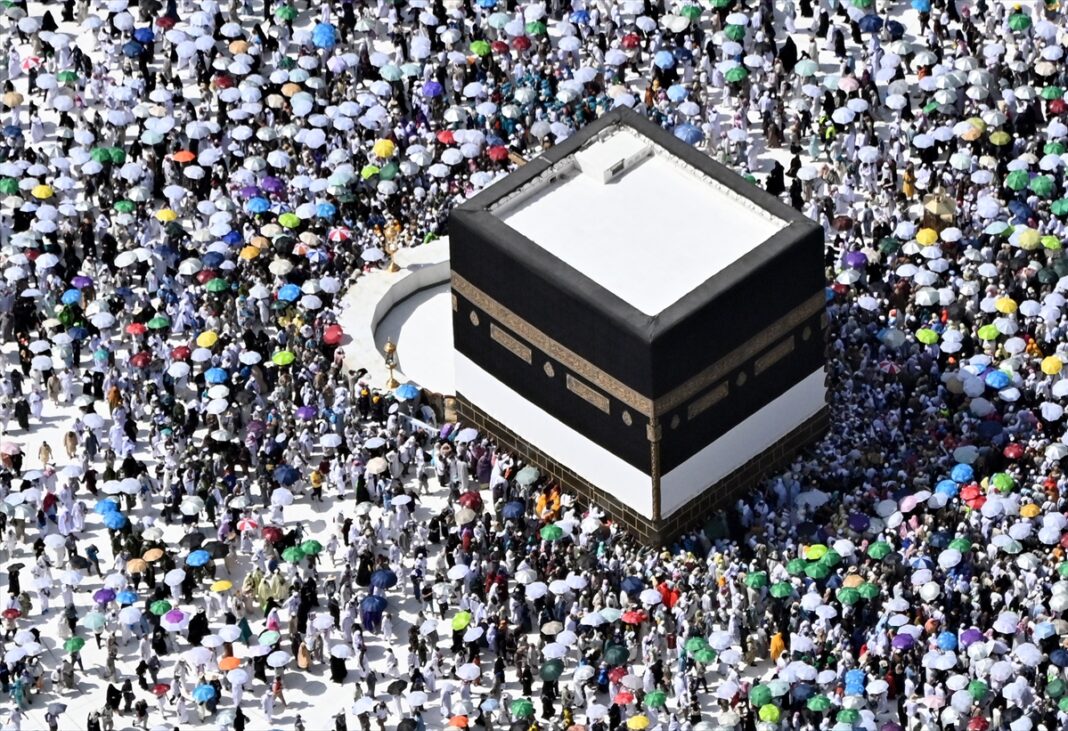

Islam is projected to overtake Christianity as the world’s largest religion by 2035, with the global Muslim population expected to grow by 80% over the next five decades, according to a major new study by the Pew Research Center.
The findings, published on 18 November, point to a historic transformation in the world’s religious landscape, driven largely by higher birth rates and younger Muslim populations across Africa, Asia and other regions.
The report, The Future of World Religions: Population Growth Projections, 2020–2070, forecasts that Muslims will outnumber Christians within the next decade, ending Christianity’s longstanding position as the world’s largest religious group.
By 2035, the number of Muslims worldwide is projected to reach 2.57 billion, compared with 2.52 billion Christians.
That gap is expected to widen substantially over the following decades, with the Muslim population reaching 3.64 billion by 2070, compared with 2.96 billion Christians.
Islam’s share of the global population is forecast to rise from approximately 26% in 2020 to 36% by 2070, while Christianity’s share is expected to remain relatively stable at 29%.
The projected 80% increase in the Muslim population would far exceed the world’s overall population growth of 29% during the same period, making Islam the fastest-growing major religion in demographic terms. Pew Research Center+1
Muslims could make up one in six Britons
Britain is also expected to experience a substantial change in its religious composition, with Muslims projected to account for 16% of the population by 2070, up from 6.4% in 2020.
This would mean approximately one in six people identifying as Muslim, reflecting the community’s younger population, higher birth rates and continued migration.
At the same time, Britain is projected to become a majority non-religious country, with the proportion of people identifying as having no religion increasing from 40.2% in 2020 to 52.3% by 2070.
The findings suggest that Muslims will represent an increasingly significant proportion of British society, even as Christianity continues to decline and more people abandon formal religious affiliation.
Similar demographic changes are expected across Europe, where the Muslim share of the population is projected to more than double, rising from 6% in 2020 to 13% by 2070.
France’s Muslim population is forecast to reach 20%, followed by Austria at 18.9%, Belgium at 17.5% and Germany at 14.3%.
Despite this growth, Muslims are not projected to become a majority in Britain or Europe by 2070. Pew Research Center+1
Why Islam is growing faster than other religions
The study attributes Islam’s rapid population growth primarily to demographic factors rather than religious conversion.
Muslim women had an estimated fertility rate of 3.1 children per woman between 2020 and 2025, compared with 2.0 among non-Muslim women.
The difference is particularly significant in sub-Saharan Africa, where Muslim women had an estimated fertility rate of 5.1 children, compared with 4.0 among non-Muslims.
Muslims also have the youngest population of any major religious group, with a median age of just 24 in 2020, compared with 33 among non-Muslims.
This means a larger proportion of Muslims are entering their childbearing years, contributing to continued population growth even as fertility rates are expected to decline.
Pew also examined the effects of migration and religious switching, including people embracing Islam or leaving the faith.
However, the researchers identified natural population growth, driven by births exceeding deaths, as the principal factor behind Islam’s projected expansion.
The findings indicate that the growth of Islam is being driven predominantly by the demographic characteristics of existing Muslim communities rather than large-scale religious conversions. Pew Research Center+1
Pakistan set to overtake Indonesia as world’s largest Muslim population
The report also forecasts a major shift in the geographical distribution of the global Muslim population, with Pakistan expected to overtake Indonesia as the country with the largest number of Muslims by 2070.
India is projected to have the world’s second-largest Muslim population, followed by Nigeria and Indonesia.
Despite remaining a Hindu-majority country, India’s Muslim population is expected to grow substantially over the coming decades.
Meanwhile, Africa is projected to play an increasingly important role in the demographic future of Islam.
Sub-Saharan Africa’s Muslim population is expected to expand significantly, with the proportion of Muslims in the region rising from approximately 33% in 2020 to 36% by 2070.
The region is expected to account for a substantial share of global population growth, driven by its relatively young population and higher fertility rates.
Christianity is also projected to experience major growth across sub-Saharan Africa, which is expected to become home to more than half of the world’s Christians by 2070.
The Democratic Republic of the Congo is forecast to overtake the United States as the country with the largest Christian population.
These developments suggest that Africa will become increasingly central to the demographic future of both Islam and Christianity, even as their relative positions change across other parts of the world. Pew Research Center+2
Christianity loses ground in the West
While Islam is projected to become the world’s largest religion, Christianity is expected to continue growing in absolute numbers, although its influence as a majority religious identity is forecast to decline across several Western countries.
The United States, Canada and Germany are among the countries where Christians are projected to fall below 50% of the population by 2070.
Across North America, Christianity’s share is expected to decline from approximately 63% in 2020 to 46% by 2070.
The proportion of people identifying as religiously unaffiliated is also forecast to increase across much of the Western world, reflecting the continuing decline in formal religious identification.
However, the global trend is expected to move in the opposite direction.
Worldwide, the proportion of people identifying with no religion is projected to fall from 24% in 2020 to 17% by 2070.
Pew attributes this partly to population decline in China, which has one of the world’s largest religiously unaffiliated populations.
Other major religious groups are also expected to experience different demographic trajectories.
Hindu and Jewish populations are forecast to grow in absolute numbers while declining slightly as a proportion of the global population.
Buddhism, meanwhile, is projected to decline both in total population and as a share of humanity. Pew Research Center+2
A historic demographic shift
The Pew Research Center stresses that its findings are demographic projections rather than guaranteed outcomes.
Its calculations are based on population estimates, fertility rates, mortality, migration and patterns of religious affiliation, assuming that recent demographic trends broadly continue.
Future developments, including changes in migration policies, birth rates, religious identification and broader social conditions, could alter these projections.
Nevertheless, the study points to a major transformation in the global religious landscape over the coming decades.
For centuries, Christianity has held the position of the world’s largest religion. According to Pew’s projections, Islam could take that position within the next nine years.
By 2070, more than one in three people worldwide could identify as Muslim, with increasingly large Muslim communities across Africa, Asia and Europe.
The findings highlight not only Islam’s projected demographic expansion but also the growing significance of Muslim populations in shaping the world’s religious composition throughout the 21st century.
Source: Pew Research Center: The Future of World Religions (2026)


