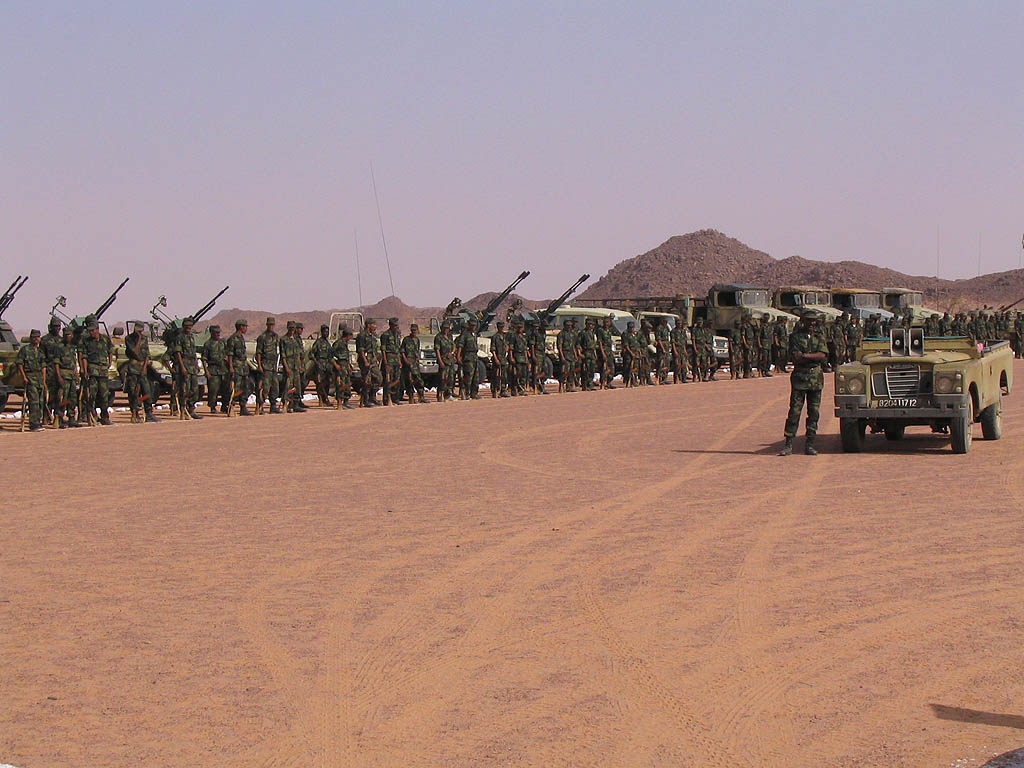

Less than two weeks after the UN began withdrawing from Western Sahara, the Polisario Front declared a general mobilisation. Is the desert heading back to war — or is this a warning shot?
Less than two weeks after the announcement of the withdrawal of the United Nations mission in Western Sahara, the Polisario Front declared a general mobilisation against Morocco. The decision, taken after an emergency meeting under the leadership of Brahim Ghali, marks one of the most serious escalations in the territory in recent years.
It comes at a particularly dangerous moment, as the United Nations Mission for the Referendum in Western Sahara (MINURSO) withdraws following the expiry of its mandate on 31 October 2026.
A mobilisation without details
In a statement issued on 10 November 2026, the Polisario Front called on Sahrawis to mobilise against what it described as Morocco’s “manoeuvres” and to defend their right to self-determination and independence. The movement alleges that Moroccan troops and military equipment are being concentrated in several strategic areas along the separation wall — the 2,700 km sand berm that divides Western Sahara.
It denounced what it called a “dangerous escalation” that, according to the Polisario, threatens to intensify hostilities between the two sides. So far, there has been no independent confirmation of the alleged Moroccan troop movements reported by the Polisario, nor any reliable assessment of the actual scale of Sahrawi mobilisation on the ground.
Journalists and independent observers have reportedly been denied access to certain military areas along the sand wall and within the buffer zones. At the same time, sources cited by Moroccan media outlets report an intensification of Morocco’s military deployment along the wall amid the withdrawal of the UN mission.
According to those same sources, “the Moroccan Armed Forces are ready to respond to any attempt by the Polisario Front to approach the buffer zones.”
On the Algerian side, the Polisario Front’s mobilisation is being portrayed as a political warning — a signal that Morocco must not exploit a security vacuum to extend its control over territories administered by the independence movement. Several sources have raised the possibility that Moroccan authorities could seek to take control of MINURSO facilities located east of the sand wall, particularly in the Tifariti sector. These reports, however, have yet to be independently verified.
For its part, the Polisario has announced no additional detailed operational measures to counter any potential movement by Moroccan troops. Nor has it specified the practical arrangements for the general mobilisation, the number of personnel involved or the timetable for any possible deployment. That silence is telling.
According to Myriam Guellec Sefraoui, an associate researcher in political science at Paris-Panthéon-Assas University, the mobilisation is also a way for the movement to reaffirm its influence in the conflict at a time when diplomatic positions are increasingly shifting in Morocco’s favour.
It could also serve as a signal to Rabat while drawing the attention of the United Nations and the African Union to their responsibilities in the decolonisation process. In other words, this may be less about preparing for war and more about refusing to be forgotten.
Washington steps in
One week after the announcement of the general mobilisation, the United States stepped in. On 17 November, Mike Waltz, the United States Representative to the United Nations, travelled to Rabat.
The US envoy called on the Polisario Front to fully respect the ceasefire, which he considers to have been upheld by Morocco. He reaffirmed Washington’s recognition of Moroccan sovereignty over Western Sahara and said the United States would continue its efforts to secure a lasting settlement, despite Russia’s veto of its draft resolution at the UN Security Council.
The US envoy also warned against a possible resumption of hostilities, urging restraint to avoid further aggravating tensions.
Washington’s message was clear: de-escalate. But it was also one-sided. By praising Morocco for upholding the ceasefire while publicly pressuring the Polisario, the US has reinforced the perception in Sahrawi camps that the diplomatic process is biased.
Can the Polisario fight Morocco alone?
Militarily, the movement has an organised armed force, the Sahrawi People’s Liberation Army (SPLA), as well as extensive historical experience in desert warfare and asymmetric combat operations. However, part of its arsenal consists of ageing equipment dating back to military support provided by Libya under the regime of Muammar Gaddafi.
The military imbalance with Morocco could be particularly significant in terms of combat aircraft, drones, intelligence capabilities, modern equipment and logistics.
According to analyses by the Carnegie Endowment for International Peace and the International Crisis Group, the independence movement retains the capacity to resist and conduct military harassment operations but faces difficulties competing with Morocco’s technological capabilities.
Algeria’s political, material and logistical support helps sustain its operational capacity, without necessarily implying direct military intervention by Algiers.
Under these circumstances, the general mobilisation announced by Brahim Ghali may reflect a greater determination to strengthen the movement’s positions and maintain pressure on Rabat — rather than genuine preparation for a large-scale conventional offensive.
The Polisario can harass. It can resist. But it would struggle to win a conventional war against Morocco on its own. And both sides know it.
Where is the African Union?
Although the Polisario Front formally appealed to the African Union following its announcement of general mobilisation on 10 November 2026, the continental organisation has not issued an official response to the appeal so far.
Since the 2018 Nouakchott Summit, the AU has favoured an approach centred on supporting United Nations-led efforts, notably through the Troika mechanism, rather than pursuing a parallel mediation process. Nevertheless, MINURSO’s withdrawal could alter the diplomatic balance and revive questions about the African Union’s role.
In theory, the organisation could intervene at several levels, although its room for manoeuvre remains limited. In particular, it could reactivate its Troika mechanism, comprising the outgoing, sitting and incoming AU chairpersons, alongside the Chairperson of the AU Commission, to provide a channel for dialogue and de-escalation between the parties and prevent the conflict from spreading across the region.
The AU Commission Chairperson and the Peace and Security Council could also exert diplomatic pressure on Rabat, Algiers and the Polisario Front to prevent a further escalation of hostilities.
Ultimately, the African Union could become a more visible diplomatic player in the Western Sahara dispute, but it cannot simply replace the United Nations. Its main challenge will be to translate its continental legitimacy into effective mediation capacity in a conflict where the strategic interests of Rabat and Algiers continue to weigh heavily on prospects for a settlement.
What happens now?
Three scenarios are now on the table:
1. Controlled tension: The mobilisation remains largely symbolic. Morocco holds its positions. MINURSO’s withdrawal proceeds without major incidents. The US and AU push both sides back from the brink.
2. Miscalculation: With no UN peacekeeping mission monitoring the ceasefire on the ground, a small incident near Tifariti or the buffer zone spirals. A drone strike, a patrol clash, a seized facility — and the region faces a wider military confrontation it did not plan for.
3. A frozen conflict, again: The world looks away. The Polisario’s warning is ignored. The Sahrawi people, in camps in Tindouf and in territory east of the wall, are left to wait — again — for a referendum that was promised more than 30 years ago.
For now, the desert is holding its breath. The UN is withdrawing, the US is warning, the Polisario is mobilising and Morocco is reportedly reinforcing its positions.
And the question that has haunted Western Sahara for half a century remains unanswered: who decides its future — its people or its neighbours?