
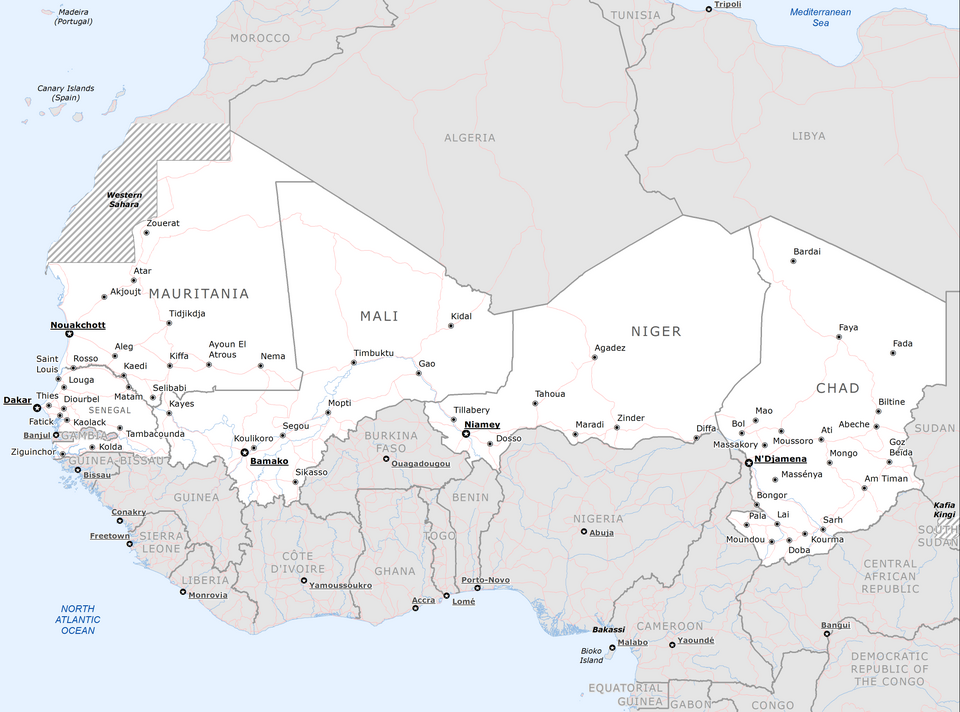

As Algeria seeks to strengthen its influence across the Sahel, Niger is forging new security ties with eastern Libya while Chad finds itself at the centre of competing regional interests. With old alliances shifting and new partnerships emerging, the struggle for influence is redrawing the geopolitical map of the Sahel.
As Algeria strengthens its military and security ties with Niger’s ruling authorities, Niamey has taken another step towards closer relations with Benghazi by signing a strategic cooperation protocol with the camp of Field Marshal Khalifa Haftar. This diplomatic paradox takes on particular significance against the backdrop of President Abdelmadjid Tebboune’s diplomatic initiative towards his Chadian counterpart, Mahamat Idriss Déby.
At a time when relations between Niamey and N’Djamena are facing serious strains amid allegations of an attack on Nigerien territory, Algiers has dispatched an envoy to meet the Chadian head of state. The move raises questions about Algeria’s ambitions and its ability to maintain relations with partners whose interests do not necessarily align.
Niamey looks east to Benghazi
For observers of the Sahel crisis, the rapprochement between Niamey and Benghazi goes beyond a mere diplomatic formality. It reflects the Nigerien authorities’ determination to diversify their security partnerships rather than depend on a single interlocutor.
Along the Niger-Libya border, several groups hostile to Niger’s military authorities are active, some of which claim to support ousted President Mohamed Bazoum, who remains in detention under the junta. Against this backdrop, establishing channels of cooperation with Saddam Haftar and the forces of Khalifa Haftar could enable Niamey to better monitor cross-border movements and strengthen its security apparatus.
Although the contents of the protocol have not been made public, unconfirmed reports suggest that Niger has requested an end to alleged support for the Patriotic Liberation Front (FPL), a political and military movement seeking to overthrow General Abdourahamane Tiani’s government. There are also reports of a request for the handover of several military officers wanted in connection with a recent attempted coup.
The question remains whether the United Arab Emirates, an ally of the Haftar camp and a regional rival of Algiers, played a role in this rapprochement. Could Moscow, which maintains relations with Niamey, Algiers and the Haftar camp, also have facilitated this cooperation in a bid to prevent potential tensions along the Niger-Libya border? At this stage, no direct involvement by either power in the negotiations or the conclusion of the agreement has been publicly established.
Algiers moves on N’Djamena
Algiers has made no public comment on the signing of the strategic cooperation protocol between Niger and the authorities in eastern Libya. Its diplomacy has, however, been active on the ground. President Abdelmadjid Tebboune dispatched Foreign Minister Ahmed Attaf to N’Djamena to meet the Chadian president and discuss bilateral and security issues.
According to Dr Ahmat Yacoub Dabio, a Chadian expert and political analyst, the move could have three potential dimensions: first, a partnership message aimed at elevating Algerian-Chadian relations to a strategic level; second, a security message intended to prevent a confrontation between Chad and Niger that could threaten Algeria’s interests; and finally, a geopolitical message designed to prevent Chadian territory from becoming an arena for confrontation between France and the Sahel’s military-led regimes.
The visit could also be interpreted as a signal to Niamey amid its growing rapprochement with the Haftar camp. For Bakary Sambe, director of the Timbuktu Institute, these developments reflect a broader realignment of regional alliances.
“It’s a map that is being redrawn. Old alliances are breaking apart, and we are seeing new ones taking shape. Algeria clearly wants to be part of the picture. A year and a half ago, it was at odds with the entire Sahel. Since then, it has restored ties with Niger, then Mali, and now it is knocking on Chad’s door. So this is by no means a coincidence. It is all part of a broader strategy,” he said, commenting on the visit by Algeria’s foreign minister to N’Djamena.
AES closes ranks
Amid this regional realignment, Niger is emerging as a focal point for diplomatic and security rivalries. The Alliance of Sahel States (AES) is also seeking to preserve its cohesion in the face of these shifting dynamics.
On 5 November, Mali’s transitional president, General Assimi Goïta, held successive consultations with his Nigerien and Burkinabè counterparts, travelling first to Niamey and then to Ouagadougou. The tour came a day after his return from Moscow.
According to multiple sources, the Malian leader is taking the lead in efforts to consolidate unity among AES heads of state in response to external pressure and evolving regional security dynamics. These include the reported strengthening of Algeria’s military presence in Niger, tensions between Niamey and N’Djamena, and the prospect of French fighter jets being deployed to Chad.
Beyond these consultations, one question remains: will the AES manage to forge a common position in response to developments that could permanently reshape the balance of power across the Sahel-Saharan region?
For Algiers, the stakes are equally high: maintaining its influence without becoming trapped in the shifting alliances of its own partners.


