
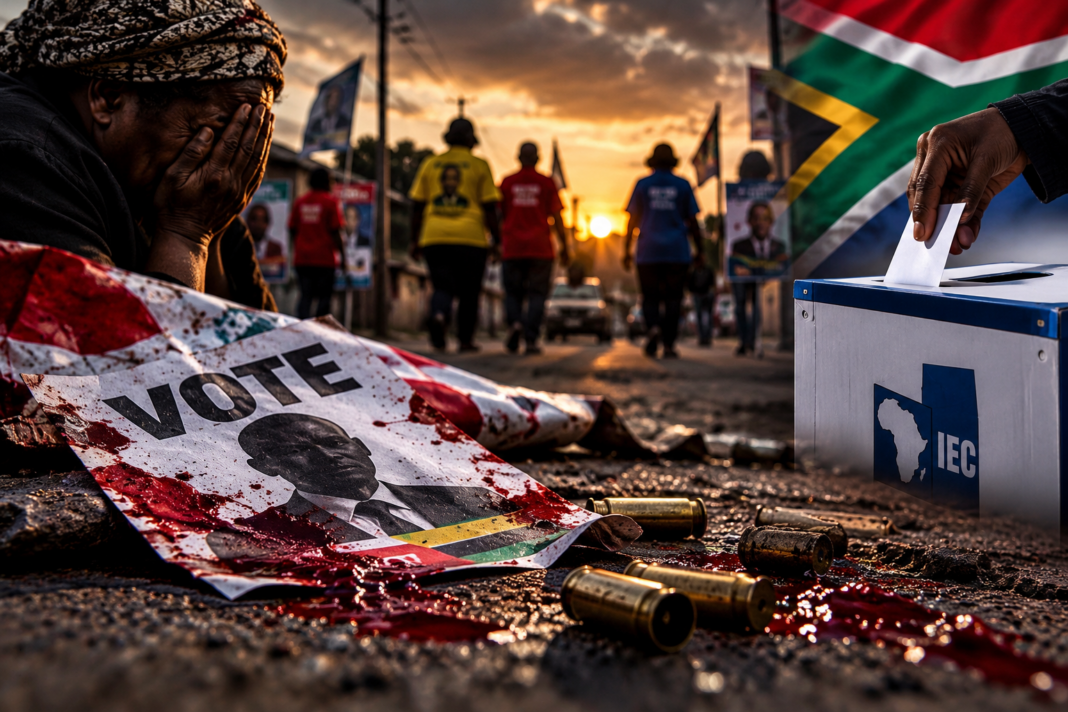

As South Africans head to the polls today, at least 43 people have been killed in suspected politically motivated attacks, with deadly rivalries increasingly erupting within political parties rather than between them.
For many South African politicians, entering public life is no longer associated with public service but with a career — even if it means committing murder to secure it.
“South Africa has a history of violence inter-party conflict has shifted into intra-party conflict, and the presence of organised crime and its closeness to politics,” Angelo Fick, Director of Research at the Auwal Socio-economic Research Institute (ASRI), told One Nation Media.
As South Africans go out to vote today, that shift has turned deadly, with at least 43 people killed.
Behind the posters, promises and competition for municipal power are families mourning loved ones, volunteers afraid to continue campaigning, and communities questioning whether political participation has become too dangerous.
The highest number since 2015
At least 43 people were killed in 45 suspected politically motivated attacks across seven provinces between January and September 2026, according to the Global Initiative Against Transnational Organized Crime (GI-TOC).
It is the highest number of politically linked attacks in its monitoring series since 2015, surpassing figures recorded during the 2021 municipal elections and the 2024 national elections.
During a security briefing at the NATJOINTS coordination centre in Tshwane on Sunday, Deputy National Commissioner for Policing Lieutenant General Tebello Mosikili revealed that police had recorded 20 murders involving political representatives, party members and supporters during the 2026 election period alone. Only seven arrests had been made.
Gauteng recorded the highest number, with seven murders, followed by KwaZulu-Natal with six. The Western Cape recorded three, the Eastern Cape two, while the Free State and North West each recorded one.
In total, 139 election-related criminal dockets have been registered nationally since the start of the election process, resulting in 48 arrests.
For some volunteers, going door-to-door has become an activity accompanied by fear.
On 15 October, two ANC members, Lungani Makhathini and Nokuthula Mavundla, were shot dead while conducting a door-to-door campaign in Umgababa, south of Durban. Three others were injured when unknown gunmen reportedly opened fire with rifles and pistols.
On 26 October, DA ward councillor candidate and Metsimaholo caucus leader Thulani Mbana was shot dead outside his home in Zamdela, Sasolburg. According to police, two unknown men called him outside before shooting him several times at close range. He died at the scene.
From IFP vs ANC to ANC vs ANC
Political violence, Fick says, has persisted since the transition to democracy, although its nature has changed.
He pointed to the IFP-ANC violence in KwaZulu-Natal after 1994 as an early example. Today, the violence is largely internal.
“Since 2012, we have seen more intra-party violence, meaning violence within political parties. As parties receive fewer votes and secure fewer seats, members increasingly compete against one another to secure higher positions on party lists and gain political positions,” Fick said.
The competition extends to alliance partners seeking influence. What drives it? Power and patronage.
Political positions, particularly councillor and municipal leadership roles, carry significant influence over municipal decisions, public resources and development opportunities.
Fick said concerns about members joining parties for personal gain were raised within the ANC as far back as 2012, when its National Executive Committee warned that some members were entering the party to enrich themselves rather than advance its objectives.
“The party becomes the vehicle for self-enrichment,” he said.
Holding office can provide access to public funding, government departments, municipal entities and state-owned enterprises — opportunities exposed in Auditor-General and Public Protector reports on maladministration and corruption.
“In a country with massive unemployment, a municipal council position is a very quick way to get an income,” Fick said.
A compromised justice system
Securing a position is not the only concern. Whether killers are caught is another.
Fick said alleged compromises within institutions of the criminal justice system have raised concerns about prosecutions.
“I think there are multiple compromises, including within crime intelligence. We have also heard evidence at the Madlanga Commission suggesting that different arms of the criminal justice system, including the National Prosecuting Authority (NPA) and the police, have been compromised,” he said.
“These difficulties within the criminal justice system may result in delays in successfully prosecuting those accused of political killings.”
With only seven arrests linked to 20 murders reported by NATJOINTS, questions remain about progress.
When campaigning becomes fear
The impact extends beyond victims. When campaigners are afraid to enter communities, parties cannot engage with residents. Voters face intimidation.
Fick warned that turnout would suffer. “In places where political violence has long been endemic, such as KwaZulu-Natal and increasingly the Eastern Cape, we are likely to see lower voter turnout as people feel unsafe. This threatens the credibility of the vote itself.”
The road to political leadership is often difficult, involving years of campaigning and competition. But when people lose their lives in the process, the consequences reach far beyond parties and ambitions.
The road to power is hard. In South Africa in 2026, it is also deadly.


