
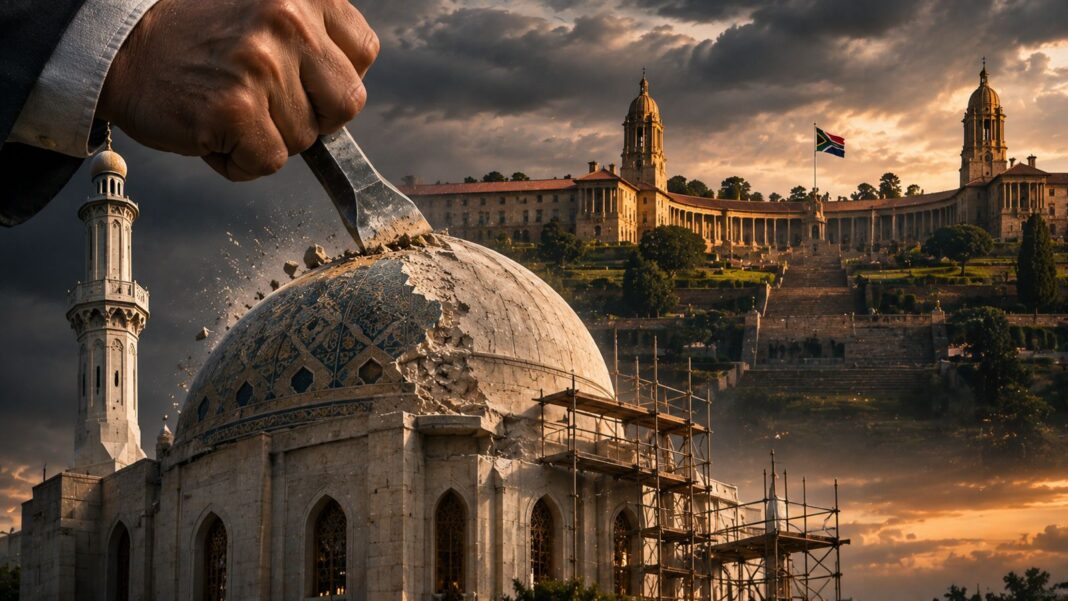

MYTH THREE, PART TWO | The creation of secular religiosity
In the previous article I argued that secularism subjugates religion by claiming the authority to define its boundaries, classify its practices and decide what the law will tolerate. But there is a second, subtler process. The modern state does not always need to suppress religion. It may prefer to encourage a version of religion that is predictable, governable and reassuringly compatible with the political order. That is what I mean by the creation of secular religiosity, writes Moulana Uwais Dockrat.
The distinction matters. A Muslim community may be allowed to build mosques, teach children, maintain charities and celebrate festivals. These are real allowances, not imaginary ones. But if religion is welcomed only on condition that its moral and political claims never challenge the assumptions of the state, we have not discovered neutrality. We have discovered the terms of accommodation. The question is not whether Islam may be visible; it is whether Islam may remain intellectually and morally whole.
Consider first the attempt to construct a shared secular spirituality around ubuntu. The ANC’s 2007 discussion document, The RDP of the Soul, described compassion, cooperation and commitment as fruits of “secular spirituality”, with ubuntu at its heart. It called for “comprehensive programmes for secular transformation by spiritual values”, envisaging religious bodies, the media, government and political structures participating in that project. Here, spirituality is not being excluded from public life. It is being enlisted in a particular vision of social transformation.
The ANC presented this as discussion material, not adopted policy, so it cannot be described as an existing government programme. The objection is not to compassion or cooperation. The question is who sets this spiritual framework, especially when religious convictions challenge its secular terms.
The more striking example appears in Cedric Mayson’s chapter on engaging religious communities, published by the Institute for Security Studies in 2007. He describes African spirituality as “a deeply spiritual secularity” focused on ubuntu. But he goes further, proposing “a new view of African Islam, African Judaism and African Hinduism” within a wider rethinking of politics and society. Read those words slowly. We are not being offered a religion-free public square. We are being invited to imagine religious traditions afresh within a particular civilisational vision.
That raises a more serious question: why might political authorities want to cultivate their own form of religiosity? Because a religious tradition claiming an independent source of ultimate moral authority cannot always be relied upon to endorse the state’s priorities. When the state claims the final word on the ordering of society, it may find competing ultimate loyalties inconvenient. It is easier to preserve the familiar language and rituals of faith while redirecting their public meaning. One allegiance is gradually weakened; the other reinforced.
This does not preclude peaceful coexistence or cooperation. It is about whether religion remains answerable to its own foundations, or becomes a partner in a shared political and spiritual project whose terms are set elsewhere. For Muslims, the question is who defines this reconstructed Islam, what is retained from revelation, and what must be adjusted to make it acceptable.
The result can be a remarkably convenient Islam: public enough to decorate national harmony, private enough not to question the state’s foundations, and flexible enough to accommodate whatever moral assumptions the surrounding culture treats as settled. Its language remains Islamic, while its governing reference points gradually move elsewhere. Islam becomes identity; secular liberalism becomes the arbiter of acceptability.
Muslims should refuse both isolation and uncritical assimilation. We can cooperate with neighbours, protect peaceful coexistence and respect the dignity of others without allowing a secular programme to rewrite our dīn. A religion reshaped to fit the state may still look familiar. The harder question is whether it remains answerable, above all, to Allah.


