
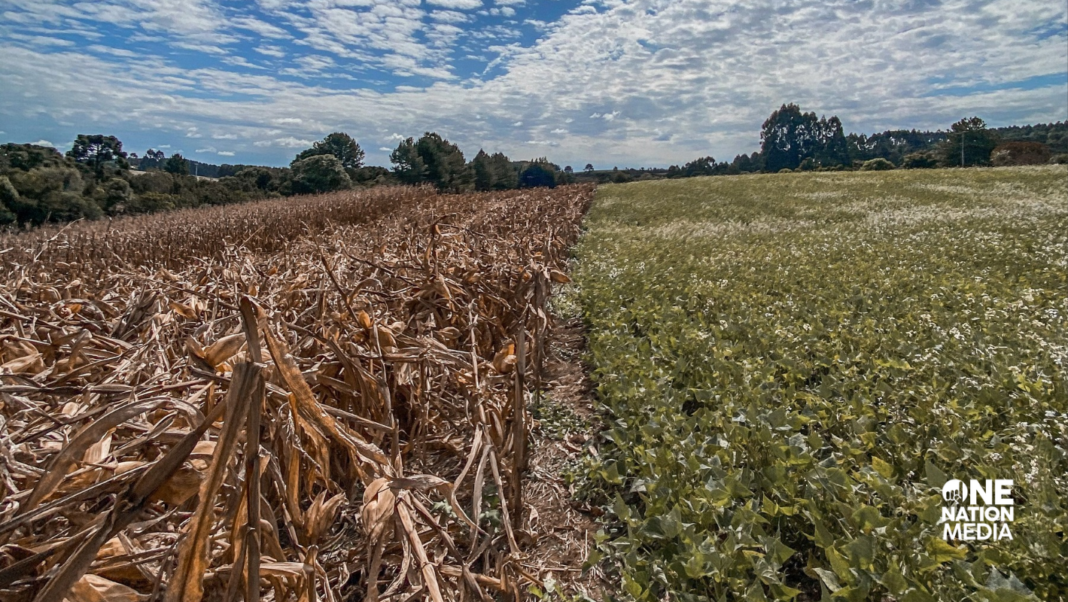

El Niño-related droughts have threatened farmers and food security across South Africa, raising concerns about environmental protection and the need for sustainable agriculture.
The weather pattern, which occurs when parts of the Pacific Ocean become unusually warm, can cause reduced rainfall and extreme weather in different parts of the world.
In South Africa, the 2023–2024 El Niño contributed to severe droughts, damaging crops, reducing water supplies and placing pressure on farmers and families who depend on agriculture.
According to the World Meteorological Organisation (WMO), cereal yields across Southern Africa fell 16% below the five-year average in 2024. Zambia and Zimbabwe were among the worst-affected countries, with harvests falling 43% and 50% below average, respectively.
Farmers struggling with water shortages
Patroo Montle Matsimela, an Industrial Design Assistant Lecturer at the University of Johannesburg, warned that small-scale farmers in South Africa are particularly vulnerable to drought. He said the number of small-scale farmers has already fallen in provinces such as Limpopo, one of the country’s best-known farming regions, because of changing climatic conditions.
Matsimela, whose honours research focused on promoting sustainable agriculture, explained that farmers who have relied on rainwater or water from nearby rivers now face additional costs when those sources dry up. Some are forced to buy water, while those without tanks or reservoirs try to install them but still have to purchase water to fill them.
With many South African provinces facing water shortages, he expects numerous small-scale farmers to stop farming, at least temporarily.
“We are going to see a lot of small-scale farmers taking a break because of this drought,” Matsimela said.
Can sustainable farming provide a solution?
Matsimela’s research explored how affordable farming systems could help rural communities grow food while using less water.
He first looked for indigenous methods of conserving water and farming sustainably but found that these work only when farmers still have access to nearby rivers or seasonal rainfall, which some provinces are no longer receiving.
He then turned to innovative methods such as hydroponic growing systems. These are largely designed for urban areas and are often too expensive for farmers in rural communities, where, he noted, agriculture should be thriving because of the available land. His research focused on making these systems affordable and simple to use for small-scale farmers.
Matsimela explained that farmers accustomed to traditional methods can find such systems challenging, as they often require electricity, regular maintenance and constant monitoring.
His research explored combining traditional methods of growing crops in the ground with water containers commonly found in rural households, including 20-litre buckets, 210-litre blue drums and basins.
The aim was to develop systems that require less maintenance and can operate without electricity.
“So far we have implemented about 10 of them and they’re actually thriving,” Matsimela said.
Further research is continuing to determine how long these systems last and whether people can adapt to using them. For families struggling with food insecurity, such systems could make it possible to grow a few vegetables at home for several months, using water that can be reused rather than lost through conventional irrigation.
Even with little rainfall, Matsimela said families who buy water or obtain it from neighbours for drinking, cooking and washing could set aside one or two buckets to run the systems for two to four weeks.
“You don’t really need a lot of water for you to actually run the systems,” he said.
However, Matsimela acknowledged that a few systems may only provide food for one or two seasons. A family of six or more would need additional systems to feed everyone throughout the year.
Is South Africa doing enough?
Matsimela said South Africa is not doing enough to encourage environmentally responsible farming. Before 2010, he said, communities attended workshops that taught sustainable farming methods, but those programmes are no longer available.
“I would say that a lot of South Africans do not know about sustainable farming because of this,” he said, adding that this is one of the reasons many people no longer farm.
He called for those workshops to be reintroduced, alongside boot camps and training programmes that provide people with resources and teach sustainable methods over several weeks or months.
Islam’s responsibility towards the environment
While farmers search for ways to protect their livelihoods, Islam has long encouraged the protection of nature, agriculture and natural resources.
The Qur’an teaches that Allah has appointed humanity as Khulafa, or successors on Earth, with responsibilities towards His creation.
In Surah Al-An’am (6:165), Allah reminds humanity that He has placed people on Earth and tests them through what He has given them.
This responsibility is also understood through Amanah, the trust placed upon humanity to care for what Allah has provided.
The Prophet Muhammad (SAW) encouraged planting trees and cultivating land, teaching that when people or animals benefit from what a Muslim grows, it is regarded as charity.
In Sahih Muslim 1553a, the Prophet taught that planting trees or growing crops from which people, birds or animals eat earns the reward of charity. These teachings encourage Muslims to preserve trees, protect natural resources and avoid unnecessary environmental destruction.
The Qur’an also warns in Surah Ar-Rum (30:41) about corruption appearing on land and sea through human actions.
Although El Niño is a natural climate pattern, these Islamic teachings remind Muslims of their responsibility to protect the environment and limit the harm caused by human activity.
For farmers and families, this responsibility can begin with conserving water, reducing waste, planting trees and supporting sustainable agriculture.
As droughts continue to threaten agriculture and food security, protecting the environment has become increasingly important. Sustainable farming, water conservation and support for struggling communities are practical steps towards protecting both livelihoods and the land.
For Muslims, caring for the Earth is not simply an environmental responsibility but an Amanah (trust) from Allah. By following the teachings of the Qur’an and Prophet Muhammad (SAW), Muslims can help protect natural resources, support those affected by drought and preserve the Earth for future generations.


