
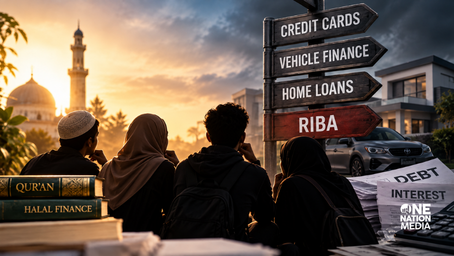

As rising debt and living costs threaten the financial futures of young South Africans, Islam offers an alternative economic system rooted in justice, ethical wealth creation and the prohibition of riba (interest). Ra’eesah Hassim explores whether Islamic economic principles can provide a more sustainable path towards financial security for a generation increasingly burdened by debt.
For millions of young South Africans, financial independence increasingly comes at the cost of debt. A credit card to survive the month, vehicle finance to get to work or a home loan to secure a family’s future can mean years of repayments, interest charges and financial uncertainty. But Islam offers a fundamentally different approach to wealth, debt and financial security, one that challenges the foundations of an economic system in which borrowing at interest has become an accepted part of everyday life.
For young Muslims, the question therefore extends beyond how to survive financially without engaging in riba. It must also confront a more fundamental issue: whether the Islamic economic system offers a more just and sustainable solution to the financial difficulties confronting their generation.
The pressure on South African households is undeniable. According to the South African Reserve Bank, household debt stood at 61.3% of annual disposable income in the second quarter of 2026. This measures outstanding household debt relative to income, illustrating the extent of the financial obligations carried by consumers. Meanwhile, Statistics South Africa reported annual consumer inflation of 4.4% in August 2026, with rising living expenses continuing to strain household budgets.
Within this economic environment, young Muslims face a challenge that goes beyond affordability. They must navigate a financial system fundamentally shaped by interest while remaining faithful to Islam’s prohibition of riba.
Islam challenges the foundations of the debt economy
Islam does not merely discourage excessive borrowing. It prohibits riba and establishes an economic framework built on justice, transparency, ethical trade, shared responsibility and the circulation of wealth. The Qur’an makes the distinction unequivocally: “Allah has permitted trade and forbidden interest” (Surah Al-Baqarah 2:275).
This prohibition is not an isolated religious restriction. It forms part of a wider Islamic economic philosophy that rejects exploitation, discourages unjust enrichment and promotes financial transactions connected to genuine economic activity. While conventional lending allows creditors to earn interest on debt, Islamic finance seeks to structure transactions through permissible trade, leasing, investment and risk-sharing arrangements.
The distinction is significant. Islam does not prohibit wealth creation, entrepreneurship or financial prosperity. Rather, it establishes moral boundaries within which wealth must be acquired, invested and distributed. For financially vulnerable young people, these principles offer an alternative to an economic culture that can encourage consumption through borrowing and leave individuals struggling to escape long-term debt.
Can Islamic banking flourish within an interest-based system?
Sheikh Laja, Director of Legal and Shariah Compliance at the Independent Islamic Court (IIC) and a Da’wah consultant for the Guardian Da’wah Institute, argues that Muslims must examine the broader financial system rather than concentrating exclusively on individual banking products.
Whether customers use a fully Islamic bank such as Al Baraka Bank or Islamic banking services offered through conventional institutions such as FNB and Absa, these operations remain subject to South Africa’s banking legislation and regulatory framework. This raises a critical question: can Islamic banking achieve complete Shariah compliance while operating within a financial system whose underlying structures are built around interest?
According to Laja, Muslims should not automatically assume that a product is genuinely Shariah-compliant simply because it carries an Islamic label. They must examine how financial products are structured, how institutions obtain and manage their funds, and whether their operations genuinely conform to Islamic principles.
His argument points towards a deeper concern: the difference between offering Islamic financial products within an existing conventional system and establishing a comprehensive economic order governed by Islam. While Islamic banking can provide Muslims with alternatives to conventional interest-bearing products, the broader Islamic economic vision extends beyond banking contracts to questions of wealth distribution, social responsibility and economic justice.
Choosing faith over financial convenience
For 24-year-old Johannesburg entrepreneur Shakeel-Ahmad Hendricks, co-founder and director of Hostli (Pty) Ltd, avoiding riba takes precedence over securing the cheapest financial deal. Hendricks uses FNB Islamic Banking and says his decision was guided by religious principles rather than a comparison of banking charges. “The Sharia compliance was more important to me than finding the absolute cheapest account,” he said.
His commitment extends to investment decisions. Hendricks avoids opportunities he considers incompatible with Shariah, even where they promise potentially higher returns. He has also deliberately avoided credit cards, recognising that access to convenient borrowing can create the temptation to incur interest-bearing debt. Instead, he believes financial discipline, patience and responsible spending are essential to remaining within Islamic boundaries.
That conviction will face its greatest test when he eventually purchases a vehicle or property. “The dream is to have the money and pay for it cash to avoid interest,” Hendricks said.
His experience illustrates the tension facing young Muslims who want to establish businesses, acquire assets and build financial security without compromising their faith. Yet it also raises a broader question: why should young Muslims be forced to choose between financial opportunity and religious obedience when Islam provides an economic framework designed to accommodate both?
The spiritual cost of riba
Islam’s prohibition of riba carries profound spiritual consequences. Allah commands believers: “O believers! Fear Allah, and give up outstanding interest if you are true believers” (Surah Al-Baqarah 2:278). The following verse warns those who persist in riba of “a war with Allah and His Messenger” (2:279). These warnings establish that avoiding riba is not simply a matter of personal financial preference, but a religious obligation.
However, Hendricks acknowledges that young Muslims face considerable temptation when conventional financial products promise easier access to credit, greater purchasing power or higher investment returns. The fear of missing out can become particularly powerful when young people compare their financial progress with others who face no religious restrictions on conventional borrowing or investing.
“In the worldly sense, you lose financially. But in the Islamic sense, I don’t believe that you lose,” he said. “When your money is halal, there’s more barakah in it.”
His perspective challenges the assumption that financial success should be measured exclusively through material accumulation. Within Islam, wealth is inseparable from accountability before Allah, and its true value cannot be determined solely by the returns it generates.
Beyond Islamic banking towards an Islamic economic solution
Hendricks believes greater financial education is essential, particularly regarding Islamic home finance and other products whose structures may appear similar to conventional loans. Young Muslims, he argues, should understand the contracts they enter rather than relying unquestioningly on an Islamic banking label. But education alone cannot resolve the wider problem.
The Islamic economic system encompasses far more than the prohibition of interest. Its institutions and principles include zakah, the encouragement of charitable spending, ethical investment, fair commercial dealings, wealth circulation and mechanisms designed to protect vulnerable members of society. These principles seek to establish an economy in which financial activity serves society rather than allowing wealth and economic power to become concentrated without corresponding social responsibility.
For Muslim communities, this creates an opportunity to look beyond individual banking decisions towards developing stronger Islamic financial institutions, cooperative initiatives, ethical investment opportunities and community-based economic support. It also requires serious discussion about how Islamic economic principles can be implemented meaningfully within the constraints of South Africa’s existing financial system.
The struggle confronting young Muslims is therefore not simply about finding a cheaper home loan, avoiding credit cards or selecting an Islamic bank. It concerns the economic structures shaping their lives and the extent to which those structures reflect the values of their faith.
Islam does not merely offer Muslims a way to survive within an interest-driven economy. It presents a fundamentally different vision of how an economy should function. For a generation burdened by debt, rising costs and financial uncertainty, the answer may lie not in finding new ways to borrow, but in rediscovering Islamic economic principles that place justice, responsibility and human wellbeing above the pursuit of interest-based profit.


