
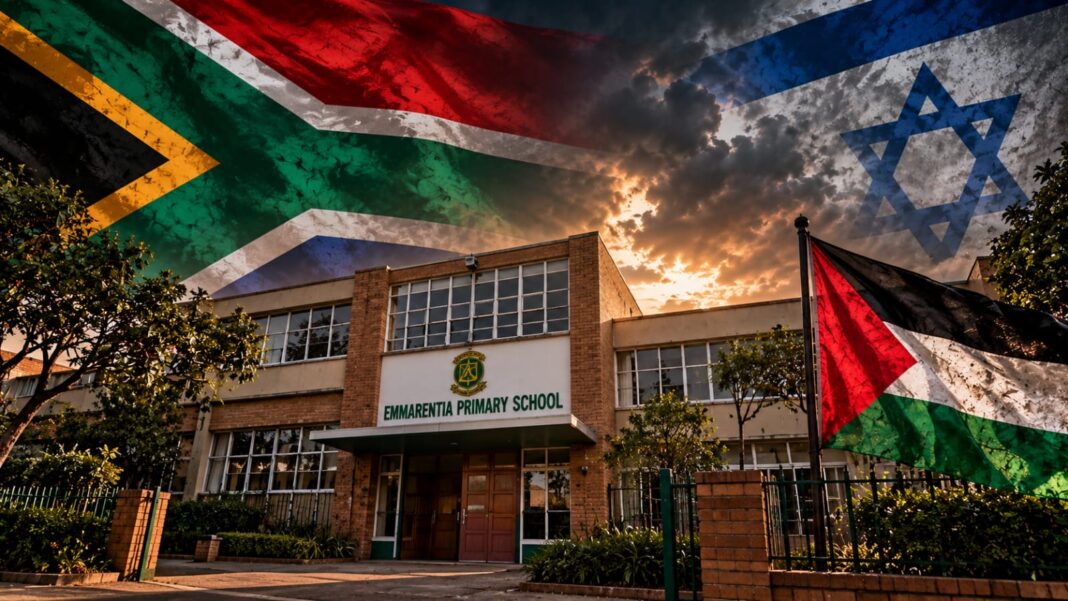

While a South African pastor rages over a Johannesburg school’s apology for displaying Israel’s flag, Palestinian children are being killed, their classrooms reduced to rubble and their futures devastated. The real outrage is not the removal of a flag, but the impunity surrounding Israel’s destruction of Gaza and the suffering of an entire generation of Palestinian children.
An Israeli flag appears at a Johannesburg primary school concert, and a pastor erupts in outrage. Thousands of kilometres away, Palestinian children continue to be killed, their schools lie in ruins and an entire generation has been deprived of years of education.
Yet, in this grotesque inversion of moral priorities, it is the dignity of Israel’s flag that apparently demands urgent defence.
The controversy erupted after Emmarentia Primary School issued an apology on 14 October 2026 for displaying the Israeli flag during a school concert. The school described the incident as an oversight, reaffirmed its opposition to apartheid and genocide, and expressed solidarity with Palestine.
One Nation Media (ONM) contacted the school for comment, but it declined to respond.
The apology provoked a furious response from Pastor Thom, whose lengthy statement, circulating on Facebook, questioned whether South Africa had lost its mind. He alleged political pressure, demanded an explanation for the school’s decision and portrayed the incident as an affront to Israel’s sovereignty.
But what kind of moral reasoning produces outrage over a national flag while overlooking the devastation inflicted on children under that nation’s military power?
A flag defended, a generation destroyed
According to UNICEF’s September 2026 humanitarian appeal, at least 21,700 Palestinian children had been reported killed in Gaza by 30 June 2026, while another 45,000 had been injured, including more than 11,000 who suffered life-altering injuries.
In its report, After Two Years of War: Gaza’s Education System on the Brink of Collapse, UNICEF found that more than 97% of Gaza’s schools had been damaged or destroyed.
A subsequent UNICEF education assessment reported that approximately 700,000 Palestinian children had missed formal in-person schooling for almost three consecutive academic years.
These are children who should have been learning, playing and preparing for their futures. Instead, thousands have been killed, while countless others endure displacement, bereavement, devastating injuries and the destruction of their educational opportunities.
The suffering has continued despite the ceasefire.
UNICEF reported on 7 October 2026 that more than 340 Palestinian children had been killed and over 600 injured since the ceasefire began a year earlier.
Where is the comparable indignation from those demanding respect for Israel’s national symbol? Where are the furious questions about Palestinian children’s right to safe classrooms, education and life itself?
Why does the removal of a flag provoke such outrage when the killing of children and destruction of schools have become almost routine features of international news?
Sovereignty is not a licence for impunity
Pastor Thom proudly declares that he recently returned from Israel, where he witnessed a country taking its sovereignty, national identity and security seriously.
But Israel’s national pride tells us nothing about whether its military conduct complies with international law.
Sovereignty does not confer the right to destroy civilian infrastructure unlawfully, inflict disproportionate harm or disregard the protections owed to children.
The International Committee of the Red Cross makes clear that military operations must be conducted with constant care to spare civilians and civilian objects.
South Africa’s genocide case against Israel before the International Court of Justice has placed Israel’s conduct under international legal scrutiny. The Court has ordered provisional measures under the Genocide Convention, although it has not issued a final ruling on the merits of the genocide allegations.
Israel has rejected accusations of genocide and maintains that its military operations are directed against Hamas.
Nevertheless, the flag of a state cannot become a shield against scrutiny or accountability for that state’s actions.
Israel’s flag is not beyond political scrutiny
Pastor Thom asks whether the Israeli flag is a weapon, a bomb or a threat to children.
Nobody is suggesting that a piece of cloth is itself a weapon. The issue is what that flag represents in the circumstances in which it appears.
National flags embody political identities, sovereign authority and national allegiance. They are raised during military victories, displayed at political demonstrations and invoked to defend the actions and interests of states.
Why, then, should Israel’s flag suddenly be treated as politically meaningless when its display is questioned?
Pastor Thom’s own outrage exposes the contradiction. If the flag carries no political significance, why does its removal provoke such an intensely political response?
Displaying a national flag does not automatically constitute an endorsement of every action taken by its government. Nor should Israeli civilians or Jewish communities be held collectively responsible for Israeli state policies.
But that distinction does not oblige South Africans to ignore the political significance of Israel’s flag amid the devastation of Gaza.
A school’s decision not to display a particular national symbol is not the erasure of a country or its people. It may simply reflect an ethical position informed by the circumstances in which that symbol is being displayed.
Pastor Thom repeatedly asks whether Emmarentia Primary School would have apologised had it displayed the Palestinian flag.
The answer should be equally straightforward: Why should a school apologise for displaying the Palestinian flag in solidarity with an oppressed people?
The Palestinian flag represents national identity, dignity, self-determination and resistance to occupation and dispossession.
Today, it also symbolises children whose families have been shattered, schools destroyed and futures placed in jeopardy.
Raising that flag is not an act of hostility towards Jewish people or Israeli civilians. It is an affirmation of Palestinian humanity and the right to freedom, justice and education.
South Africa’s history makes such solidarity particularly meaningful.
The struggle against apartheid depended on people refusing to treat institutionalised oppression as a neutral political disagreement. International solidarity, boycotts and symbols of resistance helped mobilise opposition to racial segregation and injustice.
Would Pastor Thom have demanded neutrality towards apartheid because condemning it might offend the national pride of those defending the system?
Would he have insisted that schools avoid taking an ethical position because doing so might be considered too political?
Consistency does not require pretending that every state’s conduct is morally equivalent. It requires applying the same principles of justice, human dignity and accountability, regardless of the state involved.
Education is not moral indifference
Pastor Thom argues that schools should concentrate on education, safe classrooms and independent thinking rather than importing international conflicts into the classroom.
Yet how can education be separated from the destruction of educational institutions and the denial of children’s fundamental right to learn?
According to the UN Office for the Coordination of Humanitarian Affairs, approximately 200,000 Palestinian children remained without access to any form of structured learning when Gaza’s new academic year began in September 2026.
Hundreds of thousands more were relying on temporary learning spaces and humanitarian education programmes rather than functioning schools.
If education is genuinely Pastor Thom’s concern, surely these children deserve more than silence.
Teaching South African learners about Palestine, military occupation, apartheid, international law and the protection of civilians is not inherently indoctrination.
When grounded in evidence, historical context and critical inquiry, such education develops moral reasoning, historical understanding and the ability to recognise injustice.
Schools should encourage pupils to question political narratives, examine evidence and understand the consequences of state policies, rather than simply accept the symbolism of national flags at face value.
An education that teaches respect for national symbols while discouraging scrutiny of the states behind them is not independent thinking. It is obedience masquerading as neutrality.
The real outrage
Emmarentia Primary School’s apology should never have become an occasion to elevate Israel’s national dignity above Palestinian humanity.
The school reaffirmed its opposition to apartheid and genocide, principles consistent with South Africa’s history of resisting oppression and supporting international solidarity.
Pastor Thom is entitled to admire Israel and defend its national flag. But he cannot reasonably expect others to suspend moral judgment about Israel’s conduct simply to accommodate that admiration.
The contrast could hardly be starker.
An Israeli flag can be removed from a school concert without harming a single child. The same cannot be said of bombs falling on schools, homes and communities.
A flag can be replaced. A classroom can eventually be rebuilt. But a child who has been killed cannot be brought back, and years of lost education cannot simply be restored through patriotic speeches.
The real scandal is not that a Johannesburg primary school apologised for displaying Israel’s flag. It is that such an apology has inspired outrage while the devastation of Gaza’s children and educational institutions continues to demand urgent international action.
When defending Israel’s flag inspires greater fury than the killing of Palestinian children and the destruction of their schools, the question is not whether South Africa has lost its mind.
It is whether those expressing such outrage have lost sight of their humanity.


