
Before discussing political parties, election manifestos or candidates, Muslims must first confront a more fundamental question: who possesses the ultimate authority to determine what is lawful and unlawful, permissible and prohibited, obligatory and forbidden? The debate surrounding voting cannot be separated from the broader question of legislative authority and sovereignty, argues Sheikh Laja Yasini in a talk delivered at a recent gathering of ulama hosted by the Association of Muslim Professionals of South Africa (AMPSA).
Islam affirms that ultimate legislative authority belongs to Allah alone. While human beings may govern, administer public affairs and adjudicate disputes in matters open to juristic reasoning, they do not possess independent authority to establish moral and legal standards that contradict divine revelation. Human authority is recognised in Islam, but it is derivative, delegated and ultimately subordinate to the commands of Allah and His Messenger ﷺ.
The Qur’an repeatedly establishes this principle. Allah says: “Judgement belongs only to Allah.” (Qur’an 12:40)
Allah further says: “Is it the judgement of ignorance that they seek? And who is better than Allah in judgement for a people who have certainty?” (Qur’an 5:50)
Likewise, believers are commanded to refer disputes to Allah and His Messenger ﷺ (Qur’an 4:59), while Allah declares that a believing man or woman has no independent choice once Allah and His Messenger ﷺ have decided a matter (Qur’an 33:36). These verses establish a clear hierarchy of authority: divine revelation determines the standards by which human conduct is judged, not the other way around.
This principle does not negate governance or public administration. Islamic jurisprudence recognises rulers, judges, public institutions, consultation, public welfare and administrative regulations. Throughout Islamic history, scholars developed sophisticated theories of governance and statecraft. However, these operate within the framework of revelation rather than independently of it. Human beings may regulate matters that Allah has left open to regulation, but they cannot claim unrestricted authority to determine what is lawful and unlawful according to their own discretion.
South Africa’s constitutional order is founded upon a different conception of legislative authority. Section 2 of the Constitution declares: “This Constitution is the supreme law of the Republic; law or conduct inconsistent with it is invalid.”
Section 43 of the Constitution vests legislative authority in Parliament, provincial legislatures and municipal councils, while Section 44 defines Parliament’s legislative powers. Although Parliament is no longer sovereign in the Westminster sense, and its powers remain subject to constitutional limitations and judicial review, the Constitution remains the legal source from which legislative institutions derive their authority and the standard against which the validity of laws is determined.
The Constitutional Court has repeatedly affirmed the principle of constitutional supremacy. In Masetlha v President of the Republic of South Africa, the Court reaffirmed that the exercise of all public power is subject to constitutional control. Within South Africa’s legal system, constitutional supremacy therefore provides the standard against which legislation and government conduct are measured.
For Muslims, however, the question extends beyond legal validity. A law may be constitutionally valid and enforceable under South African law while simultaneously contradicting divine revelation.
The issue is therefore not whether constitutional institutions possess legal authority within South Africa’s legal system. Their authority is recognised as a matter of positive law. The deeper question is whether constitutional authority can constitute the ultimate standard of legitimacy for a Muslim, particularly when it conflicts with the commands of Allah.
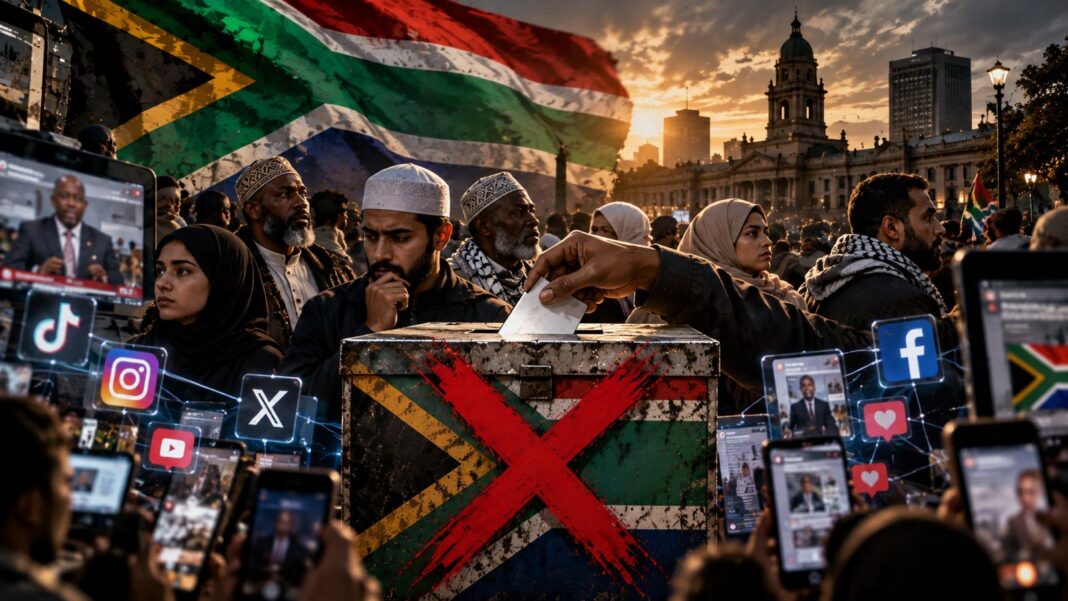
It is at this point that elections become relevant. Voting is often presented as a neutral procedural mechanism through which citizens select representatives or administrators. Such a characterisation, however, does not fully account for the constitutional reality of representative democracy.
Voting does not merely determine who occupies public office. It forms part of the process through which legislative institutions are constituted and empowered. Through elections, citizens participate in selecting representatives who possess the authority to enact, amend and repeal laws that bind society.
Consequently, the relevant inquiry is not simply who is being elected, but which institution is being constituted through the electoral process and what kind of authority that institution is empowered to exercise.
From the perspective of divine sovereignty, this distinction is critical. If legislative institutions are vested with authority to formulate binding legal norms independently of revelation, participation in constituting and empowering those institutions cannot automatically be regarded as a morally neutral act. The issue extends beyond administrative representation and enters the more fundamental question of legislative authority itself.
Accordingly, the argument is not merely that certain laws enacted by Parliament may contradict Islam. Rather, the concern is that electoral participation forms part of a constitutional framework in which legislative authority is vested in institutions deriving their powers from constitutional and democratic processes rather than divine revelation.
The question therefore becomes whether participation in establishing such institutions can be reconciled with the Islamic doctrine that ultimate legislative authority belongs exclusively to Allah.
This debate, however, should not be oversimplified. Muslim scholars do not unanimously agree on the permissibility of voting in democratic systems. Some contemporary scholars permit electoral participation on grounds of necessity, preventing greater harm, safeguarding communal interests or protecting religious freedoms. Others argue that participation in democratic systems impermissibly contributes to empowering institutions that exercise legislative authority independently of divine revelation.
The disagreement is therefore not simply about the physical act of casting a ballot, but about the constitutional and theological significance of the political institutions that the ballot helps to establish.
Whatever position one adopts, the foundational question cannot be ignored. Before discussing political outcomes, strategic interests or electoral advantages, Muslims must first examine the source and legitimacy of legislative authority.
South African constitutional law answers that question by reference to the Constitution and the institutions established under it. Within the Islamic framework advanced by Yasini, ultimate legislative authority belongs to Allah and His revelation.
For this reason, the first question a Muslim should ask is not simply: “Which party should I vote for?”
Rather, it is: “What authority does my vote help to establish, and can participation in that process be reconciled with the Islamic doctrine that ultimate legislative authority belongs to Allah alone?”
Until that question is seriously and honestly addressed, discussions about political parties, electoral promises and voting strategies remain secondary to the more fundamental questions of sovereignty, legitimacy and the ultimate source of law.
Sheikh Laja Yasini is an Islamic scholar and legal practitioner who serves as the Director of Legal and Shariah Compliance at the Independent Islamic Court (IIC).