

Mali’s military authorities and their Russian allies have been accused of killing women and children, destroying livestock and using cluster munitions and barrel bombs in airstrikes on civilian communities.
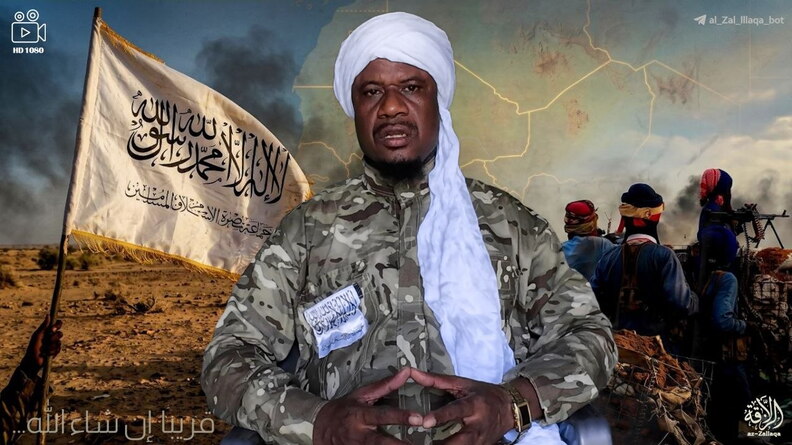
The allegations were made in a video address published online by Mahmoud Barry, also known as Abu Yahya, a representative of Jama’at Nusrat al-Islam wa-l-Muslimin (JNIM), the al-Qaeda-linked armed coalition operating across the Sahel.
In his address, Barry accused Mali’s military junta of deploying Russian mercenaries against its own population, challenged official accounts of recent battles and alleged widespread abuses against civilians.
He also claimed a series of military victories and appealed for support from urban residents, professionals and other sections of Malian society.
Claims of victories in central Mali
Barry opened his address by congratulating Muslim communities across the Sahel, particularly in Mali, over what he described as recent victories in Mali, Burkina Faso and Niger.
He highlighted operations in Dioura and Sévaré, portraying them as significant military successes and attributing them to divine assistance.
He characterised the fighting as part of an “ongoing jihad” and an “effort to repel aggression.”
Accusations against Bamako
Barry accused Mali’s military junta of targeting Muslim communities, obstructing the implementation of Islamic law, betraying its own population and selling the country’s land and resources to foreign powers.
He alleged that the authorities had employed various methods of intimidation and repression, including deploying foreign mercenaries and personnel from Russia’s Africa Corps, carrying out massacres and committing acts he characterised as genocide.
He further accused government forces of conducting indiscriminate airstrikes against civilian communities using cluster munitions and barrel bombs. The video included images purporting to show the weapons and destruction caused by the alleged attacks.
Barry sought to justify JNIM’s own military operations as acts carried out “in defence of the oppressed and in vengeance for the innocent people who lost their lives in these sinful strikes.”
The allegations have not been independently verified.
Dioura: Conflicting accounts
Barry directly challenged the Malian military’s account of recent fighting in Dioura.
The Malian Armed Forces’ Directorate of Information and Public Relations (DIRPA) had claimed that government troops successfully repelled an attack and killed all the fighters involved.
Barry rejected that account, claiming JNIM fighters maintained their positions despite aerial intervention and that government troops eventually fled, leaving bodies on the battlefield.
His remarks challenged the authorities’ portrayal of their military operations as successful and raised questions about their claims of territorial control and battlefield superiority.
Neither side’s account of the confrontation has been independently verified.
Alleged civilian deaths in airstrikes
Barry also disputed official accounts of military operations in Macina and along the Mauritanian border.
He alleged that airstrikes publicly presented as operations against armed fighters had instead killed unarmed villagers, including women and children, as well as livestock.
JNIM’s accusations come amid reports that seven airstrikes attributed to Malian forces and their Russian allies struck the village of Nzanakoro, near Niono in central Mali, on 12 October.
The strikes reportedly killed six civilians, including four girls and two women, one of whom was pregnant. Another 13 people, all women and children, were reportedly wounded.
These reports have not been independently verified.
Human Rights Watch and Amnesty International have previously documented serious abuses involving Malian government forces and Russian personnel, including torture and summary executions of civilians suspected of supporting or sympathising with JNIM.
Appeal to cities and professionals
In the latter part of his address, Barry urged JNIM fighters on the front lines to remain patient and steadfast, describing them as a “source of hope for widows, orphans and the oppressed” and pledging to continue fighting.
He then turned his attention to Mali’s urban population, appealing for support from professionals, academics, technical specialists and those responsible for civilian institutions.
Barry portrayed JNIM fighters as brothers and sons of the communities he was addressing, seeking to present the coalition as an integral part of Malian society rather than an external armed movement.
He said the group’s members had their hearts open and hands extended, inviting cooperation to end what he described as aggression and oppression.
The speech concluded with a pledge that Mali could achieve prosperity, security and justice under Islamic law.
Mali’s military authorities have not publicly responded to the specific allegations made in Barry’s address.