
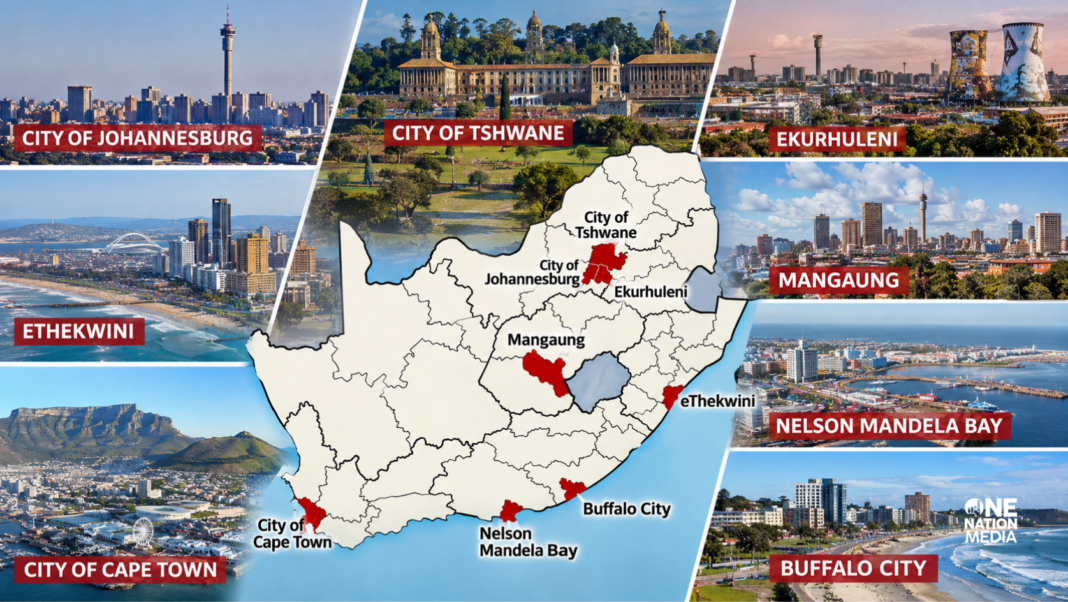

As South Africa heads to the polls, the Auditor-General’s findings expose irregular spending, infrastructure failures and financial distress across the country’s eight largest municipalities.
On the eve of South Africa’s local government elections, the financial health of the country’s biggest cities is under the microscope. None of the country’s eight metropolitan municipalities achieved a clean audit in 2024/25, according to Auditor-General Tsakani Maluleke’s Consolidated General Report on Local Government Audit Outcomes, while five received qualified audit opinions.
The metros — Johannesburg, Tshwane, Ekurhuleni, Cape Town, eThekwini, Nelson Mandela Bay, Buffalo City and Mangaung — are home to 24.9 million people, about 40% of the population, and serve 8.9 million households. Together, they manage R335.97 billion, representing 54% of the entire local government expenditure budget. Yet residents continue to face water shortages, electricity interruptions, deteriorating roads and unreliable waste collection.
Billions lost while infrastructure crumbles
The report found that all eight metros showed signs of underinvestment in infrastructure maintenance and renewal, contributing to deteriorating services. In 2024/25 alone, the metros recorded an estimated R9.89 billion in water losses and R17.28 billion in electricity losses — a combined R27.17 billion.
The losses are either technical, such as leaks from damaged pipes and ageing infrastructure, or non-technical, such as theft, incorrect billing or failure to bill. Either way, they represent revenue the metros never collect.
Johannesburg, Tshwane and Ekurhuleni also adopted unfunded budgets — planned spending exceeding available funding. Tshwane has done so for four consecutive years.
Professor Daryl Glaser, Professor of Political Studies at Wits University, told One Nation Media that municipalities are experiencing different levels of failure and should not be lumped together. “Cape Town has performed better than Johannesburg,” he said, warning against treating all eight as equally unsuccessful.
The AG’s findings support that distinction: only Cape Town and eThekwini had good financial health indicators, while the other six showed multiple signs of financial distress.
Johannesburg, Glaser said, is particularly concerning. For years, residents worried about potholes, broken streetlights and traffic lights, but today those concerns have been overtaken by more serious failures in water, electricity and rubbish collection. Weak national economic growth has limited public funding to address backlogs, he added, while corruption and inefficient spending further reduce resources for essential services.
R73bn in irregular spending
Between 2021/22 and 2024/25, the eight metros and their entities accumulated R73.87 billion in irregular expenditure, with R23.14 billion recorded in 2024/25 alone. Seventy-seven percent resulted from failures to comply with procurement and contract management legislation.
Irregular expenditure does not automatically mean money was stolen. It refers to spending that did not comply with laws governing public money — such as awarding tenders without following proper procedures or competitive bidding processes, or making payments outside contractual terms. The goods or services may still have been delivered, but without assurance of fair value or fair competition. However, these failures increase the risk of corruption, unfair tender awards and financial losses.
The metros also accumulated R4.65 billion in fruitless and wasteful expenditure over four years, nearly half of which resulted from interest and penalties for late payments.
Glaser said corruption and extortion by so-called mafias operating on the edges of the state divert scarce money away from services, while contractors appointed through political connections may not be the most capable. “We need to employ people on the basis of their professional skill and suitability for the job, and not on the basis of their partisan connections,” he said.
When growth is weak and revenue is limited, he argued, money diverted through corruption has an even greater effect on maintenance and service delivery.
Political instability and empty posts
Financial problems are not the only challenge, as coalition disagreements and leadership changes also affect governance. “Coalition instability has probably made the problem worse in some municipalities,” Glaser said. Multiparty coalitions can make it difficult for residents to identify who should be held responsible when services fail.
The AG’s report points to a capacity crisis: by the end of 2024/25, the average vacancy rate across the metros was 23%, with senior management vacancies at 25%. At some metros, high vacancy rates in technical departments responsible for electricity, water, wastewater and solid waste negatively affected performance reporting, the achievement of targets and service delivery.
Leadership as a trust
From an Islamic perspective, leadership is an amaanah — a trust carrying responsibility. Allah says in Surah An-Nisa (4:58):
“Indeed, Allah commands you to render trusts to whom they are due and when you judge between people to judge with justice.”
Surah Al-Baqarah (2:188) warns against consuming the wealth of others unjustly or using it to influence authorities. Public money is not personal property; it is a responsibility to be managed fairly.
Promises must become action
The Auditor-General has called on municipal leaders to build capable institutions with support from all spheres of government, professionalise local government through compliant appointments and skills development, and instil a culture of ethics, accountability and consequence management.
With new councils set to be elected on 4 November, she has also urged political parties to prioritise capability and integrity when selecting candidates for councillor and mayor. Glaser echoed the view that commitments to efficiency and fighting corruption must be reflected in action, not just campaign promises.
While municipalities face different challenges, the findings show that financial oversight and reliable service delivery remain serious concerns across the country’s largest cities. For millions still struggling with unreliable water, electricity and sanitation, accountability will ultimately be measured not by audit opinions, but by improvements in daily life.


