
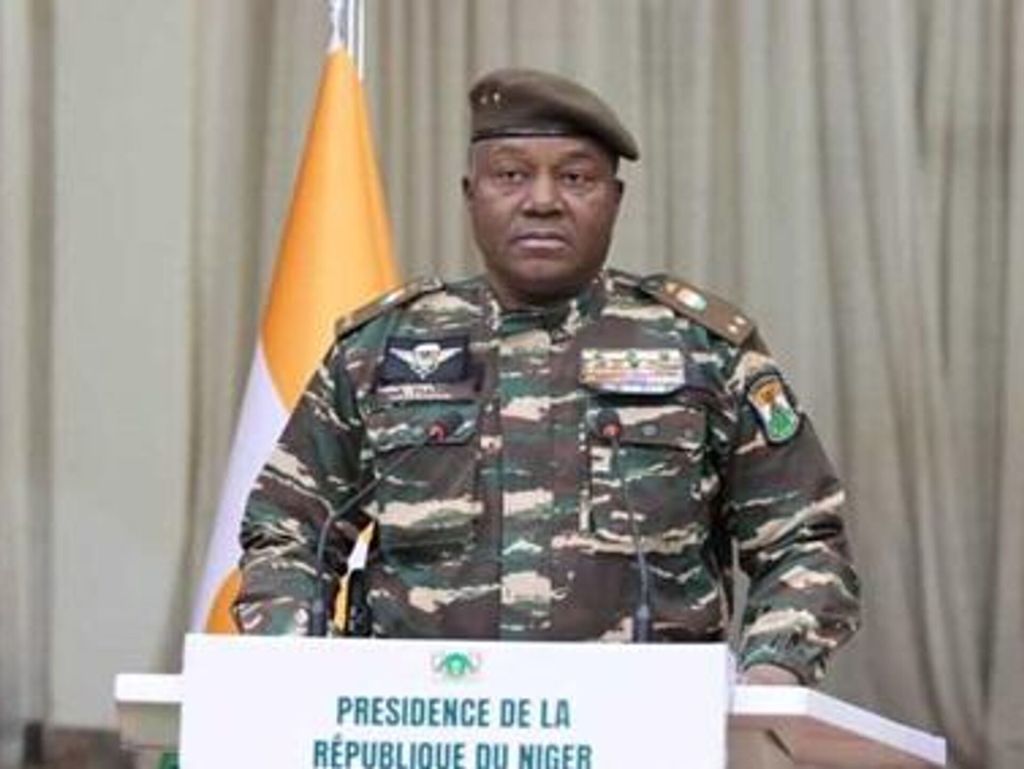

Two weeks after a mutiny exposed serious tensions within Niger’s armed forces, General Abdourahamane Tiani has carried out a major reshuffle of the country’s military leadership.
The dismissal of General Moussa Salaou Barmou, a key figure in the July 2023 coup and former commander of Niger’s special forces, is the most significant change.
But the reshuffle raises a question that extends beyond Tiani’s political survival. Nearly three years after Niger’s military authorities came to power promising greater sovereignty, improved security and an end to longstanding dependence on Western powers, divisions within the armed forces are becoming a test of whether that new political order can deliver on its promises.
Barmou has been removed as Chief of Defence Staff and replaced by Brigadier General Mamane Sani Kiaou, who previously served as Chief of Staff of the Army.
General Abdourahamane Abou Zataka has meanwhile taken over as head of the Army, while further changes have been made within the air force and wider military command.
The presidential decree provides no detailed explanation for Barmou’s removal. Its timing, however — less than two weeks after the August 28-29 mutiny — has inevitably raised questions about whether the reshuffle is connected to the internal unrest.
According to sources cited in the dossier on the crisis, Barmou’s dismissal had been “predictable” and was linked to the events at the end of August. The former army chief was reportedly viewed as having adopted an “ambiguous” position during the crisis.
No official explanation has been provided, however, meaning such claims remain allegations and must be treated accordingly.
Barmou’s background makes his departure particularly significant. Trained in counter-terrorism in the United States, he previously commanded Niger’s special forces before becoming Chief of Defence Staff. He was also an important figure in the coup that brought Tiani to power in July 2023.
His removal exposes an uncomfortable paradox: an officer who helped construct the military order that emerged after the coup has now been sidelined as that same order confronts one of its most serious internal challenges.
Some sources have portrayed his dismissal as the culmination of Tiani’s desire to remove an officer who had become too “troublesome”. A political analyst cited in the dossier points to another factor, arguing that Barmou’s longstanding association with the special forces became particularly sensitive after elements from their ranks were reportedly implicated in the mutiny.
Restoring cohesion
The appointment of Brigadier General Mamane Sani Kiaou appears to reflect a new priority: restoring cohesion within the armed forces.
The new Chief of Defence Staff inherits a military confronting armed insurgencies, reports of defections within some units and internal tensions that the recent mutiny has brought into the open.
According to military sources cited in the dossier, Kiaou has begun touring several garrisons in an effort to “restore cohesion among the soldiers”.
The initiative suggests that unity within the military can no longer simply be assumed and that the central command must actively work to secure the loyalty and confidence of its forces.
His task will be particularly sensitive when it comes to the special forces. If reports of departures or defections from their ranks are confirmed, Niger’s military authorities would face a serious contradiction: some of the forces considered most important to confronting armed groups would themselves be struggling with questions of discipline, loyalty and cohesion.
For ordinary Nigeriens, however, the crisis extends far beyond changes at the top of the military hierarchy.
Communities across parts of Niger continue to endure armed violence, economic hardship and the consequences of military operations conducted in the name of security.
Divisions within the armed forces therefore raise broader questions about a military-led political order that came to power promising to protect the population and restore stability.
For opponents of the authorities, those fractures may also provide an opportunity to challenge military rule and present an alternative political vision.
The sovereignty question
The crisis also raises uncomfortable questions about the sovereignty project that has defined Niger’s political direction since 2023.
Following the coup, Niger severed or sharply reduced important security relationships with France and the United States, ordered foreign troops to leave and moved closer to Mali and Burkina Faso through the Alliance of Sahel States. At the same time, Niamey deepened its security relationship with Moscow.
For many across the Sahel, these changes represented more than a diplomatic realignment. They were presented as an attempt to reclaim African sovereignty after years in which extensive Western military deployments had failed to end worsening insecurity across the region.
The August mutiny, however, has exposed a new tension within that project.
Russia’s Africa Corps appears to have played an important role in protecting Tiani’s government during the crisis.
General Ismael K. Sidi Omar, who has now been appointed Deputy Chief of Staff of the Air Force, previously commanded Niamey’s Base 101. According to information cited in the dossier, he remained loyal to Tiani during the mutiny and discreetly assisted efforts involving Russian personnel deployed to restore control.
For Niger’s authorities, that support may have been decisive. But for their opponents, Russian involvement strengthens the argument that Niger has exchanged one form of foreign military dependence for another.
French forces once supported a political and security architecture that became deeply unpopular across parts of the Sahel. Russian forces are now providing support to some of the military governments that emerged in its place.
That distinction matters. Rejecting Western domination does not automatically produce genuine sovereignty if external military power remains necessary to sustain the state’s political order.
For Nigerien soldiers and civilians opposed to foreign-backed military rule, Russian involvement in a confrontation within Niger’s own armed forces provides further ammunition for that argument.
Tiani therefore faces a growing credibility problem. His government must preserve the Russian military relationship on which it increasingly relies while continuing to present its project as one of national independence.
If foreign forces are required to help protect the military authorities from unrest within their own armed forces, the distinction between the dependency they condemned and the dependency they subsequently created becomes increasingly difficult to defend.
Opposition seeks an opening
The instability is also being exploited by armed opposition groups.
The Patriotic Liberation Front (FPL), an armed movement opposed to Tiani and supportive of the political order displaced in 2023, has sought to broaden mobilisation against the military authorities.
In its own statements, the FPL claims to speak to communities across Niger and portrays its struggle as being directed against the authorities rather than the Nigerien population.
It has denounced poverty and economic hardship and called on civilians and soldiers to support efforts to remove Tiani and restore constitutional rule.
These are the claims and political arguments of an armed opposition movement and should not be treated as neutral descriptions of Niger’s crisis.
The FPL is clearly seeking to transform economic frustration and divisions within the armed forces into political and military leverage against the government.
At the same time, Niger’s authorities continue to confront armed groups operating across the wider Sahel, some of which have exploited longstanding local grievances, weak state presence and insecurity to entrench themselves within vulnerable communities.
The deeper challenge, therefore, is not simply military. It is one of legitimate governance, security, social stability and sovereignty — and whether Niger can protect its independence without replacing one foreign dependency with another.
The reshuffle is consequently about far more than changing commanders. It is an attempt to restore confidence and discipline within the institution that has become the principal pillar of Niger’s post-2023 political order.
Kiaou will have to contain frustrations, preserve the chain of command, keep elite units operational and sustain the campaign against armed groups.
Tiani, meanwhile, must prevent the fractures exposed by the mutiny from developing into a deeper crisis of authority.
But the larger question extends beyond Tiani himself.
Niger’s military authorities came to power promising greater sovereignty, stronger security and an end to an external order that many across the Sahel believed had failed them.
If the armed forces begin to fracture while insecurity persists and reliance on foreign military support deepens, the crisis will test not only Tiani’s rule, but the credibility of Niger’s entire post-2023 sovereignty project.