
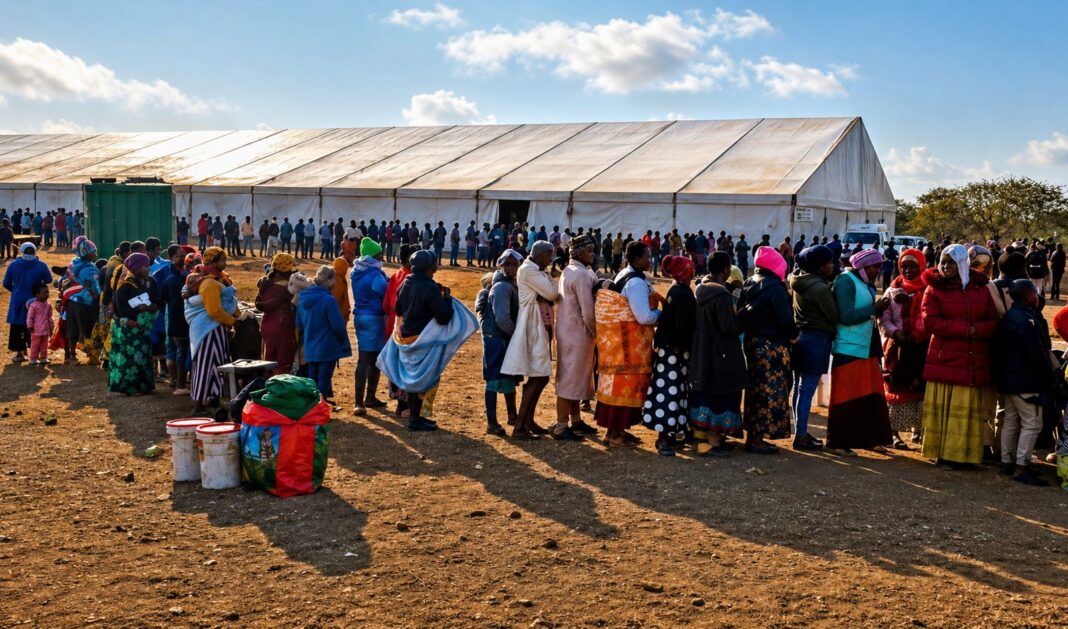

The humanitarian crisis that left thousands of undocumented migrants stranded at South Africa’s northern border has eased significantly, but Muslim humanitarian organisations continue to provide daily relief to people passing through the government’s repatriation centre in Musina.
While the massive backlog that accumulated in late June has largely been cleared, buses carrying undocumented migrants continue to arrive from across South Africa each day, before passengers are processed and repatriated to neighbouring countries.
Among the organisations responding on the ground is the Al-Imdaad Foundation, which has worked alongside government departments and other humanitarian organisations since the repatriation centre was established earlier this month.
Speaking to One Nation Media (ONM), Irfaan Ahmed, Head of Emergency Disaster Response at the Al-Imdaad Foundation, said the organisation became involved after receiving an urgent request from Musina’s Muslim community, which had been overwhelmed by the sudden influx of migrants.
“As the Al-Imdaad Foundation, we received a call from the local Musina Muslim community, which had been inundated by the number of buses arriving. It initially started on 24 June.”
Ahmed said buses began arriving before the government had established a formal repatriation facility, leaving local residents and humanitarian organisations to respond to the immediate needs of people who had travelled long distances.
The government subsequently established a coordinated humanitarian site at the beginning of July, bringing departments and non-governmental organisations together under one roof.
“They identified a humanitarian tent for all NGOs to operate under one roof, so that we do not duplicate our efforts, provide assistance to the right people and ensure that everyone receives support.”
Since then, the Al-Imdaad Foundation and other humanitarian organisations have provided migrants with hot meals, bottled water, fruit, snacks and essential supplies while they wait to be processed.
Families with young children receive additional support, including baby formula, nappies, hygiene packs and sanitary products.
“For the babies and mothers, we provided hygiene kits, sanitary pads, baby formula and nappies — the basic necessities they need to continue their journey.”
Ahmed said the situation at the centre had changed dramatically over the past two weeks. During the initial phase of the operation, more than 20,000 people accumulated at the site as government departments worked to deploy sufficient immigration and Home Affairs officials.
That backlog has now been eliminated. “They now have enough human resources,” he said.
Instead of migrants remaining at the centre for extended periods, Ahmed said buses generally arrive overnight, passengers are processed during the day and depart later that afternoon.
“We do not usually find people staying for more than a day.”
Although new buses continue to arrive daily, the improved processing system means there are times when the centre is temporarily empty before the next group arrives.
“There are times when there are no people at the site.”
Ahmed told ONM that humanitarian organisations remain focused on ensuring migrants are treated with dignity throughout the repatriation process, despite growing pressure on the government to intensify immigration enforcement operations.
“They should be treated in a dignified manner.”
He said the repatriation centre was now operating effectively because government departments and humanitarian organisations were working together.
“These centres are operating extremely well. Various government stakeholders and departments are present on site, and we, as the NGO providing humanitarian assistance, are working hand in hand with them.”
Ahmed also called on the wider Muslim community to continue supporting humanitarian efforts, saying Islam teaches compassion regardless of a person’s nationality, race or religion.
“One thing our religion has taught us is that we do not look at a person’s religion, creed, colour or background. Our religion teaches us that we must continue serving people.”
He said humanitarian workers always try to place themselves in the position of those they are assisting.
“We always put ourselves in their shoes to understand how we would want to be helped. That is how we assist.”
Ahmed acknowledged that some organisations had faced criticism for assisting undocumented migrants, but stressed that their work was purely humanitarian.
“We are looking at a humanitarian situation involving people who are already travelling across the country. We assist them in that moment so that they have something in their stomachs while continuing their journey.”
As buses continue to arrive in Musina each day, Muslim humanitarian organisations say they will remain on the ground, providing emergency assistance to ensure those passing through the repatriation centre can continue their journey with dignity.