
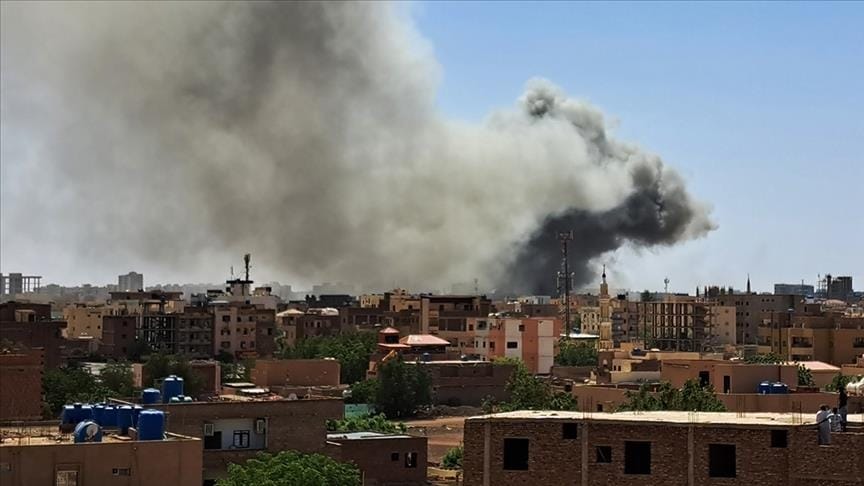

The United Nations High Commissioner for Human Rights has issued an urgent warning that the Sudanese city of El Obeid could become the site of another mass atrocity unless the international community acts immediately.
Addressing the UN Human Rights Council, Volker Türk warned that the situation in El Obeid, the capital of North Kordofan State, bears the hallmarks of an impending humanitarian catastrophe.
“Another human rights catastrophe is unfolding in Sudan, this time in the capital of the strategic state of North Kordofan,” Türk said.
He said civilians had endured siege-like conditions for the past 18 months as fighting between the Sudanese Armed Forces (SAF) and the Rapid Support Forces (RSF) intensified.
“My Office documented 15 drone strikes on El Obeid and surrounding areas between 6 and 28 June, which killed at least 45 civilians and injured 41. The actual number of civilian casualties is likely higher.”
Türk said both sides had repeatedly deployed drones against civilian infrastructure across the Kordofan region.
“Across the Kordofan region, drones launched by both sides have repeatedly struck markets, schools, fuel stations, water infrastructure and civilian vehicles. In recent weeks, we documented damage to at least 13 fuel stations in El Obeid and Al Rahad from RSF drones.”
He warned that the attacks had severely disrupted essential services, leaving residents without reliable access to clean water, food, transport, healthcare and communications.
“Shortages of clean water are reaching a critical point in El Obeid. As the rainy season starts, this puts people at risk of waterborne diseases, including cholera.”
Türk said tens of thousands of people fleeing violence elsewhere in Kordofan had placed further pressure on the city’s already scarce resources.
“Some people are selling their belongings to finance their escape from the city. For many, the exorbitant cost of transport, and constant attacks on vehicles along exit routes, make leaving impossible.”
His office has also documented widespread abuses against civilians attempting to flee.
“We have documented patterns of summary executions, abductions, torture and ill-treatment, sexual violence and looting along the routes taken by displaced people across the Kordofan region.
“Those who stay in El Obeid are also at risk of arbitrary arrest and detention. People who have fled areas controlled by the RSF and allied forces are frequently accused of collaboration.”
Türk urged the international community not to repeat the failures witnessed in North Darfur, where previous warnings went unheeded.
“My Office assessed that at least 6,000 people were killed in the span of just three days when the RSF captured El Fasher. We found the RSF and allied militia committed war crimes and crimes against humanity, including mass killings, summary executions, sexual violence and torture.”
He stressed that the atrocities had been anticipated but were not prevented.
“These crimes were foreseen, with repeated warnings by myself and my Office. But they were not prevented.”
“This is not a drill. It is a red alert that needs to land on the desks of heads of state and government around the world.”
Türk called on world leaders to intensify diplomatic efforts to prevent further atrocities and urged the UN Security Council to fulfil its responsibility to protect civilians.
“All leaders must use their influence to exert pressure on all parties, and particularly the RSF, to stop an offensive on El Obeid; to end strikes on civilians and essential infrastructure; to stop the flow of weapons; and to comply with their obligations under international law.”
He also called for accountability for alleged war crimes and crimes against humanity, welcoming the International Criminal Court’s continued investigation into crimes committed in Sudan.
The High Commissioner appealed for safe passage for civilians seeking to leave El Obeid and called for an immediate humanitarian pause to allow food, medical supplies and other aid to enter the city.
Türk further warned that the conflict was being sustained by economic interests and the continued flow of weapons into Sudan.
“Our upcoming report will focus on how conflict resources, specifically the trade in gum arabic, are fuelling the war economy in Sudan. Other key commodities include gold and livestock.”
He reiterated his call for an end to external arms supplies to all parties involved in the conflict.
“Without action to end this, the conflict risks continuing indefinitely. I repeat my call for the arms embargo on Darfur to be extended to the whole country.
“And I urge concerted efforts by the international community to assume its responsibilities to protect the people of Sudan, and support their efforts to build a peaceful, inclusive and democratic future.”
Separately, analysts have warned that the RSF could soon overrun El Obeid, raising fears of a large-scale massacre if the city falls.
They have also called on the international community to increase pressure on the United Arab Emirates over allegations that it continues to provide financial and military support to the RSF.
Similar calls have been made in the US Congress, where lawmakers have introduced legislation aimed at pressuring the UAE to halt alleged weapons supplies to the paramilitary group.
Sudan’s civil war began in April 2023 following a power struggle between the SAF and the RSF over the integration of armed forces and a planned transition to civilian rule.
The conflict has since developed into the world’s largest humanitarian crisis, displacing an estimated 14 million people inside Sudan and across its borders.