
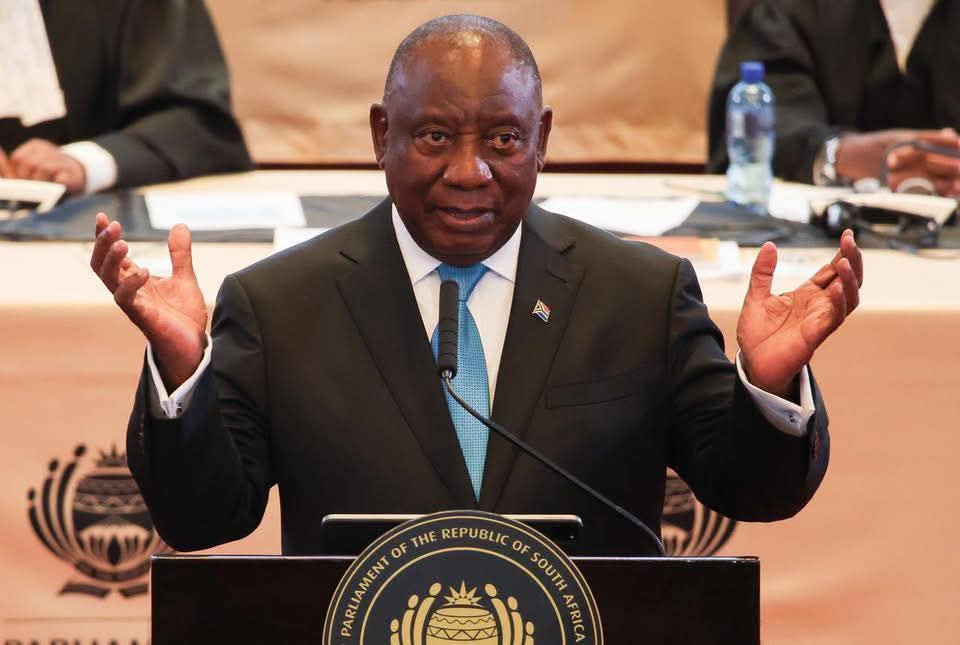

The South African Constitutional Court judgment on Friday on the Phala Phala scandal points to fundamental flaws in the country’s political systems.
instead of conducting a proper and formal impeachment inquiry into the matter as recommended by a panel headed by a former Chief Justice of the Constitutional Court, the country’s Parliament contrived to sweep it under the carpet.
The country’s apex court has now ruled in favour of an application brought by two opposition parties against Parliament’s decision to block the impeachment inquiry recommended by the panel which had concluded that South Africa’s President Cyril Ramaphosa had a case to answer for the concealment of the theft of $580,000 dollars at his farm in the northern province of Limpopo.
The Constitutional Court had to examine the procedural fairness of Parliament’s actions and how it handled the impeachment inquiry recommendations and not the merits or the claims surrounding the theft of the dollar cache at Ramaphosa’s farm.
In a split ruling, the Constitutional Court found Parliament erred and that the impeachment inquiry into Ramaphosa’s conduct must proceed.
Implausibly, Ramaphosa said the cash haul had been payment by a wealthy Sudanese businessman for the purchase of rare Ankole cattle but which the businessman had never collected. Bizarrely, the farm manager, on Ramaphosa’s instruction, stuffed the large amount of money under a sofa!
The African National Congress (ANC), which still had a very large majority in 2022, voted down the panel’s recommendation which was a first step in the implementation of the the Constitution’s impeachment clause to effect the possible removal from office of the head of state.
In 2019 and 2024 Ramaphosa, at his consecutive inaugurations as the country’s president, placed his hand on the Bible and made a solemn pledge to “uphold the constitution and to defend the law”.
In the cover-up after the theft, the president compromised his biblical oath and flagrantly breached the law he swore to uphold by:
- By his failure to immediately report and lodge a case of theft with the police;
- Being in breach of the country’s strict exchange control regulations by being in possession of foreign currency not obtained through an authorised dealer;
- Dispatching his VIP security personnel to conduct a “cloak and dagger” investigation into the theft and pursuing the thieves into a neighbouring state without observing diplomatic protocols;
- The Independent Police Investigative Directorate (IPID) concluded the head of Ramaphosa’s Presidential Protection Services, Wally Rhoode, abused state resources to shield an “unauthorised investigation” into the Phala Phala matter instead of opening a case at a local police station.
Various state institutions fell in line with Parliament’s decision to shield Ramaphosa from the Phala Phala’s messy fall out. The National Prosecuting Authority (NPA) declined to pursue charges which was echoed by the Director of Public Prosecutions. The South African Revenue Service (SARS) indicated it had found no evidence of tax evasion by the president or unlawful financial activity regarding the foreign currency.
In addition, the Public Protector cleared the president of misconduct or being in violation of the Executive Ethics Code.
Mufti Ebrahim Smith, chief justice of the Independent Islamic Court and principal of the Darul Iftaa school in the Western Cape, said the Phala Phala scandal arose from the flaws and the delusion inherent in man-made secular democratic systems.
“As opposed to the Islamic system of governance which require state officials to declare and restore, reimburse personal wealth to state coffers (bait-ul-maal) as demonstrated in Islamic history (the second Caliph of Umar ibn al-Khattab (RA)), he declared and demanded to declare and restore whatever wealth belonged to the state.
“This indicates the need for transparency and accountability from the head of state to ordinary state citizens and that all are equal under the law. This is what is lacking in South Africa and so-called democratic systems across the world,” Mufti Smith said.
In evaluating the court’s decision, the South African public have an absolute right to question the accountability of Parliament and other national institutions and harbour a deepening disquiet about transparency at the highest level of the society.
The handling of the Phala Phala scandal will more than likely lead to greater public alienation from the country’s political institutions and disillusionment with democracy. It’s reflected in the voter turn-out in national elections declining from 86.9% in 1994 to 58.6% in 2024. South Africans are voting with their feet.