
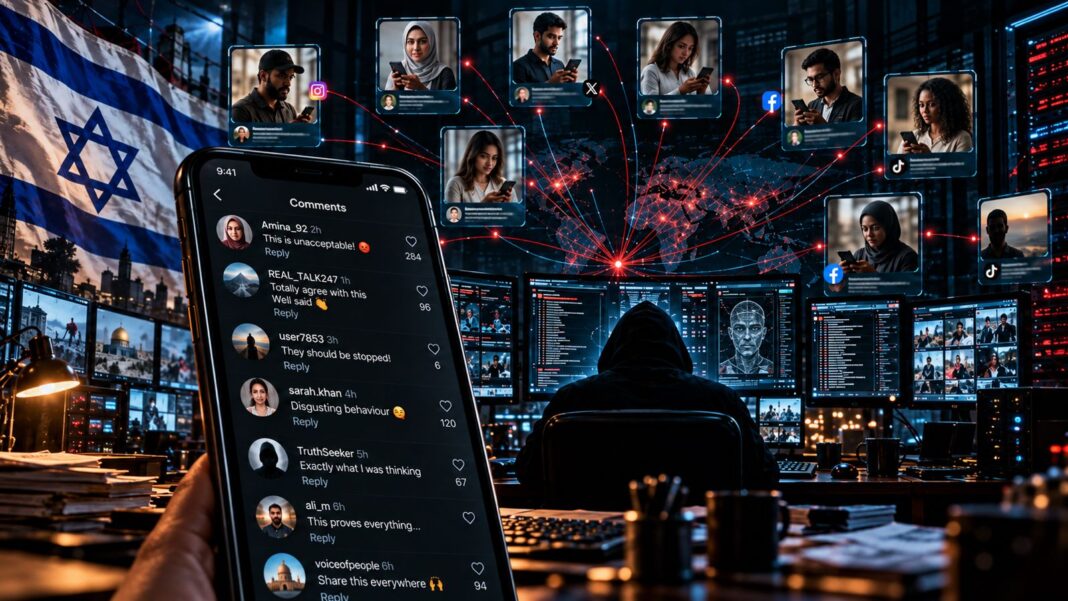

A sophisticated disinformation operation linked to an Israeli-based team has exposed how fake online identities can be made to resemble genuine users, raising wider questions about how technology can manufacture the appearance of public opinion, writes Neelam Rahim.
The operation came to light through a 2023 international investigation involving more than 100 journalists from 30 media organisations, coordinated by Forbidden Stories. The investigation exposed Team Jorge, an Israel-based disinformation operation led by Tal Hanan, and its Advanced Impact Media Solutions (AIMS) software, which was reported to control more than 30,000 fake social media profiles.
Moulana Ebrahim Moosa of the Palestine Information Network spoke to One Nation Media (ONM) about the wider disinformation industry and its relevance to South Africa, particularly amid what he describes as growing anti-foreign sentiment, Islamophobia and online disinformation.
“As part of our proactive research, advocacy and awareness mandate, we have been following with a vigilant eye the rise of the anti-foreign movement in South Africa, anti-foreign sentiment in South Africa, and particularly the explosion of disinformation and Islamophobia in the South African online space,” Moosa said.
“And where this sits essentially is at the coalface between global injustice and local manifestation of those injustices.”
Moosa said the research has also examined Islamophobia as part of the wider information environment surrounding Israel and Gaza.
“We’ve looked at Islamophobia in a global sense and have shown that it is an organised industry with very well-funded backing from a number of Zionist players, and that Israel as a state has clearly stated that it seeks to use Islamophobia as a deliberate rehabilitation or image rehabilitation strategy in the wake of its global image plummet as a result of the genocide in Gaza,” he told ONM.
He said the research subsequently turned towards understanding how disinformation is produced and distributed online.
“Given the importance of social media in shaping public opinion, as well as creating crises or maintaining crises, we wanted to go a bit deeper in understanding the global disinformation industry. What is the tech particularly at play?”
Moosa said the research identified a range of actors operating within the global disinformation industry, but highlighted what he described as the prominent role of Israeli actors.
“And while there are various global networks in disinformation, whether it is Western networks, whether it is Western PR firms, Russian PR firms, Indian PR firms, we particularly found that the state of Israel and players aligned to the state of Israel play a disproportionate role in this global industry.”
The 2023 investigation into Team Jorge provided a documented example of how sophisticated online influence operations can function. Reporters found that AIMS could create and manage fake profiles across platforms including Facebook, Twitter, Instagram, YouTube, Gmail and LinkedIn.
Some avatars were given detailed digital backstories, while investigators also found evidence that photographs belonging to real people had been used to create fake identities.
Moosa pointed to the investigation as an important example.
“And essentially what we have shared in our exposé is just the findings of existing journalism, particularly an international consortium of journalists in 2022-2023, [which] lifted the lid on something called Team Jorge.”
He cautioned against automatically assuming that the same actors were responsible for disinformation campaigns in South Africa.
“We are not saying that they are necessarily the players involved in South Africa’s disinformation space or similar players, but the parallels are quite clear and quite instructive for one to look into in trying to understand what is happening in South Africa.”
At the centre of the investigation was AIMS, which could generate seemingly authentic online identities and adapt them to different locations and demographics.
“This particular exposé put it down to an advanced Israeli software that was created by Team Jorge called Advanced Impact Media Solutions, or AIMS,” Moosa said.
“So you have the profiles created according to the regional requirements, they match the regional demographic, they steal the real pictures of people, people don’t know that the pictures are being misused, they create fake names, and they go on to generate local cell numbers and email addresses so that these accounts can be registered on social media.”
“Thereafter a local team would sculpt the talking points, it would use AI to create variations, and thereafter these bots would be let loose on various social media posts as would be deemed fit to be able to shape public opinion and create an aura or create the impression that there is huge traction on a particular issue, there’s huge public support for or against a particular issue,” Moosa explained.
The significance lies in the illusion of consensus. When multiple accounts appear to be independent users repeating similar messages, audiences may perceive a particular position as enjoying widespread public support even when the activity has been coordinated.
For Moosa, understanding the technology is therefore essential to making sense of the wider online environment in South Africa.
“The relevance of this information that we’ve put in the public domain is that these details now allow us to piece together the puzzle of what is happening in South Africa’s online space and the broader scheme perhaps at societal destabilisation in South Africa and other societies around the world.”
As social media increasingly shapes public discourse, distinguishing genuine public participation from manufactured engagement is becoming more difficult.
Behind a profile that appears authentic may be an identity created for a specific purpose. A photograph may belong to a real person with no connection to the account using it. And a coordinated network of seemingly independent users can make a particular narrative appear far more popular than it really is.