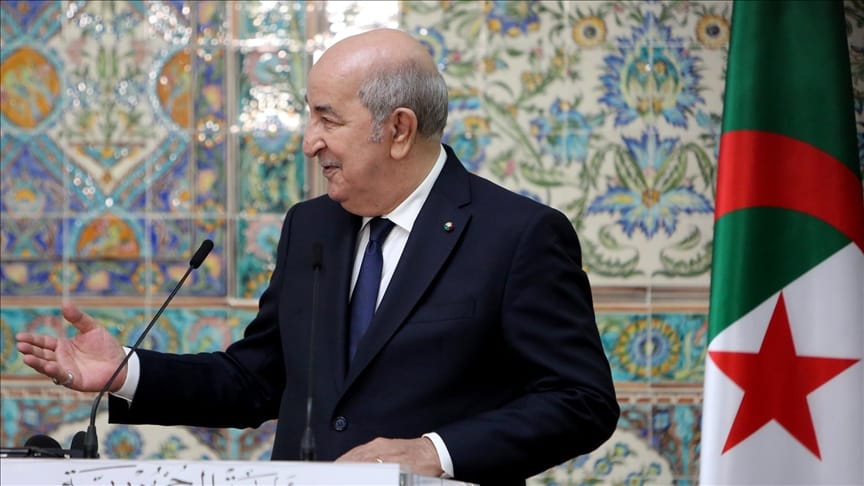

Algerian President Abdelmadjid Tebboune has signalled a subtle but significant shift in Algeria’s Sahel doctrine: Algiers is willing to intervene in Mali, but only if Bamako asks.
The statement reaffirms Algeria’s long-standing principle of non-interference while opening the door to a far more active role in a neighbourhood that Algiers increasingly sees as impossible to ignore.
“If Mali or Niger asks us to intervene, we will be there,” Tebboune told journalists over the weekend, adding that such action would be aimed at helping combat insurgent groups. He reiterated that Algeria remains committed to respecting state sovereignty.
The distinction matters. In Algiers’ framing, any future deployment would not amount to interference, but assistance requested by a sovereign state, allowing Algeria to preserve its doctrine while adapting to a changing security reality.
Why now?
Northern Mali remains volatile, with multiple armed groups active and the question of Azawad unresolved. Tebboune called for reason and dialogue to prevail over force, particularly regarding the Azawad Liberation Front (FLA), whose communities straddle the Algerian-Malian border.
But insurgency is not Algiers’ only concern. Drug trafficking is rising up Algeria’s security agenda, with authorities viewing revenue from criminal networks as a source of financing for weapons purchases and armed groups. For Algiers, disrupting those networks is increasingly a matter of national security.
Tebboune also pointed to what he described as the role of certain foreign powers in the emergence or expansion of insurgent groups in the Sahel, specifically mentioning MUJAO, the armed organisation whose activities previously spilled over into Algeria.
The message from Algiers is clear: crises in the Sahel can no longer be treated as distant threats.
A wider rivalry
For geopolitical analyst Djabire Marwan Ouédraogo, the shift is not driven by solidarity alone.
“President Tebboune is not proposing to activate his constitutional doctrine of external intervention out of pure Saharan philanthropy, but to counter the offensive of a bloc perceived as an existential threat to Algiers,” he argues.
Ouédraogo points to Morocco, the United Arab Emirates and Israel as actors Algeria believes are expanding their influence in the region, a dynamic Algiers increasingly views as detrimental to its strategic interests.
The Sahel, in this reading, is becoming a convergence point for several overlapping crises: counter-insurgency, border security, regional rivalries and competition for political and economic influence. Within that configuration, Mali, with its long and porous border with Algeria and an unstable north, occupies a particularly strategic position.
FLA pushes back
Algiers’ position has not gone unchallenged.
Within the Azawad Liberation Front, some officials argue that Tebboune’s position on Azawad’s demands sits uneasily with Algeria’s own stated commitment to self-determination.
“He reduced Azawad to Malian tribes with an extension into Algeria. Yet, regarding the Sahrawi question, he said that no one can impose on the Sahrawis a reality they do not want. So where is the principle of not imposing a reality that President Tebboune defends?” one FLA activist asked.
The criticism highlights the tightrope Algiers must walk: defending state sovereignty and negotiated political settlements while navigating its positions on autonomy and independence movements that are watched closely across the region.
What comes next?
The key question is how far Algeria is prepared to take this emerging posture.
The next visit by Malian leader Assimi Goïta to Algiers could provide greater clarity, both on prospects for dialogue with northern movements and on the concrete shape any Algerian security assistance might take.
For now, Algiers has changed the formula. Non-interference remains the stated principle, but intervention at the request of a neighbouring state is now firmly on the table.