
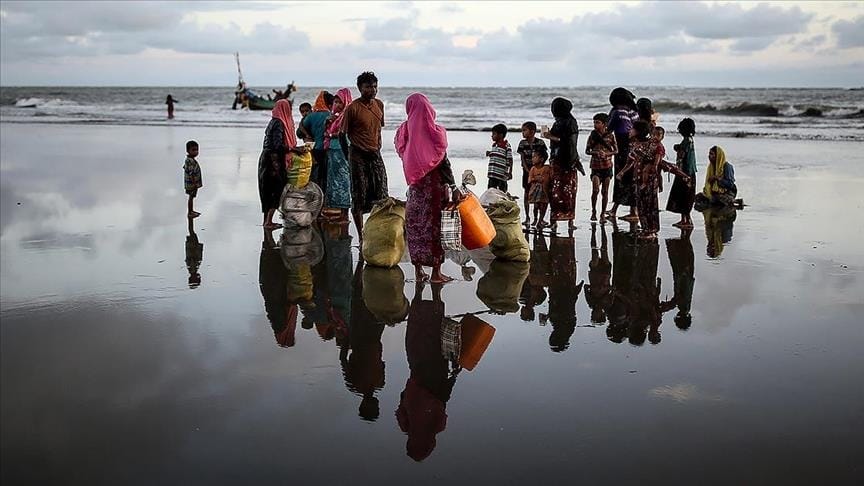

More than 500 Rohingya refugees are feared to have drowned in the Andaman Sea off Myanmar earlier this month. Yet the disaster passed with little international attention. There was no large-scale search-and-rescue operation and few global headlines.
For many observers, the tragedy reflects the continuing plight of the Rohingya, who remain among the world’s most vulnerable and displaced communities.
Nearly nine years after Myanmar’s military launched a brutal campaign that forced hundreds of thousands to flee Rakhine State, many Rohingya remain trapped in prolonged displacement. They are unable to return home, few countries are willing to offer them permanent refuge, and there is little certainty about their future.
The United Nations has confirmed that two boats carrying mainly Rohingya men, reportedly bound for Malaysia, sank off Myanmar’s coast earlier this month.
According to the UN, both vessels departed from Rakhine State in late June, with the journeys believed to have been organised by human trafficking networks.
One boat lost contact with the shore shortly after departing, while the second capsized around a week into the voyage. In recent weeks, bodies have begun washing ashore along Myanmar’s coastline.
Today, an estimated 1.2 million Rohingya refugees live across 33 overcrowded camps in Cox’s Bazar, Bangladesh, the world’s largest refugee settlement.
Most remain unable to return to Myanmar, where they face persecution and have been stripped of their citizenship. Opportunities for third-country resettlement are also limited, with relatively few nations accepting Rohingya asylum seekers or refugees.
Médecins Sans Frontières (MSF), which provides medical care inside the camps, described the situation starkly.
“After eight years in limbo in Cox’s Bazar, the humanitarian situation for Rohingya refugees remains untenable.”
Conditions inside the camps continue to deteriorate.
The United Nations says humanitarian funding for the Rohingya response, valued at more than US$700 million, has fallen by around a quarter. The shortfall has resulted in cuts to food rations and healthcare services, with an estimated 315,000 women at risk of losing access to maternal healthcare.
Education remains another major challenge. Approximately 235,000 children between the ages of five and 17 in Cox’s Bazar are currently out of school.
At the same time, armed criminal groups operating inside the camps have been linked to kidnappings, extortion and the forced recruitment of refugees.
With few legal pathways to safety and little hope of a better future, many Rohingya continue to risk dangerous sea crossings.
According to the UN High Commissioner for Refugees (UNHCR), around 5,300 Rohingya attempted perilous boat journeys during 2025. The agency described it as the deadliest year on record, with nearly 900 people losing their lives at sea.
Among those believed to have perished was 24-year-old Siraz Ullah, whose final voice message to his family was reported by The Guardian.
“Please pray for me and for all the passengers. We are risking our lives, but there is nothing else we can do. I can’t tolerate this life.”
After sending the message, Siraz boarded a boat in the hope of escaping the violence, persecution and hopelessness surrounding him in Myanmar.
His nephew, Mumtaz Ullah, said the family last spoke to Siraz on 22 June. Around that time, an initial attempt to leave had failed, forcing the boat to return before setting out again several days later.
“We don’t know whether he’s alive. Like many others, we are living in fear and uncertainty. It feels as if we’ve been torn into pieces.”
He added:
“We begged him not to go because we knew how dangerous it was, but he believed he had no other choice. This isn’t just the story of Siraz; it’s the story of many other Rohingya families.”
Despite the uncertainty, the family continues to hold on to hope.
“We still hope that Siraz is alive. We pray that one day he will come home.”
The United Nations has expressed growing alarm over the increasing number of Rohingya attempting dangerous crossings through the Bay of Bengal and the Andaman Sea, warning that without greater international action, more lives will be lost.
In a joint statement, the UNHCR and the International Organization for Migration (IOM) urged governments across the region to strengthen cooperation to prevent further tragedies.
“Stronger regional and international efforts are needed to prevent further loss of life along one of the world’s deadliest maritime routes,” the two UN agencies said.