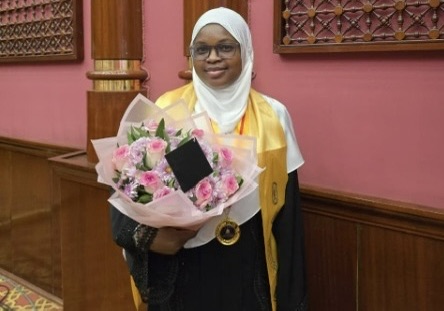

A 22-year-old Nigerian woman has made history at Egypt’s prestigious Al-Azhar University, emerging as the overall best graduating student in Islamic law in 2026. Her achievement is a powerful reminder of the longstanding tradition of female scholarship in Islam.
Sa’eedah Abdulazeez graduated with first-class honours from the Faculty of Shari’ah Law, achieving an outstanding score of 95.87%.
In Islam, the pursuit of knowledge is not merely a personal achievement but a responsibility encouraged among both men and women. For over a millennium, Muslim women have played an instrumental role in shaping, preserving and advancing Islamic scholarship.
She graduated with first-class honours from the Faculty of Shari’ah Law.
Through knowledge, individuals understand their religion, fulfil their responsibilities and contribute meaningfully to society. Yet the educated Muslim woman is often portrayed today as a product of modern liberation, despite the longstanding contribution of women to Islamic scholarship. What is often overlooked in these discussions, however, is the question of what constitutes beneficial knowledge and what Islam seeks to achieve through education.
A history of knowledgeable women in Islam
In today’s world, an educated Muslim woman is often associated with liberation and independence. However, Islam has long recognised women’s ability and right to acquire and impart knowledge.
The Prophet’s wife, Aisha bint Abu Bakr, acquired extensive religious knowledge from the Prophet ﷺ and, following his death, served as a teacher and guide to the Muslim community, narrating over 2,000 hadith. She lived for nearly 50 years after the Prophet’s death, during which time she remained a valuable source of religious knowledge for the Muslim community, and her house served as a school of religious learning.
In 859 CE, Fatima al-Fihri founded al-Qarawiyyin University in Fez, Morocco. It is recognised by the United Nations Educational, Scientific and Cultural Organization (UNESCO) and Guinness World Records as the world’s oldest continuously operating institution of higher learning. Her legacy demonstrates that Muslim women were not only acquiring knowledge but also establishing institutions through which generations could learn.
However, the rich history of female scholarship in Islam should not be used to justify every modern conception of female education. There is a distinction between encouraging women to acquire knowledge and accepting the objectives that modern society has set for their education.
Mufti Usamah Dockrat of the Guardian Institute’s research department says Islam encourages the pursuit of knowledge but also emphasises its purpose and benefit.
“Whilst Islam encourages the pursuit of knowledge, the Prophet ﷺ would also supplicate, ‘O Allah, I seek refuge in You from knowledge that brings no benefit.’ This teaches us that not all knowledge is equally desirable for everyone.
“Knowledge that is beneficial to one person may not necessarily be beneficial or relevant to another. Likewise, what a man may need, a woman may not, and vice versa,” he said.
Education beyond economic independence
Today’s discussions about women’s education are often centred on financial independence, employment and participation in the economy.
From the perspective of the modern state, there is an economic incentive to educate as many people as possible for the workforce. The more people earning taxable incomes, the greater the state’s potential tax revenue. However, what serves the economic interests of the state does not necessarily serve the interests of the individual, the family or the wider Muslim community. A woman’s contribution to society cannot be measured simply by her ability to earn a taxable income.
Mufti Dockrat argues that contemporary education also raises questions about the values and environments in which Muslim students acquire knowledge.
“Universities are ideological battlegrounds where competing worldviews, values and conceptions of life are contested. We need to seriously consider what we stand to lose in the pursuit of a professional qualification,” he said, adding that these concerns apply to both men and women.
This becomes particularly concerning in the absence of adequate Muslim educational institutions. Besides the religious concerns associated with mixed-gender environments, Muslim students are exposed to ideas that may change their understanding of Islam, their responsibilities and what they aspire to achieve in life.
He also questions the assumption that every woman must acquire a professional qualification in order to earn a living.
“As Muslims, we need to question that assumption rather than simply attempt to accommodate it within an Islamic framework.”
Islam does not prohibit women from earning an income or managing their own wealth. However, the permissibility of pursuing a particular profession does not necessarily mean that preparing for it should be a priority in a woman’s education. Mufti Dockrat highlights that Islam places the financial responsibility of maintaining a family upon men rather than women.
“There are, of course, exceptional circumstances in which a woman may need to earn a living, and there are genuine communal needs for women in certain professions,” he said.
“However, we cannot build our entire approach to female education around exceptional circumstances. Even where a need exists, it must be a real need, and we must recognise the cost at which meeting that need may come, particularly in terms of religious commitments, marriage, family life and the upbringing of children.”
The value of women’s contribution to society
Whilst professional achievements are often celebrated as a measure of women’s progress, far less recognition is given to the knowledge, skills and sacrifices involved in nurturing children, building strong families and passing religious and moral values on to future generations.
“No society can function without the roles traditionally fulfilled by women. The nurturing of children, the formation of their character, the preservation of the family and the transmission of religious values are not secondary responsibilities. They are fundamental to the future generations of the Ummah,” Mufti Dockrat said.
He also challenges the argument that daughters should be prepared for a career so that they can financially support themselves if their marriages fail.
“We spend years preparing our daughters for the possibility of their marriages failing, while investing comparatively little in preparing them to become good wives and mothers.
“Surely our primary concern should be building strong and stable families rather than organising the upbringing of our children around the possibility of their breakdown.”
There is a danger that this becomes a self-fulfilling prophecy. In preparing young people for the possibility of their marriages failing, we may neglect the very education and upbringing that could help them build successful marriages.
Addressing modern feminism, Mufti Dockrat argues that professional achievements have increasingly become the measure of a woman’s worth, whilst traditional family roles are undervalued.
“One of the greatest disservices of modern feminism has been to undermine the value attached to the traditional roles of women. It has created a culture in which a woman is celebrated for her professional achievements but feels the need to justify her decision to devote herself to her home and children.
“We have allowed the marketplace to become the measure of a woman’s contribution to society,” he said.
The question is not whether Muslim women should be educated but what knowledge they should acquire, for what purpose and at what cost. Islam’s history demonstrates that knowledgeable women have always had a place in shaping Muslim society.
Rather than allowing modern society to determine the objectives of education and then attempting to reconcile them with Islam, Muslims should look to Islam itself to determine their educational priorities. A woman’s education should be valued for the benefit it brings to her religion, her life, her family and the wider Ummah, irrespective of whether it enables her to earn an income.