

MYTH THREE, PART ONE: Beyond the slogan of “separation”
As South Africans head to the polls in today’s municipal elections, we will hear the reassuring explanation that secularism simply separates religion and the state. It sounds tidy: each stays in its lane, nobody interferes with anybody else, and everyone goes home satisfied. But lanes do not paint themselves. Somebody draws the lines, decides which activities belong in which lane, and determines what happens when the boundaries are crossed. That is where the serious question begins, writes Moulana Uwais Dockrat.
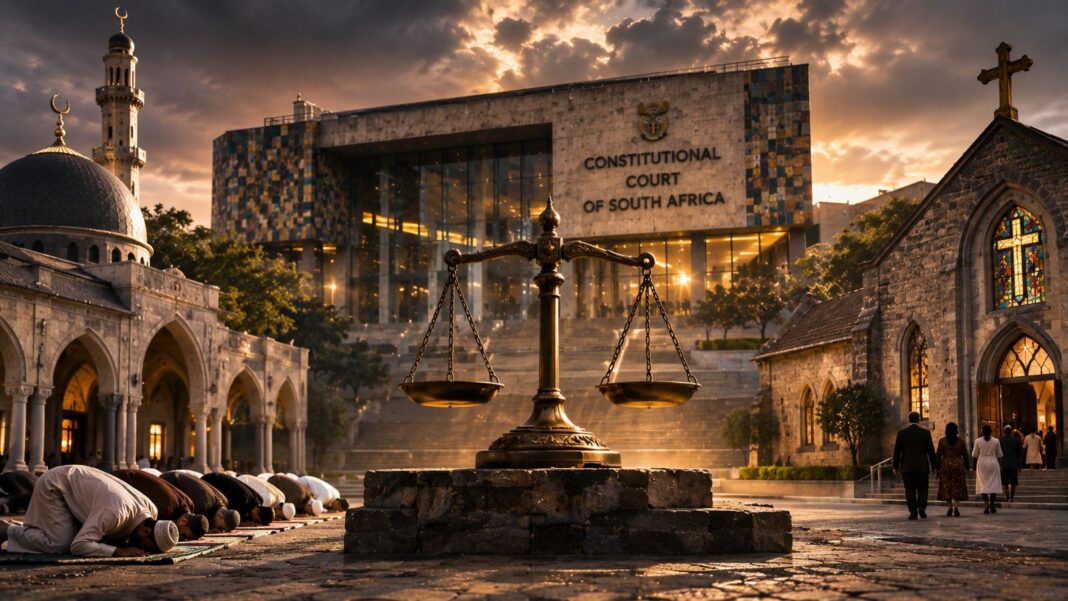
My argument is that secularism does more than separate: it places religion under a superior public authority. Two processes deserve examination. The first is subjugation, where the state determines religion’s permissible scope. The second, which I will address in the next article, is the reconstruction of religion into a form compatible with secular governance. Subjugation itself operates in three distinguishable ways, and South African examples make them impossible to dismiss as abstractions.
First, the state decides what counts as “religion”. South Africa’s education policy does not permit Islam, or any other religion, to be taught as objective truth in public schools, classifying this as religious instruction. Yet the same government introduces ideas about gender identity associated with transgenderism and queer theory through educational materials, presenting them as education.
These ideas are themselves rooted in a particular worldview, with philosophical assumptions about human nature, sex and gender that are far from universally accepted. So why does the state get to decide that Islam is religious, while transgenderism is not? Who gave it the authority to make that distinction? The question is simple: who gave the state the authority to decide which worldview is religious and which is supposedly neutral?
Second, the state decides what qualifies as “religious” in a particular dispute. In Strydom v Moreleta Park, a church ended the contract of a music teacher because of his same-sex relationship. The school explained that he was not merely a music teacher but was also responsible for the spiritual leadership of the learners. In 2008, the Equality Court held that the teacher was not performing spiritual leadership duties and that the termination constituted unfair discrimination. Notice the structural fact: a civil court evaluated the church’s claim about religious responsibility and decided how far it could extend. So, in essence, the government decided that teaching does not have a spiritual dimension and is not a religious act. Whether one agrees with the outcome is separate from recognising who held the deciding authority.
Third, the state determines which religious practices it will permit when they conflict with general law. In Christian Education South Africa v Minister of Education, the Constitutional Court refused an exemption from the prohibition on corporal punishment in independent Christian schools, despite the religious convictions advanced by parents and schools. Likewise, during the 2020 COVID-19 restrictions, Muslim applicants were unsuccessful in seeking permission for limited congregational mosque prayers. Again, the issue is to identify which authority ultimately decided the limits of a religious practice.
And as followers of Islam, we understand that Islam has financial, legal and other dimensions that we are unable to practise. So we need to be much more careful when we claim we have absolute religious freedom.
South Africa’s Constitution expressly guarantees religious freedom. However, a right recognised within a constitutional framework remains subject to that framework. Section 31 itself protects communal religious practice while requiring consistency with the Bill of Rights. This is a legal hierarchy, not a partnership of equal sovereigns.
For Muslims, the concern is theological before it is tactical. Islam does not teach that Allah’s guidance ceases to matter whenever a question becomes public, economic or legal. The state may have the practical power to regulate our institutions; that does not establish that its worldview is the final measure of truth. We can recognise legal reality without turning it into religious legitimacy.
As South Africans cast their votes, let us replace the soothing slogan of separation with three better questions: who defines religion, who determines what is religious, and who decides which religious acts are allowed? Once those questions are answered, the architecture of subjugation becomes visible. The next question is what happens when the state does not merely limit religion, but helps produce a more manageable version of it.


