
For more than 200,000 South Africans reportedly awaiting cataract surgery, deteriorating eyesight can mean losing far more than vision. It can mean losing a livelihood, independence, the ability to read and even the simple joy of seeing a grandchild’s face.
With public hospitals struggling to clear the backlog and private surgery beyond the reach of many families, Muslim humanitarian organisations are increasingly stepping in to fill the gap, funding operations, supplying medical equipment and working alongside state hospitals to restore sight to patients who might otherwise wait months or even years.
“There are over 200,000 cataract patients waiting for surgeries in the country. The backlog is very high, and public hospitals alone are unable to provide treatment to these patients on time,” Nadeem Ahmed, Project Manager Cataract at the Islamic Medical Association (IMA), told One Nation Media.
Across Gauteng, KwaZulu-Natal and the North West, as well as through similar initiatives elsewhere in Africa, Muslim charities are turning humanitarian service into something patients can experience firsthand: the restoration of sight, independence and hope.
South Africa is currently marking Eye Care Awareness Month, while cataracts remain a leading cause of avoidable blindness across Africa.
These charitable initiatives do not replace the work of the state, but they provide crucial relief to communities facing lengthy public-sector waiting lists or unable to afford private treatment.
50 operations in one day
On 8 October, as part of activities marking World Sight Day, the Gift of Sight Programme partnered with IMA Durban and the Caring Sisters Network (CSN) to provide 50 free cataract surgeries in a single day at McCord’s Provincial Eye Hospital in Durban.
In the North West, the Al-Imdaad Foundation’s Vision 4 Life team, working in partnership with Job Shimankana Tabane Hospital, conducted a series of sight-restoring operations at Moses Kotane Hospital.
“The main aim is to help address the significant backlog of patients awaiting cataract surgeries and to thereby impact the fight against preventable blindness,” Hamza Badrudeen of the Al-Imdaad Foundation told One Nation Media.
“Many health institutions face severe challenges in terms of available resources for cataract programmes, and this adds further delay to the process. The support we offer covers certain drugs, medical consumables, and logistical support to ensure effective delivery of significant numbers of surgeries within a short time frame.”
Further afield, the Rumah Foundation has provided cataract surgery and community eye screening in Nigeria for patients with limited financial means.
A model that works on weekends
For Ahmed, the work being undertaken in Gauteng demonstrates what an effective public-private partnership can achieve.
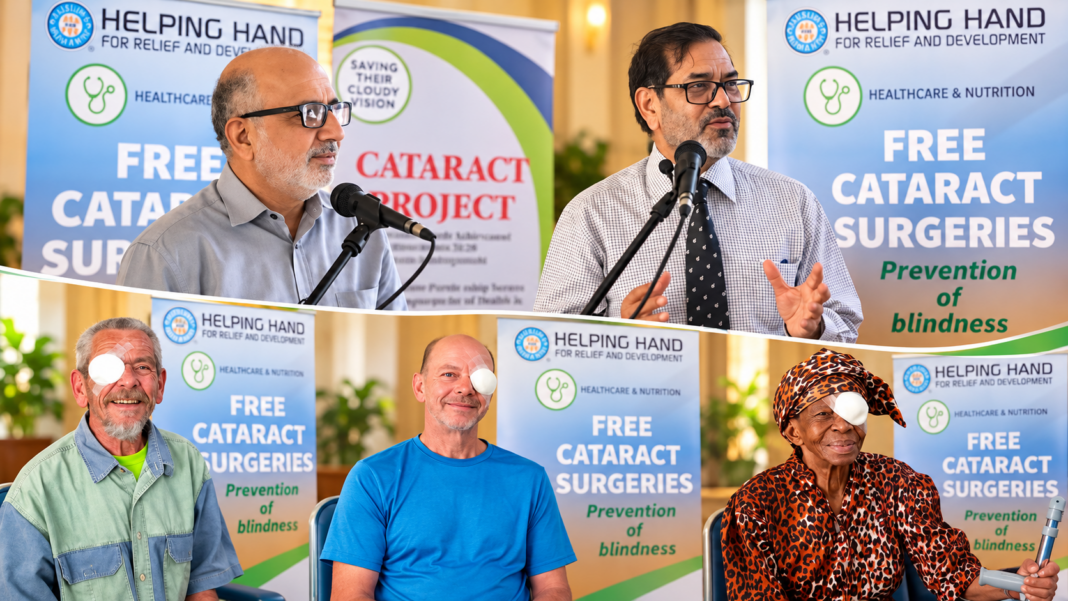
“This is a public-private partnership program between the Gauteng Department of Health and the Islamic Medical Association of South Africa. We have been running this project smoothly since 2005 and have successfully performed 15,004 free operations to date,” he said.
“We call it the Weekend Cataract Project; our model is to work over the weekend. We have done all these operations on Saturday and Sunday. Currently, 8 hospitals in Gauteng regularly perform cataract operations each month. At least one cataract camp every month. We think this is a successful public-private partnership model.”
The initiative demonstrates how volunteer medical professionals, charitable funding and existing public hospital infrastructure can work together to expand access to essential eye care.
For Badrudeen, financial hardship should never be the reason someone loses their sight.
“This was a key consideration since many patients are unable to access the care they need in the public sector or to afford private care. Financial barriers and accessibility should not be the reason that cataract patients lose their vision,” he said.
Faith expressed through service
For the Muslim organisations involved, the work carries both medical and spiritual significance.
The Prophet Muhammad ﷺ said in a hadith recorded in Sahih al-Bukhari (5653) “Allah said, ‘If I deprive my slave of his two beloved things (i.e., his eyes) and he remains patient, I will let him enter Paradise in compensation for them.’”
Against that backdrop, helping restore a person’s sight becomes more than a medical intervention. It can return independence to an elderly patient, allow a breadwinner to work again, ease the burden on a family and restore someone’s ability to read, move freely and participate fully in daily life.
“Our main purpose is to serve communities. Humanitarian work is a part of Islam. Religion teaches us to serve, help, and look after those who are in need,” Ahmed said.
“We don’t face any anti-Muslim issues in our country. This is a beautiful country, as Mandela said, ‘a rainbow nation’. We found that communities in SA respect all religions and all cultures. We did not see any discrimination.”
Badrudeen said humanitarian service could also become a form of dawah through conduct rather than words, demonstrating Islamic values through compassion, generosity and service to wider society.
“We always believe that our work can be a form of soft dawah through akhlaaq and service to creation. We remain neutral, apolitical, and focused on humanitarian efforts, but inshaAllah we do believe that these efforts can be an insulation against the rising tide of Islamophobia.”
He added that there was considerable scope to expand the initiative through partnerships with international donors and NGOs specialising in eye care, including large-scale cataract camps similar to those undertaken in 2019 and 2020.
As Eye Care Awareness Month draws attention to the importance of protecting and restoring vision, these initiatives demonstrate what can be achieved when Muslim charities, medical professionals and public hospitals work together.
Beyond the operating theatres and statistics, their impact is measured in the lives of people who regain something many take for granted: the ability to see.
For patients who can once again recognise a loved one’s face, return to work or navigate daily life independently, the benefits extend far beyond the restoration of eyesight.
One patient, one pair of eyes and one life transformed at a time.