
There was a time when Muslim organisations approached participation in secular democratic politics with caution. Voting was not presented as something inherently virtuous. Those who permitted it did so as an exceptional measure: the lesser of two evils, a temporary concession or a strategic intervention intended to prevent greater harm, writes Mufti Usamah Dockrat.
That distinction mattered. It preserved the difference between engaging with a political system and believing in it, identifying with it or accepting its underlying assumptions.
Today, that distinction is steadily disappearing.
What was once defended as the lesser of two evils is increasingly described as a “civic responsibility”. What was previously tolerated under exceptional circumstances is now presented as a noble act. Political participation is no longer framed as an undesirable engagement with an existing order. Instead, Muslims are encouraged to see themselves as stakeholders in that system, morally and religiously responsible for sustaining it and participating in its processes.
This is more than a change in terminology. It reflects a deeper transformation in how Muslims are being taught to understand themselves, their religion and their relationship with the secular states in which they live.
When participation becomes the objective
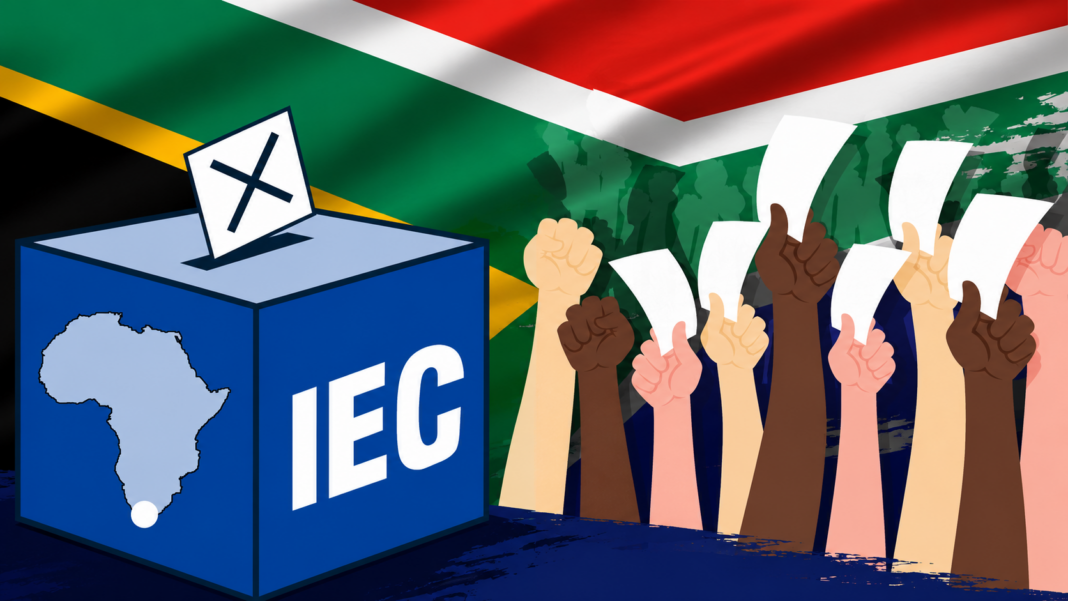
A recent voter registration campaign led by several prominent Islamic organisations in South Africa illustrates this shift.
Its messaging does not advocate a specific strategic intervention. It does not identify a particular threat that must be prevented, an Islamic interest that must be protected or even a political party or candidate whose support might produce a measurable benefit.
Instead, participation itself has become the objective.
The language employed reveals a profound tension between two competing identities and sets of loyalties. Those advancing this agenda speak as Muslims and employ Islamic terminology, while simultaneously speaking as citizens of the state and repeating the language of civic duty, democratic participation and responsibility towards the political system.
Rather than confronting the tension between these competing claims, they merge them into a hybrid identity. Responsibilities owed to the Ummah are redirected towards a new political identity. Obligations assigned by the secular state to its citizens are repackaged as Islamic duties.
Loyalty to the political order is expressed in Islamic terms, while the duty of the citizen becomes an amānah before Allah and participation in state institutions is portrayed as an act of religious virtue.
Such a synthesis does not resolve the contradiction. It merely conceals it beneath Islamic vocabulary while subordinating Islamic identity to national identity.
The result is a secularised understanding of Islam in which the religion is affirmed, but the secular state is accepted as the unquestioned framework within which political life must operate.
Islam reduced to private religion
This framing is particularly significant because many Muslims today no longer possess a clear understanding of Islam as a complete way of life with its own political framework.
Islam has increasingly been reduced in the public imagination to personal worship, morality, charity and private spirituality. Politics is treated as a separate, secular sphere belonging naturally to the state, while Islam is expected to operate quietly within whatever boundaries the state permits.
Within such an understanding, there appears to be little contradiction in describing participation in the existing political order as an Islamic responsibility. Islam has already been stripped of its political dimension, allowing it to fit comfortably within another system.
Yet Islam is not merely a private religion seeking accommodation within a secular political framework. It contains principles relating to government, law, economics, social organisation, public morality and international relations.
It addresses questions of authority, legislation, justice, taxation, wealth, war, peace and the responsibilities of rulers. It does not merely advise individuals on how to behave within political systems created by others; it presents its own comprehensive vision of society.
Islam and the modern secular state therefore make claims over many of the same areas of life. Both address law, authority, public order, collective identity and the organisation of society.
The state does not confine itself to repairing roads, supplying water or collecting refuse. It determines what is lawful and unlawful, defines citizenship, controls education, regulates the economy, structures family law, determines political legitimacy and demands loyalty to the nation.
Islam likewise makes claims regarding these same matters.
When Muslim organisations describe participation in the secular order as an uncomplicated civic responsibility, without explaining Islam’s own political claims, they reinforce the notion that the modern secular state is the natural and unquestionable framework of political life.
Islam is then reduced to a source of personal ethics operating within that framework — little more than a religious department inside the secular state. Its function is no longer to offer an alternative conception of politics, law and society, but to supply moral language in support of duties already defined elsewhere.
Permission is not ideological endorsement
Permitting engagement with a system does not necessarily mean embracing it. Using an institution out of necessity does not amount to affirming its legitimacy.
A Muslim may enter a secular court to recover property without accepting the legitimacy of that court. Likewise, even where electoral participation is regarded as permissible under certain circumstances, that permission cannot automatically be transformed into religious praise for democratic participation itself.
One could at least understand an argument that Muslims should make a coordinated electoral decision to achieve a clearly defined objective: preventing a harmful policy, protecting an important institution, securing relief for an oppressed community or advancing a specific Islamic interest.
Such an argument would still need to be assessed according to its evidence, conditions, likely consequences and required compromises.
But this is not what is currently being proposed.
The organisations involved explicitly refuse to endorse any political party or candidate. They offer no substantive guidance on what Muslims should support, which policies should influence their decisions or what concrete outcome the campaign seeks to achieve.
Muslims are simply encouraged to register and participate.
Participation therefore ceases to be a means towards an Islamic objective. Participation itself becomes the objective.
This raises a difficult question: what meaningful role are these organisations performing beyond assisting the state in increasing voter registration?
They are not directing a coordinated Muslim voting bloc. They are not extracting commitments from political parties, establishing non-negotiable principles or identifying the policies that undermine the community’s interests.
Instead, they reproduce the state’s own messaging using the language of their congregations.
In doing so, they risk functioning less as independent representatives of the Muslim community and more as intermediaries communicating the priorities of the state to that community.
Political participation without political power
Meaningful political engagement begins with fundamental questions.
What are we trying to achieve? What are the limits? What concessions are being made? Which Islamic interests are being served? How will success be measured? At what point does tactical participation become ideological assimilation?
Political power is not created merely by placing a mark on a ballot paper. A community possesses influence when it has organisation, leadership, clarity, leverage and the capacity to act collectively.
An unorganised population voting individually for competing parties, without shared demands or strategic direction, cannot reasonably be described as politically empowered.
The assertion that Muslims can gain influence only by participating in the existing political system must also be challenged. South Africa has numerous examples of organisations and movements that exert significant pressure on the government without becoming part of formal party politics.
Political influence can be exercised through organised advocacy, public mobilisation, litigation, institution-building, economic pressure and sustained engagement with those in power. Electoral participation is only one possible instrument and should not be confused with political power itself.
The consequences for future generations
Perhaps the most significant consequence of this changing language is its impact on future generations.
Young Muslims may never encounter the earlier caution. They may never hear that electoral participation was once debated as an exception, a compromise or the lesser of two harms. Instead, they may hear only that democratic participation is an amānah and a civic duty.
More significantly, they may grow up without ever learning that Islam possesses its own political vision.
Islam may come to be understood merely as a source of moral encouragement for participation in secular politics rather than as a complete way of life with its own understanding of authority, law and society.
Within a single generation, what was once reluctantly tolerated can become an unquestioned ideal, while the original compromise is forgotten altogether.
This is how political assimilation often occurs — not through an explicit declaration that secular democracy has replaced Islam, but through the gradual rearrangement of loyalties, identities and concepts.
Muslims deserve more than slogans borrowed from election campaigns and repackaged as religious guidance. They deserve honesty about the nature of the political system, the limits of participation and the distinction between navigating political realities and identifying with them.
They also deserve clarity about the identities and loyalties being invoked.
In the absence of an Islamic polity, Muslims may find themselves living as citizens of modern nation-states. But that does not necessarily mean every civic obligation imposed by the state becomes a religious amānah.
Islamic terminology should not be employed to obscure the demands of another political ideology.
Islam is not merely a collection of values intended to produce better citizens for the secular nation-state. It presents itself as a comprehensive system with its own claims regarding politics, law, economics and public life.
A compromise should remain a compromise.
A temporary measure should remain temporary.
And something permitted because of necessity, harm reduction or strategic benefit should never be transformed into a creed.
Author’s note: This article does not assess whether current circumstances justify voting as a concession. It simply observes that the earlier position, even where disputed, maintained voting’s original impermissibility and treated any permission as exceptional. The concern expressed here is that contemporary language represents a significant shift in which that earlier understanding is gradually being forgotten.
Maulana Usamah Dockrat is an Islamic scholar who graduated from Jami’ah al-Ulum al-Islamiyyah in Johannesburg.