
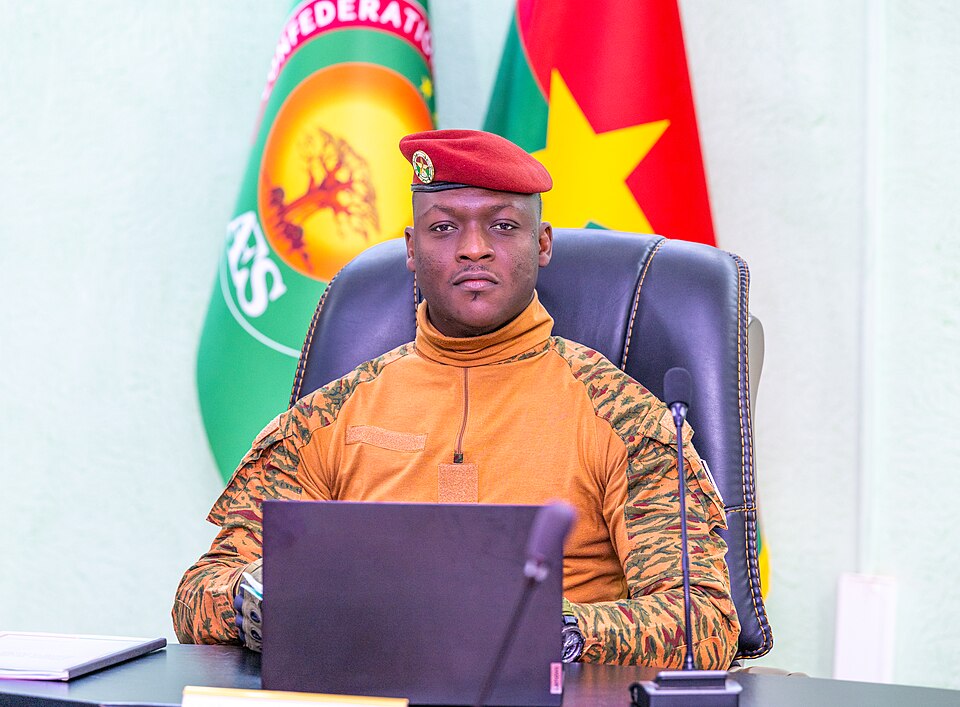

An al-Qaeda-linked armed group has accused Burkina Faso’s president, Ibrahim Traoré, of waging war against Islam and called on Muslims to join its insurgency, escalating a growing battle over religious legitimacy in the Sahel nation.
The intervention by Jama’at Nusrat al-Islam wal-Muslimin (JNIM) comes amid heightened tensions between Traoré’s military-led government and sections of the country’s Muslim community, raising fears that the group is seeking to exploit religious grievances to weaken the state and widen its support base.
In a video statement distributed through its usual communication channels JNIM accused Ibrahim Traoré, of waging war against Islam and urged Burkinabè citizens to join its insurgency.
The message was delivered by Almousana Abou, whom the group identified as one of its military commanders.
“We are making a solemn call on you to mobilise for the cause of the Muslim religion. As you have seen, Ibrahim Traoré has committed himself to fighting Islam. We will not accept Islam being uprooted.
“Religion comes before everything else. We will remove all obstacles in our way in order to bring all Burkinabè to join jihad very soon,” he said.
The statement appears to mark an attempt by JNIM to shift part of the conflict from the battlefield to the realm of ideas, portraying its insurgency as a defence of Islam while seeking to undermine the legitimacy of Burkina Faso’s military-led government.
Targeting government-aligned fighters
As Burkina Faso continues to battle armed groups, the government has increasingly relied on the Volunteers for the Defence of the Homeland (VDPs), a civilian auxiliary force established to support the national army.
The VDPs have become central to the country’s counterinsurgency strategy, making them a key target of JNIM propaganda.
In its latest message, the group sought to persuade VDP members that they were fighting fellow Muslims rather than “extremist” organisations.
“The VDPs mobilised alongside the government are Muslims who are not only fighting their own brothers, but also Islam.
“They must realise that their weapons are not aimed at unbelievers, as the authorities claim, but at defenders of Islam,” Almousana Abou said.
Analysts say such messaging reflects an effort to exploit religious identity and social divisions in order to weaken support for the state and encourage defections from pro-government forces.
Deepening divisions
According to security sources, JNIM is also attempting to influence individuals close to the authorities in an effort to create internal fractures within the country’s political and security structures.
Similar tactics have previously been observed in neighbouring Mali, where the group repeatedly appealed to political, religious and community figures to distance themselves from the military authorities.
While the effectiveness of these campaigns remains difficult to assess, observers say JNIM is increasingly using strategic communication alongside armed operations to shape public opinion and erode confidence in state institutions.
Religious leaders distance themselves
Less than 72 hours after JNIM released its statement, calls for demonstrations against Burkina Faso’s authorities began circulating on social media.
Concerned about being associated with the protests, several religious leaders publicly distanced themselves from the mobilisation efforts.
The Association of Sunni Movements in Burkina Faso, led by El Hadj Oumarou Zoungrana, rejected the online calls for demonstrations.
Some observers believe the government’s approach to religious affairs will require careful management to avoid inadvertently strengthening insurgent narratives.
A Burkinabè citizen, who spoke on condition of anonymity, warned: “The military regime in Burkina Faso must manage its dispute with some Sunni Muslim communities with great caution. What may appear today as a simple control measure could quickly become an opportunity exploited by JNIM.”
As the conflict evolves, Burkina Faso appears to be entering a new phase in which the contest over narratives, religious legitimacy and public perception may prove as significant as the fighting on the ground.