
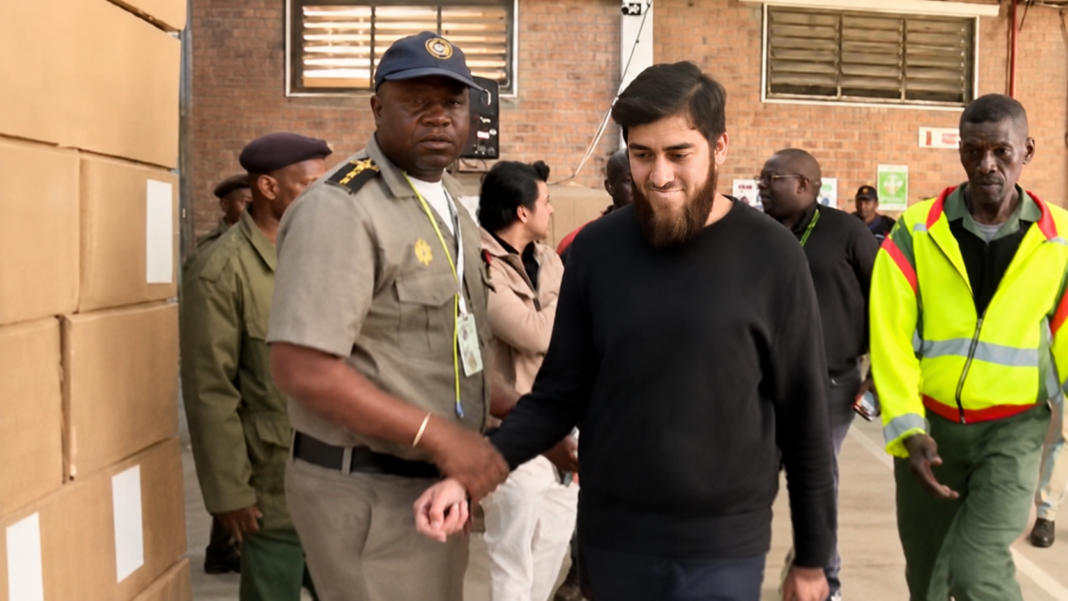

Korteks factory owner Khabir Tayob recounts how a routine government compliance inspection descended into what he describes as a humiliating, media-driven spectacle that publicly portrayed him and his family as criminals before they had been given a fair opportunity to respond.
On the morning on Friday 24 July, I dropped my son off at school, came home, got ready and went to work like any other normal day.
At 9am, we met with an important prospective customer from abroad. The meeting went extremely well. We toured the factory and, at around 10am, my brother Qadeer and I walked our guest to the gate.
As he was leaving, a Home Affairs vehicle arrived. Within seconds, SAPS vehicles pulled in and blocked the entrance. Nobody was allowed to enter or leave our premises.
Because our guest was a foreign national, he was stopped and treated as though he might have been working illegally at our factory. We had to prove that he had entered South Africa only the previous day and was visiting us for business purposes. After approximately 20 minutes, he was eventually allowed to leave.
We immediately knew that something serious was happening.
Officials from SAPS, Home Affairs and the Department of Employment and Labour entered our factory. Eventually, more than 30 government officials, along with members of the news media, were present on the premises.
We cooperated from the outset.
We told the officials that they were welcome to inspect the factory and that we would provide whatever assistance they required.
Some of the Labour Department officials were professional and fair, as they usually are when conducting inspections at our factory.
Then everything changed.
Compliance concerns identified
Home Affairs identified six Lesotho nationals working in our cut, make and trim department.
At the time, management believed these employees were legally entitled to work in South Africa based on the asylum documentation they had presented when they were employed, together with evidence that applications for work authorisation were pending.
Following the inspection, we were informed that this understanding was incorrect.
We accept that.
Where we are wrong, we will correct it.
However, what happened next went far beyond addressing a compliance matter.
Two deputy ministers suddenly arrived, accompanied by more members of the media whom we had neither invited nor permitted to enter our premises. We asked them repeatedly to leave because they were trespassing on private property.
We repeatedly told the camera crews and reporters that we did not consent to being recorded or photographed.
We continued cooperating with government officials, but everywhere we turned, there were cameras in our faces.
We were pulled from one side of the factory to another and threatened with being locked up while the cameras continued rolling.
At one point, two Home Affairs officials held me by the arms and escorted me through my own factory towards a police vehicle, in full view of my employees and the media.
We were not given a fair opportunity to respond to the allegations being made by the ministers on national television. They acted as judge, jury and executioner on the spot.
Before we had been given an opportunity to be heard, we were already being publicly portrayed as criminals.
One moment, we were hosting an international customer. The next, I was being escorted through the factory on live national television.
Treated like a criminal
I was placed inside a police vehicle without having my rights read to me and was denied access to legal representation.
I remained inside the police vehicle for approximately 45 minutes while officials and camera crews moved freely throughout our factory, recording unauthorised footage of confidential production processes on private property.
While sitting inside the vehicle, I was informed that the media was broadcasting the footage live on national television and across various online platforms.
What made the situation even more alarming and distressing was that this was taking place in front of two deputy ministers and SAPS officers, who are sworn to protect the rights of every South African, irrespective of race, religion or ethnicity.
I cannot properly describe the humiliation of sitting inside a police vehicle like a common criminal, outside the very factory that my family and I have spent years building, while the entire country watched this planned spectacle unfold like a scene from a movie.
Our employees could see us.
Our customers could see us.
Our families could see us.
Because of this prearranged publicity stunt, the public had already formed an opinion before we had been given any meaningful opportunity to respond.
I was later taken to the police station.
At the station, I was initially told that my only options were to pay an admission-of-guilt fine of R10,000 per person or have a docket opened and appear in court on Monday.
My lawyer was present at the station, but I was still not permitted to consult with him.
Enforcement without humiliation
Where legitimate compliance issues exist, we will address every one of them. We will accept responsibility where we were wrong, improve our systems and ensure that any shortcomings are corrected.
The government has a responsibility to enforce the law.
We accept that completely.
However, enforcement should never mean humiliation.
It should never mean turning a compliance inspection into a live television spectacle.
It should never mean publicly destroying the reputation of a business that has operated for more than 30 years before its owners have been given a fair opportunity to respond.
Korteks employs more than 220 people, the overwhelming majority of whom are South African.
We have invested years of our lives in the local textile manufacturing sector. We manufacture goods, create employment, develop skills and fight every day to keep South African manufacturing alive.
On Friday, it felt as though none of that mattered.
Within hours, Korteks and Zaydtex were trending for all the wrong reasons. Allegations were broadcast nationally before management had been given a fair opportunity to verify them, respond or provide context.
I am not asking anyone to excuse wrongdoing.
I am asking a simple question:
Can the government enforce the law while still treating South African businesses and citizens with fairness, dignity and respect?
After my experience on Friday, I am no longer sure.
Why were the owners of a business prevented from moving freely around their own factory while television crews, who had entered our private premises without permission or consent, were allowed to move freely and continue filming?
If there is a lawful explanation, I would genuinely like to understand it.
Whether we were right or wrong on a compliance matter is one issue.
The way we were publicly treated before being given a fair opportunity to respond is another.