
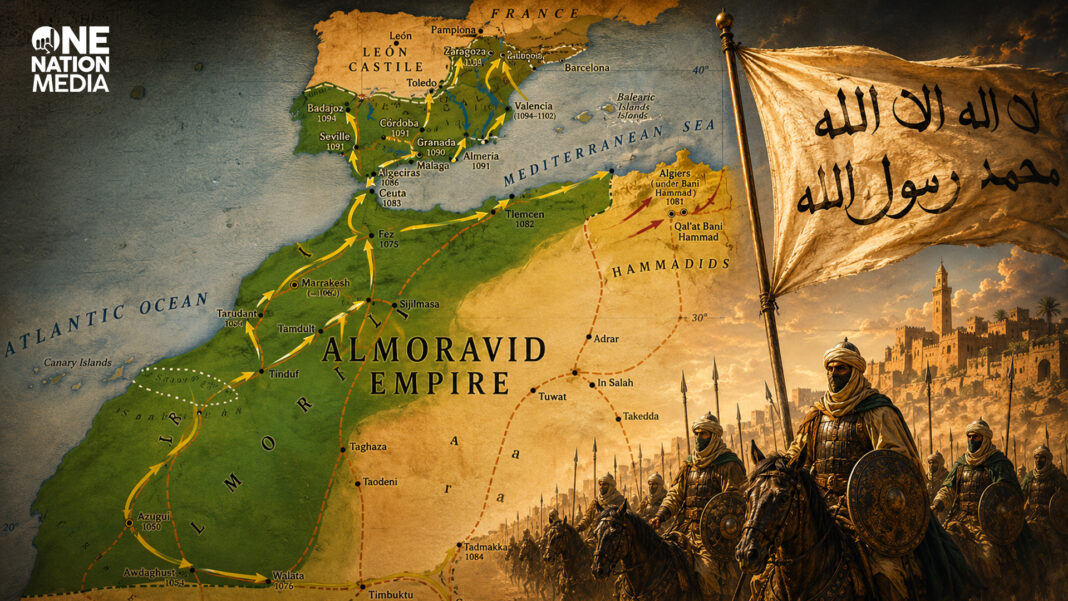

The story of the Al-Murabitun, known in English as the Almoravids, is one of the most remarkable chapters in the history of the western Islamic world. Rising from the harsh landscape of the Sahara, they began as a disciplined reform movement before becoming an empire that unified much of North Africa, defended Al-Andalus and reshaped the political, religious and commercial order of the region, writes Neelam Rahim.
At their height, the Al-Murabitun controlled territory across present-day Morocco, parts of Algeria, Mauritania and Spain. Their power rested on a fusion of Islamic reform, military discipline, tribal unity and control of the great trans-Saharan trade routes that linked West Africa to the Mediterranean.
The Al-Murabitun emerged in the early 1040s among the Sanhaja Berber tribes of the western Sahara. Their rise was closely linked to the teachings of the scholar Abdallah ibn Yasin, who called for a return to strict Sunni orthodoxy and the Maliki school of Islamic jurisprudence.
His message was not merely religious. It was also social and political. Ibn Yasin called on fragmented tribes to abandon rivalry, unite under an Islamic banner and build a society governed by Sharia and collective responsibility.
This gave the early Al-Murabitun their distinctive character. They were not simply a tribal confederation or military force. They were a tightly organised movement built on austerity, obedience, scholarship and war-readiness.
From reform movement to empire
The transformation of the Al-Murabitun into a major political power began under leaders such as Abu Bakr ibn Umar and was consolidated under Yusuf ibn Tashfin, the most influential ruler of the dynasty.
Yusuf ibn Tashfin unified the Sanhaja confederation and expanded Al-Murabitun authority across the western Maghreb. Through military campaigns, alliances and control of strategic routes, the movement grew from a desert-based reform community into one of the most powerful states in the Islamic world.
Their control of the gold and salt trade became central to their strength. These routes connected sub-Saharan Africa with North Africa and the Mediterranean, giving the Al-Murabitun the wealth and stability needed to build cities, fund armies and govern across vast distances.
Marrakesh: Capital of a new power
One of the defining moments in Al-Murabitun history was the founding of Marrakesh around 1070–1072. The city became the administrative and political centre of the expanding empire.
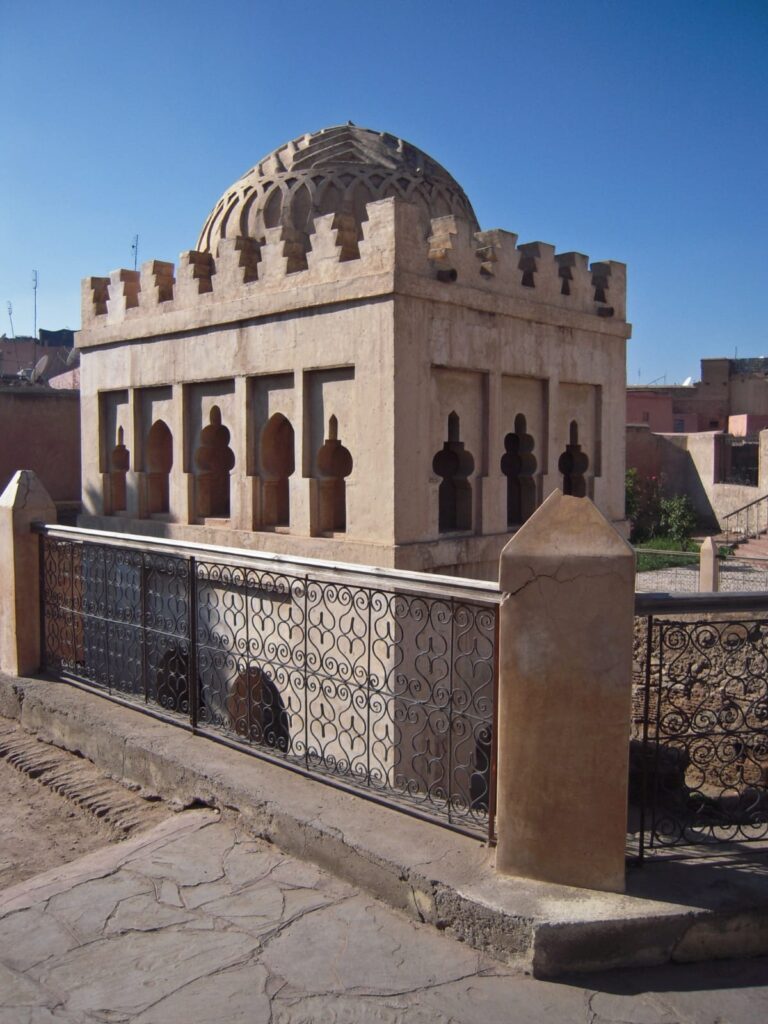
Its location was no accident. Marrakesh sat at the crossroads of trans-Saharan and North African trade, allowing the Al-Murabitun to consolidate their authority across much of present-day Morocco.
The city symbolised their transformation from desert reformers into imperial rulers. It became a base from which they could govern, project military power and shape the future of the western Islamic world.
The defence of Al-Andalus
By the late 11th century, Muslim Spain, known as Al-Andalus, had become deeply divided. The once-powerful Umayyad Caliphate of Córdoba had collapsed, leaving behind a patchwork of rival taifa kingdoms.
These Muslim states were wealthy and culturally advanced, but politically weak. Their divisions left them vulnerable to the expanding Christian kingdoms of northern Iberia, particularly Castile under King Alfonso VI.
In 1086, several taifa rulers appealed to Yusuf ibn Tashfin for help. The Al-Murabitun crossed into Spain and confronted Alfonso VI at the Battle of Sagrajas, also known as Zallaqa.
The battle was a decisive Muslim victory. It halted the Christian advance and established the Al-Murabitun as the dominant military force in Iberia. For Al-Andalus, their arrival delayed further collapse and gave Muslim Spain a new period of political unity under North African leadership.
Following the victory, the Al-Murabitun gradually absorbed the taifa kingdoms and brought much of Muslim Iberia under their authority. What began as a rescue mission became a full political takeover.
Governance, law and trade
The Al-Murabitun established a centralised system of governance rooted in Maliki Sunni jurisprudence. Judges and scholars were appointed across their territories to ensure consistency in religious and legal practice.
Their rule was marked by a strong emphasis on discipline, orthodoxy and public morality. They sought to impose order across regions that had previously been divided by tribal conflict, political fragmentation and local rivalries.
Economically, the empire depended heavily on trans-Saharan trade. Gold from West Africa flowed north, while salt, textiles, horses and other goods moved across the desert. This commercial network enriched the state, strengthened taxation, supported urban development and connected West Africa, North Africa and Al-Andalus into a wider economic system.
Scholarship and religious identity
The Al-Murabitun played an important role in strengthening Maliki legal tradition across North and West Africa. Their rulers supported jurists and scholars who reinforced Sunni orthodoxy and helped standardise Islamic practice across the empire.
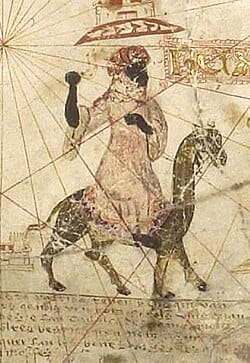
Unlike some later Islamic dynasties known for philosophy, literature or courtly culture, the Al-Murabitun were defined more by law, discipline and reform. Their intellectual legacy was rooted in jurisprudence, religious authority and the use of Islamic law as the basis of governance. This made their empire distinct. It was not built merely on conquest, but on the belief that political authority had to be tied to religious order.
The Al-Murabitun also left an architectural and cultural legacy across North Africa and Al-Andalus. Their buildings reflected both Saharan austerity and Andalusian refinement, combining simplicity, strength and elegance.
Their mosques, fortifications and urban developments influenced later architectural styles in the western Islamic world. Marrakesh itself would remain one of the great cities of Islamic civilisation long after the fall of the dynasty that founded it.
Decline and fall
By the early 12th century, the Al-Murabitun began to face serious internal and external challenges. Their strict religious approach, once a source of unity, increasingly drew criticism from rival reformers.
The greatest challenge came from the Almohads, another Islamic reform movement that accused the Al-Murabitun of religious failure and political decline. The conflict between the two was not simply a struggle for power, but a battle between competing visions of Islamic reform and governance.
By 1147, the Almohads captured Marrakesh, bringing Al-Murabitun rule to an end. Despite their fall, the Al-Murabitun left a deep imprint on Islamic history. They unified large parts of North Africa, strengthened the connection between West Africa and the Mediterranean, reinforced Maliki jurisprudence and played a decisive role in defending Al-Andalus at a critical moment.
Their rise from a desert reform movement to an imperial power showed how faith, discipline, trade and military leadership could reshape entire regions. The Al-Murabitun were not merely another medieval dynasty. They were a movement that emerged from the margins of the Sahara and became a force that connected continents, defended Muslim lands and helped define the religious and political character of the western Islamic world.
You can read more of One Nation Media’s Islamic civilisation and African history features here.