
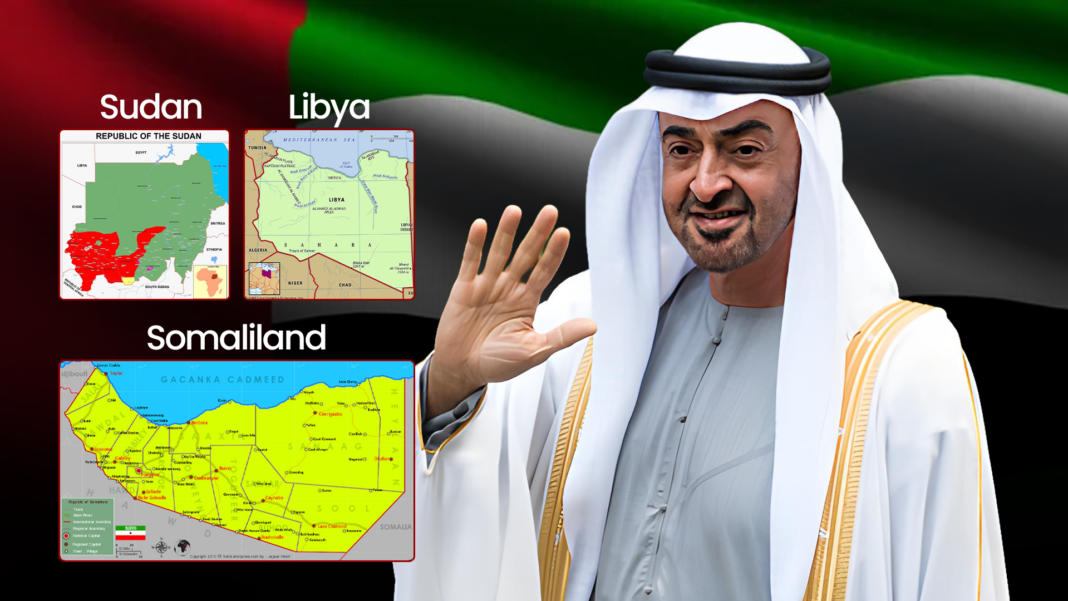

The United Arab Emirates is aggressively entrenching itself across Africa, using the language of security and development to mask a calculated campaign of political control, economic leverage and suppression of Islamic movements, write Dilly Hussain and Neelam Rahim.
Across Africa, the UAE has positioned itself as a partner in security and development. In reality, its expanding footprint reflects a calculated strategy to control strategic assets, suppress Islamic political movements, and entrench influence under the cover of economic cooperation and stability. This is not fragmented engagement, but a coordinated pattern of intervention designed to reshape key regions in line with regime-preserving, anti-Islamic interests.
Somalia: Control under the guise of stability
Over the past decade, the UAE has established itself in Somalia by securing control of ports and critical infrastructure across semi-autonomous regions such as Somaliland and Puntland. By 2017, Emirati-linked companies had established dominance over facilities along the Gulf of Aden and Red Sea, placing Abu Dhabi at the centre of one of the world’s most vital trade corridors.
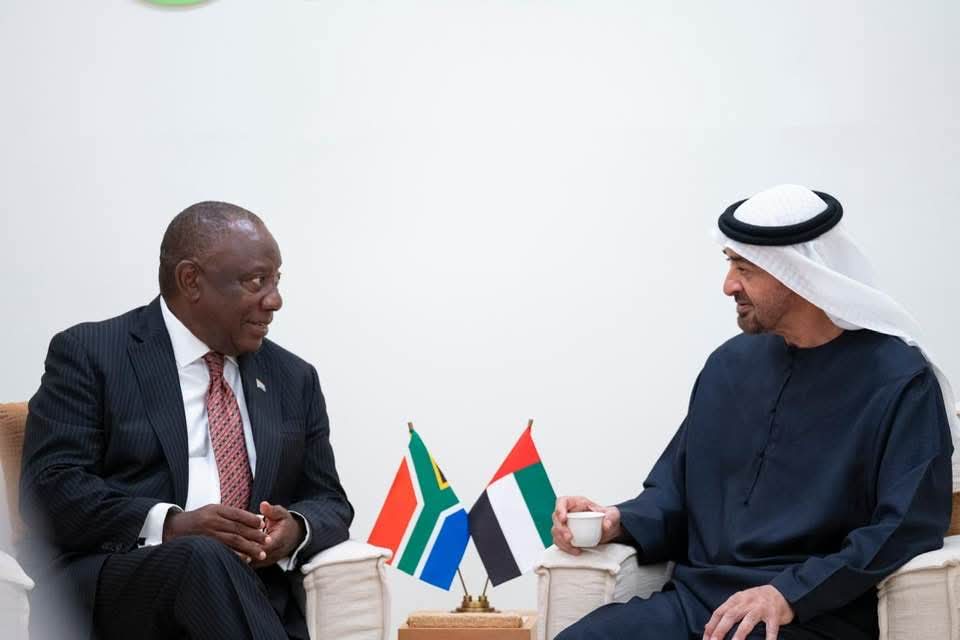
This expansion has unfolded within the context of Somalia’s prolonged instability. The ongoing conflict, driven in part by the insurgency of Al-Shabaab, has left central authority weak and fragmented. Rather than reinforcing national institutions, the UAE has bypassed the federal government, striking direct agreements with regional authorities and embedding itself where oversight is minimal.
What is presented as economic partnership functions, in practice, as strategic leverage. Control over ports and land grants has translated into disproportionate economic influence, with limited tangible benefit for local populations. In a country already grappling with governance challenges, such arrangements deepen dependency while eroding sovereignty.
More significantly, Somalia represents a frontline in a broader ideological contest. The UAE’s regional posture has consistently aligned with efforts to neutralise Islamic political actors, positioning itself as a stabilising force while shaping the political landscape in ways that marginalise Islamic political influence.
Algeria: Penetration through economic leverage
In Algeria, the UAE’s approach is less overt but equally deliberate. Since the mid-2010s, Abu Dhabi has expanded its presence through infrastructure, energy and logistics investments, entrenching itself within sectors central to Algeria’s long-term economic trajectory.
Algeria’s geographic position, linking Africa, Europe and the Middle East, makes it strategically valuable. Emirati activity has focused on securing influence within these economic corridors, ensuring longevity and leverage.
While framed as mutually beneficial investment, the deeper implication is structural dependency. By placing itself within critical industries, the UAE gains the ability to shape decision-making processes that should remain within sovereign control. This model reflects a broader strategy in which influence is secured through economic integration that gradually limits autonomy while appearing benign.
Sudan: War, resources and proxy influence
The UAE’s role in Sudan is among the most contentious. It has been widely accused of supporting the Rapid Support Forces (RSF), a militia implicated in war crimes, ethnic cleansing and acts of genocide.
Sudan’s conflict has increasingly taken on the characteristics of a proxy struggle between Gulf powers. While Saudi Arabia is associated with backing the Sudanese Armed Forces (SAF), the UAE has aligned itself with the RSF, deepening divisions within an already fractured state.
At the centre of this involvement lies Sudan’s gold industry. For years, the UAE has been the primary destination for Sudanese gold, including large volumes of smuggled resources that sustain both military and paramilitary actors. This economic relationship is not incidental; it is central to the UAE’s strategic interest in the country.
By maintaining influence across key sectors such as mining, agriculture and infrastructure, Abu Dhabi ensures its position remains necessary regardless of which faction prevails. The result is a prolonged conflict environment in which external interests continue to benefit while Sudan’s instability deepens.
Libya: Militarised intervention and strategic recalibration
Libya has served as a central arena for the UAE’s regional ambitions since the 2011 uprising that toppled long-time dictator Muammar Gaddafi.
By 2014, Abu Dhabi had firmly backed the ‘anti-Islamist’ General Khalifa Haftar, providing military equipment, funding and aerial support to expand his control across eastern and southern Libya.
During Haftar’s offensive on Tripoli between 2019 and 2020, the UAE intensified its involvement, supplying weapons, sustaining drone operations and financing mercenary forces. These actions drew widespread international criticism and underscored a willingness to pursue influence through direct militarised intervention.
As the conflict evolved, the UAE adjusted its approach. With the emergence of Libya’s Government of National Unity, Abu Dhabi shifted towards a more transactional model, prioritising economic access, infrastructure deals and strategic positioning while reducing overt military engagement.
This recalibration does not signal withdrawal, but adaptation. The UAE continues to shape Libya’s political and economic landscape, balancing between actors to maintain influence while minimising exposure and international accountability.
The UAE’s vision for Africa is anti-Islam
Taken together, these cases reveal a consistent pattern. The UAE’s actions across Africa are not isolated or reactive; they form part of a broader strategy to secure strategic assets, control economic corridors and influence political outcomes.
Crucially, this strategy operates within an ideological framework. Across multiple regions, Emirati policy has aligned with efforts to suppress Islamic political expression, favour autocratic regime stability over popular agency, and reshape governance structures in ways that exclude Islamic alternatives.
What is presented as partnership is, in reality, a nefarious model of managed influence, where economic investment, security cooperation and political intervention converge to produce long-term dependency.
For the Ummah, these developments are not merely geopolitical. They reflect an ongoing contest over who defines political authority, economic direction and societal values in Muslim-majority countries.
The challenge is not only external intervention, but the internalisation of models that sideline Islam as a governing framework. Without a clear and confident articulation of Islam as a comprehensive system, such patterns of influence will continue to expand unchallenged.
Read ONM’s full four-part ‘Imperialism in Africa’ series: Part 1 (France), Part 2 (China), Part 3 (United States) and Part 4 (UAE).