
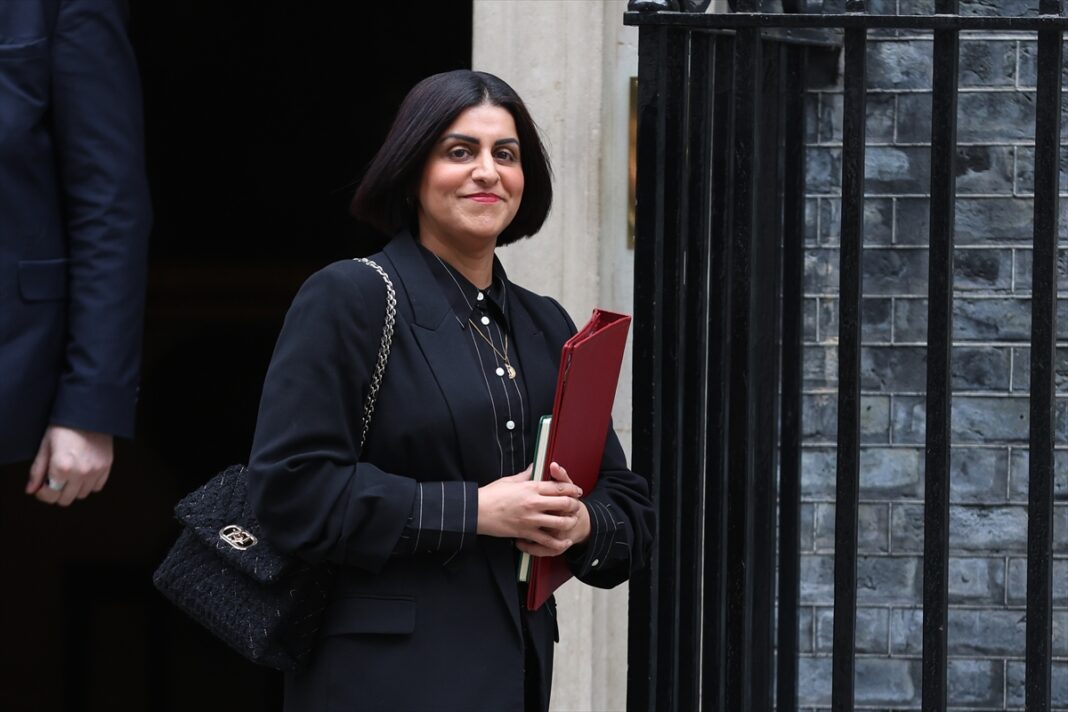

UK Home Secretary Shabana Mahmood has approved a request from the Metropolitan Police to ban the Al Quds Day march due to take place in London on Sunday, the BBC has reported.
Home Secretary Shabana Mahmood said it was aimed at preventing “serious public disorder” which has always been seen as pro-Iranian, though organisers say it is more of a pro-Palestinian event.
Despite it been suggested as a Pro-Iranian event, Al Quds day has since its inception been a day of protest against the Israeli occupation of East Jerusalem and support for the Palestinian people. Mahmood, though, has been at the forefront of shutting down any pro-Palestinian protests despite the growing view that Labour unpopularity is due to its position on the genocide being perpetrated by Israel.
Pro-Palestinian protests in London have often attracted numbers in access of 100 000, often prompting responses from the right-wing.
Mahmood, along with Prime Minister Keir Starmer, was in the forefront of the attempts to overturn the West Midlands Police ban on Maccabi Tel Aviv fans attending their Europa League match against Aston Villa in Birmingham in October 2025.

Mahmood argued that every football fan should be able to watch their team in safety and that the government was “doing everything in our power” to ensure the game could go ahead with all fans present. The ban was on the basis of the history of violence which resulted from the behaviour of Maccabi fans during previous games.
The Met said the threshold to ban a protest was high and it had not taken its decision lightly. It is the first time a protest march has been banned since 2012, the BBC has reported.
Faisal Bodi, of the Islamic Human Rights Commission which organises the event, told the BBC a ban would mean a “sad day for freedom of expression”.
“If it was not clear already, the police have brazenly abandoned their sworn principle of policing without fear or favour, and have capitulated to the pressure of the Zionist lobby.
The Metropolitan Police unashamedly regurgitate Zionist talking points about IHRC without a shred of evidence. They cannot present evidence because there is none – we are an independent NGO. In essence, this is a politically charged decision; not one taken for the security of the people of London.”
The march is normally met with pro-Israel counter demonstrators and sometimes far-right protesters as well, although these two groups often stand together as one bloc.
Mahmood said a stationary demonstration could take place instead under strict conditions.
“I am satisfied doing so is necessary to prevent serious public disorder, due to the scale of the protest and multiple counter-protests, in the context of the ongoing conflict in the Middle East,” Mahmood said in a statement.

“Should a stationary demonstration proceed, the police will be able to apply strict conditions. I expect to see the full force of the law applied to anyone spreading hatred and division instead of exercising their right to peaceful protest.”
Assistant Commissioner Ade Adelekan, Public Order lead for the Met, said that the ban applied to the “Al Quds march and any associated counter-protest marches” and would be in place from 16:00 on Wednesday, to last one month, he told the BBC.
“The Al Quds march is uniquely contentious having originated in Iran and in London is organised by the Islamic Human Rights Commission, an organisation supportive of the Iranian regime,” he added.
Noting that the power to ban a march had not been used since 2012, he said the Met had “safely policed hundreds of protests from across the political spectrum including 32 major pro-Palestinian protests and many more both pro and anti the Iranian regime”.
“But in our assessment this march raises unique risks and challenges,” he continued.
“We must consider the likely high numbers of protestors and counter protestors coming together and the extreme tensions between different factions. We have taken into consideration the likely impact on protests of the volatile situation in the Middle East, with the Iranian regime attacking British allies and military bases overseas.”
Previous Al Quds marches had “resulted in arrests for supporting terrorist organisations and antisemitic hate crimes”, the assistant commissioner said.

“However, the decision to ban it this year is purely based on a risk assessment of this specific protest and counter-protests – we do not police taste or decency or prefer one political view over another, but we will do everything we can to reduce violence and disorder,” he added.
Chief Secretary to the Prime Minister Darren Jones said the government is “very careful about these types of interventions because… so long as you’re legal and peaceful you can protest on anything you like in this country.”
“We have freedom of speech and that’s something that we all care about,” he told BBC Breakfast.
The Islamic Human Rights Commission describes Al Quds Day as an “international demonstration… in support of Palestinians and all the oppressed around the world”.