
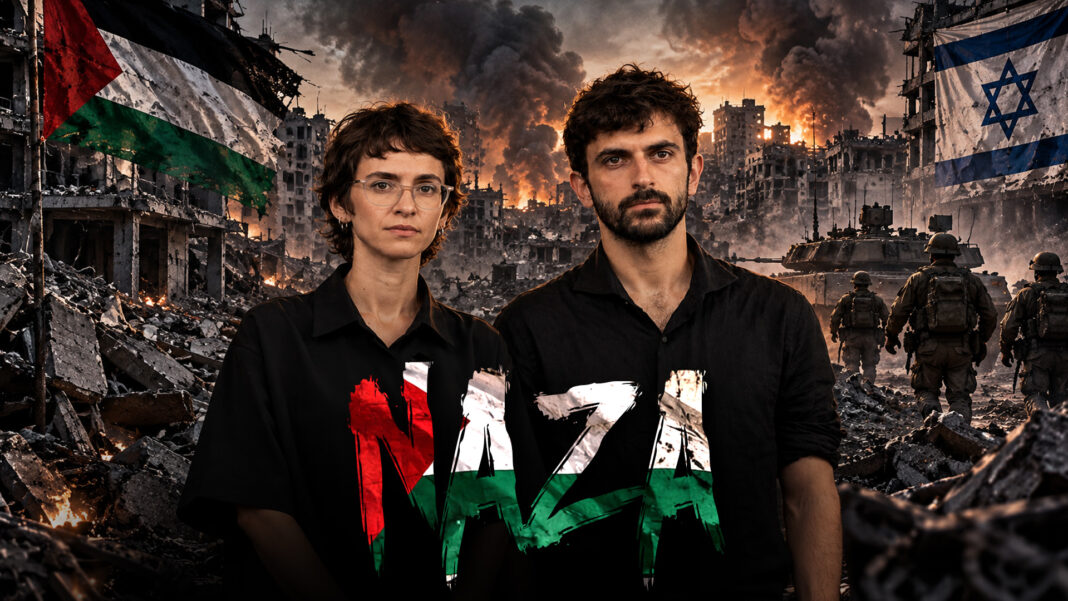

Why are NAZA’s critics talking about everything except the evidence? Neelam Rahim examines the backlash against the Israeli documentary and the uncomfortable questions its opponents appear determined to avoid.
Directed by Israeli filmmakers Yuval Abraham and Rachel Szor, NAZA investigates how Israel’s military and intelligence systems operated during its war on Gaza, drawing on testimony from 24 Israeli military and intelligence insiders.
Its central questions are uncomfortable but straightforward: How were targets selected? How were civilian casualties calculated? What role did artificial intelligence and surveillance technology play? And who authorised the strikes?
Yet much of the response to the film has focused elsewhere.
A recent South African Jewish Report article, carrying Jewish Telegraphic Agency reporting, focused heavily on protests surrounding NAZA’s New York premiere and criticism from the Israeli-American Council (IAC), which argued that the film did not provide sufficient context about Hamas’s 7 October 2023 attack.
The IAC called for screenings to be accompanied by additional context, including testimony from survivors of 7 October.
But arguing that a documentary should have included more about 7 October is not a rebuttal of what the documentary actually investigates.
NAZA does not claim to provide a comprehensive history of the Gaza war or every event preceding it. Its focus is narrower: what happened after Israel launched its military campaign in Gaza, particularly the systems through which targets were identified, civilian casualties assessed and strikes authorised. That distinction matters.
The film’s most serious allegations have not gone unanswered. The Israel Defense Forces has categorically rejected them, accusing the documentary of distorting military procedures and disputing its portrayal of targeting practices, civilian-casualty calculations and the use of artificial intelligence.
But an allegation being disputed is not the same as an allegation being disproved.
The IDF’s response demonstrates that there is a substantive dispute worthy of scrutiny. It challenges the filmmakers’ interpretation of military procedures and questions the credibility and knowledge of anonymous sources.
The filmmakers, meanwhile, maintain that the identities and accounts of their sources were verified, while The Guardian, which produced the documentary, says its investigation involved interviews with more than 100 people.
That is where the debate should take place: on the evidence.
No serious discussion of the Gaza war requires denying that Hamas attacked Israel on 7 October. But acknowledging that attack does not answer whether Israeli forces subsequently complied with their obligations to protect civilians, how targeting decisions were made, how many civilian deaths were deemed acceptable or how technology enabled military operations to be conducted at unprecedented speed and scale.
Those questions do not disappear because another atrocity happened first.
Nor does the documentary become invalid simply because some of its sources are anonymous. Anonymous sourcing requires scrutiny, corroboration and verification — established practices within investigative journalism. The relevant question is whether those standards were met.
The filmmakers say they spent three years investigating the systems documented in NAZA. The IDF disputes both their sourcing and their conclusions. Those competing claims should be assessed on their merits.
Instead, the response to the documentary has gone far beyond ordinary criticism.
Israeli officials have fiercely condemned the filmmakers, with Culture Minister Miki Zohar calling for authorities to examine whether Abraham and Szor could be stripped of their Israeli citizenship. Prime Minister Benjamin Netanyahu has also publicly attacked the documentary, describing it as incitement.
The filmmakers have faced protests, threats and accusations of treason. That reaction is itself revealing.
If NAZA is factually flawed, its allegations should be dismantled with evidence. If its sources are unreliable, demonstrate why. If its description of Israeli targeting systems is inaccurate, explain precisely where.
But demanding that the documentary centre a different atrocity does none of those things.
NAZA won the Special Jury Prize at the Venice Film Festival after receiving a 25-minute standing ovation and has attracted significant international attention since its release.
But awards and applause do not prove its allegations either. Evidence does.
And that is precisely why the questions raised by the documentary deserve answers.
How were Palestinian homes selected for attack? How many civilian deaths were anticipated and considered acceptable? What did the targeting systems used by the Israeli military actually do? And who ultimately authorised the strikes?
Those questions cannot be answered by changing the subject.
They are the questions NAZA puts before the world — and they deserve to be confronted on the evidence.
The South African Jewish Board of Deputies was approached by One Nation Media for comment on its position regarding NAZA and the issues raised by the documentary. No response had been received by the time of publication.