
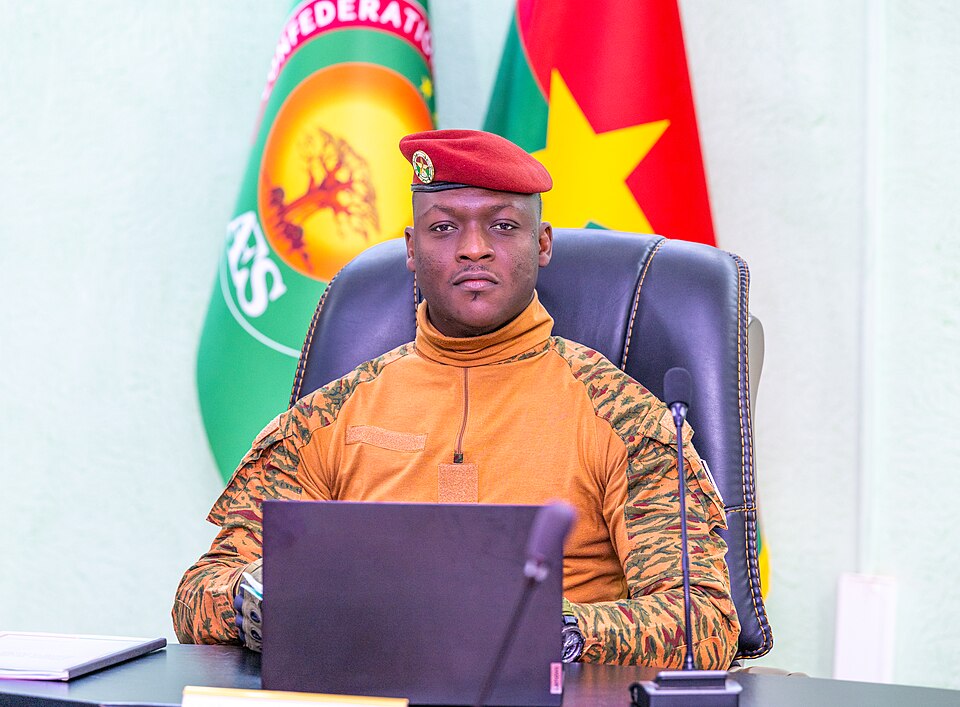

Four years after seizing power, Captain Ibrahim Traoré is doing more than defending his coup. He is seeking to redefine Burkina Faso’s political order.
Anniversary celebrations in Ouagadougou at the end of September presented a narrative of national renewal: territory reclaimed from armed groups, a break with France, closer ties with Russia, new infrastructure and the opening of the country’s first gold refinery.
It is a powerful narrative. It is also incomplete.
Armed attacks continue, civilians remain exposed to violence, humanitarian needs persist and critics report an expanding campaign of abductions and arbitrary detention.
Now Traoré wants to go further. His proposed constitutional overhaul raises a question that extends beyond the duration of military rule: how far does he intend to remake the state?
Security gains, but no decisive victory
Strengthening the army and expanding the Volunteers for the Defence of the Homeland (VDPs) have been central to the junta’s strategy since 2022. Authorities say they have recaptured several towns and positions and restored control over large parts of the country.
Those claims, however, do not by themselves establish lasting security.
Territorial control means little to communities if roads remain unsafe, public services are inaccessible and armed groups are still capable of returning.
Jama’at Nusrat al-Islam wal-Muslimin (JNIM) and Islamic State affiliates remain active. Government forces have also faced allegations of extrajudicial killings, complicating the authorities’ claim to be restoring protection and order.
The distinction matters: recapturing a position is one achievement; making civilian life safe again is another.
A shrinking civic space
The most sensitive fault line is the treatment of dissent.
To mark the fourth anniversary of the coup, the exiled Front anti-putschistes (FRAP) published a document listing 86 alleged cases of abduction and arbitrary detention involving at least 84 people between December 2022 and September 2026.
The group attributes those cases to the authorities. Its claims require independent scrutiny, but they add to wider concerns about the consequences of challenging military rule.
The reported detention of Imam Mohamed Ishaq Kindo has also raised concern within the Muslim community. Kindo was arrested in May after publicly criticising proposed legislation governing religious freedoms. Reports published in September said his place of detention remained unknown.
Such cases raise a wider question: is repression becoming an enduring feature of the political order Traoré is building?
A new constitution, but what political system?
The clearest signal came on 27 September, when Traoré announced plans for a new constitution to “completely reorganise” Burkina Faso’s political system.
He criticised partisan confrontation and questioned a model built around permanent competition between government and opposition. His stated objective was greater continuity in public policy, with a national vision capable of outlasting changes in leadership.
But the institutional details remain unclear.
What role would organised opposition play? How would leaders be selected or removed? What powers would parliament, the courts and the media retain?
That uncertainty is fuelling concern.
Exiled Burkinabè journalist Newton Ahmed Barry has invoked North Korea in warning about the concentration of power under Traoré. The comparison is a critic’s assessment rather than a description of any constitutional model formally announced by the government.
The central issue is accountability.
A government can promise continuity and national unity while still leaving citizens with fewer ways to challenge its decisions.
Sovereignty as economic and diplomatic doctrine
Sovereignty remains Traoré’s strongest political message.
Economically, the opening of Burkina Faso’s first gold refinery represents an effort to process more of the country’s mineral wealth domestically and retain a greater share of its value.
It gives concrete form to the argument that resource extraction should benefit Burkina Faso beyond the export of raw materials.
Diplomatically, the government has broken with France, strengthened ties with Russia and deepened cooperation with Mali and Niger through the Alliance of Sahel States.
For supporters, these shifts represent a rejection of French domination and the restoration of national dignity. Critics question whether new partnerships will deliver greater autonomy or simply create fresh dependencies.
The real test will be whether this sovereignty translates into tangible improvements in security, livelihoods and national control over resources.
What comes next?
After four years, Traoré’s record remains contested.
His government points to military investment, infrastructure projects, domestic mineral processing and a more assertive foreign policy.
Against those claims stand continuing insecurity, allegations of serious abuses and a narrowing space for dissent.
The constitutional project could become the decisive turning point.
A new system that preserves meaningful participation, independent institutions and scrutiny could give substance to the promise of national renewal. One that concentrates authority around Traoré would move Burkina Faso closer to making military rule permanent in everything but name.
Suppressing opposition would not resolve political disagreement. It would simply remove the channels through which that disagreement can be expressed and addressed.
Burkina Faso may now be approaching a deeper transition: from an ostensibly temporary military administration to a political order designed by those already in power.
Its significance will ultimately be measured by who can question that order, who can influence it and who can hold its leaders accountable.