
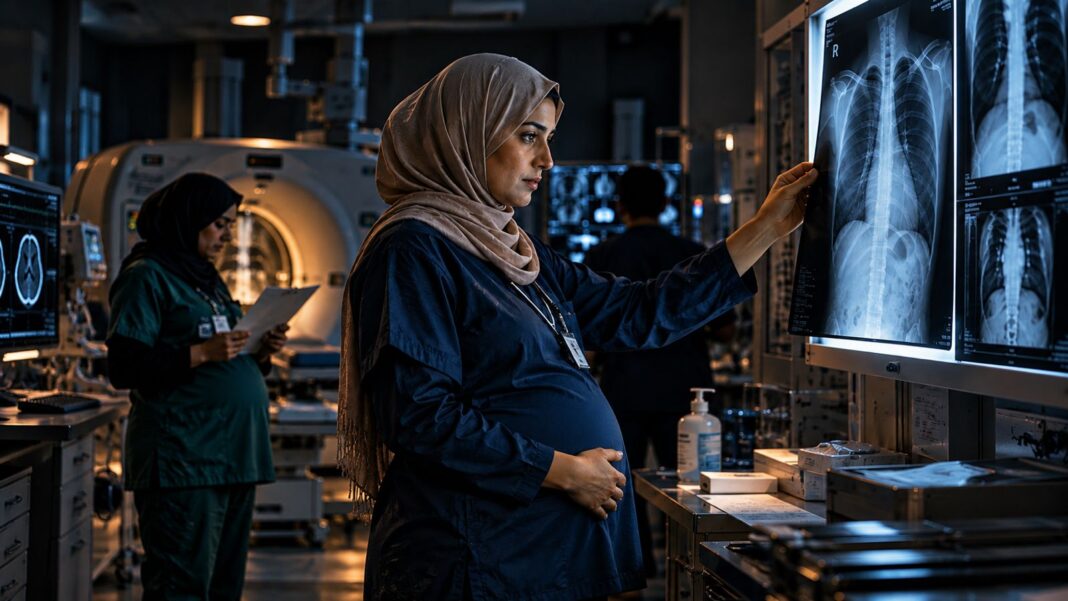

Pregnancy became the starting point for Dr Hafsa Essop’s award-winning innovation after her experience as a pregnant radiographer exposed a gap in how radiation doses were monitored and recorded.
What began as a concern during her first pregnancy eventually developed into PregiDose, a digital application designed to help pregnant healthcare workers exposed to radiation track their doses more effectively.
For Essop, the work is also rooted in faith. As a Muslim woman, she draws inspiration from a Hadith about the virtue of benefiting others — a principle she sees reflected in her work as a researcher, lecturer and innovator.
“I think about the Hadith that says the best of mankind are those who benefit others,” she said.
The idea for PregiDose grew out of Essop’s own experience. A radiographer by profession and lecturer by occupation, she was pregnant with her first child while working in a clinical department.
As a pregnant radiation worker, she was issued with a dosimeter, a device used to measure radiation exposure.
But she soon discovered a gap in how the devices were being used.
“When I received my dosimeter and asked people, ‘How do you use this here?’, they said, ‘Actually, we never used it. We put it in a drawer. We never really looked at these doses accurately,’” she recalled.
The experience prompted Essop to investigate the issue further as part of her PhD research.
She found that some pregnant workers did not have access to dosimeters, while others struggled to use them correctly or keep consistent records.
“Pregnant workers weren’t recording their doses. They weren’t using the dosimeter properly and they weren’t recording the doses either,” Essop said.
The problem was not only technical.
Pregnant workers also described feeling isolated, fearful and unsupported while working in radiation environments. Those experiences influenced the development of additional features within PregiDose, including wellness tools, journalling, mindfulness resources and access to support networks.
The application allows workers to enter their radiation doses and view them on a graph, helping them monitor exposure and identify when they may be approaching or exceeding recommended limits.
It also provides information on pregnancy policies, workers’ rights and how to use a dosimeter correctly.
For Essop, the innovation is about closing an obvious gap in an increasingly digital age.
“What I’ve found is that they give you a piece of paper and say, ‘Okay, just record your doses,’” she said.
Her work has now received national recognition.
Essop recently won the 2026 South African Women in Science Award, an honour she said meant many things to her, but particularly gave her an opportunity to showcase radiography and the science behind her profession.
She also sees the recognition as a chance to encourage young women to pursue careers in science.
“Seeing someone who has achieved something means they can also aspire to achieve, dream big and do whatever they want to achieve,” she said.
Her identity as a Muslim woman remains an important part of that message.
Essop speaks openly about wearing her hijab in scientific and professional spaces, hoping other Muslim girls can see that faith does not have to be left behind in the pursuit of ambitious careers.
“I love wearing my hijab. I love being out there and promoting science with my hijab,” she said.
She hopes Muslim women can see themselves represented in spaces where they may not traditionally expect to find them.
“I really hope that other Muslim girls can also be inspired that they can be in any position and still maintain their religion and their culture.”
PregiDose is now being developed with a wider vision.
Essop hopes it can eventually serve healthcare workers beyond radiographers and evolve into wearable technology capable of automatically tracking radiation exposure.
Her work is also moving into policy, with postdoctoral research examining how foetal radiation doses among pregnant workers are recorded.
What began with a question during her own pregnancy has grown into research, innovation and advocacy — with Essop continuing to pursue science through the same principle that first inspired her: using knowledge to benefit others.