
By Abdullah Ibn Adam
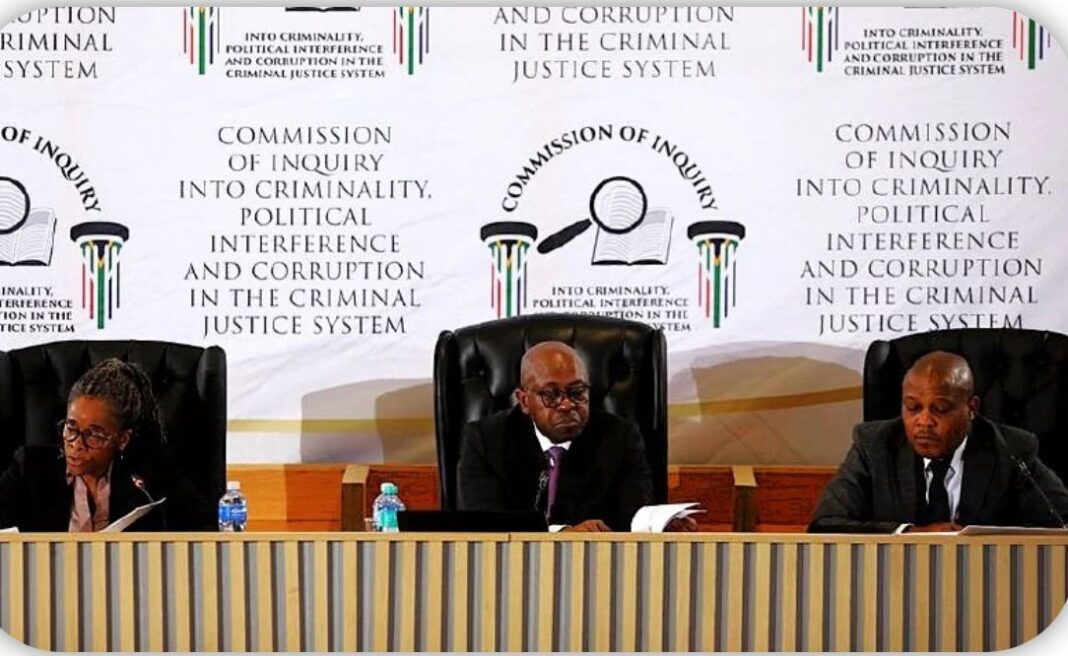
Many people are being demonised and their reputations ruined as millions follow blow-by-blow coverage of the Madlanga Commission on social media and in the mainstream press.
There is little justification for publicising to an audience with an evident appetite for the salacious what is, at this stage, still an investigation. The Commission should conduct its proceedings in private, publish its findings, and leave determinations of criminal guilt to the courts.
Long before South Africa had a Constitution or a Commissions Act, Islamic law prescribed principles for dealing with accusations.
Islam does not countenance gratuitous damage to a person’s good name. An accusation of adultery requires four morally upright eyewitnesses (Qur’an 24:4). An accuser who cannot produce them is punished and his testimony is thereafter rejected. The burden rests on the accuser, not the accused.
The Qur’anic account of the slander against ‘A’ishah (r.a.) is a stern warning to those who accept untested accusations — and worse, spread them as truth. Allah rebuked the believers for failing to think well of one another, for passing on the rumour and for treating as trivial what was, in His sight, an enormous matter (24:12, 24:15). Those who love scandal to spread among the believers are warned of painful punishment (24:19).
The principle is clear: broadcasting accusations causes harm, normalises wrongdoing and lowers the threshold for public dishonour. The Islamic paradigm is protective, not vindictive. Reports must be verified before action is taken, lest people be harmed through ignorance (49:6). The Prophet ﷺ warned that it is enough of a lie for a person to repeat everything he hears. Suspicion, spying and backbiting are forbidden (49:12). And no soul bears another’s burden (6:164): a person is not guilty by association.
Doubt favours the accused. Details should remain concealed until there is proof, and even then they are not fodder for gossip. The Prophet ﷺ said that whoever conceals another Muslim’s faults, Allah will conceal his faults. He also turned away a man who came to confess wrongdoing, telling the person who had encouraged the confession that it would have been better to cover him with his cloak.
Punishment, when due, could be public — but public did not mean humiliation before millions. Even the convicted retained their dignity. When a companion cursed a woman during punishment, the Prophet ﷺ rebuked him. In his Farewell Sermon, he declared a Muslim’s honour as sacred as his life and property.
If even the convicted may not be humiliated, then the presumed-innocent accused deserves greater protection, not less. Measured against this divine standard, the modern “name and shame” culture is deeply flawed. The Madlanga Commission falls woefully short.
A laudable purpose, a flawed method
The Commission was established to investigate allegations of criminality, political interference and corruption within South Africa’s criminal justice system, and to make recommendations arising from its findings. Its terms also empower it to refer matters for immediate criminal investigation and make recommendations concerning the employment status of officials on the basis of prima facie evidence.
The purpose may be laudable. But method matters.
Its proceedings have placed untested accusations before the public, exposing reputations to damage before evidence has been finally tested or guilt established. The default should be privacy. That is the more honourable approach.
A criminal court requires proof beyond reasonable doubt. A civil court determines matters on a balance of probabilities after the parties have had an opportunity to be heard. A commission of inquiry operates differently. Its regulations permit cross-examination by an implicated person only where the Chairperson considers it necessary and in the best interests of the Commission’s functions. It can also make referrals and recommendations on the basis of prima facie evidence rather than a criminal conviction.
WhatsApp messages are displayed and interpreted by evidence leaders who decide what material to place before the Commission. In a trial, questions of authenticity, completeness, context and interpretation would ordinarily be tested through evidentiary procedures and, where permitted, cross-examination. In a commission setting, however, the public can too easily mistake an allegation or interpretation for an established fact.
An inquiry can gather information privately. The harm arises when an investigation is consumed by the public as though it were a trial — despite there being no criminal charge before the Commission and no verdict of guilt to appeal.
The public is effectively watching an investigation through the lens of courtroom drama, but without all the protections of a criminal trial.
The Commission’s first interim report led to referrals for investigation and recommendations concerning the employment status of officials on the basis of prima facie evidence. The Presidency subsequently said that 14 high-ranking SAPS and Ekurhuleni officials had been identified as possible wrongdoers and referred for investigation.
The Commission’s second interim report later revisited several of those recommendations after relevant implicated parties had appeared and given evidence. The Presidency stressed that the Commission’s referrals were for investigation and, where sufficient evidence existed, possible prosecution — not criminal convictions.