

More than a week after the deadly attack on the military camp in Dioura, central Mali, the Malian military command is still struggling to regain control of the area. Jama’at Nusrat al-Islam wal-Muslimin (JNIM), which claimed responsibility for the attack, continues to assert its presence in Dioura despite the ground and air offensive launched by the Malian army.
The death toll from the attack has been revised upwards by the armed group. In a statement released on 17 September 2026, JNIM claimed that around 150 Malian soldiers had been killed and another 93 captured. It also claimed to have destroyed 15 military vehicles and more than 100 motorcycles.
According to several local sources, the camp was completely destroyed. Beyond the human toll, the insurgents claim to have seized significant quantities of military equipment.
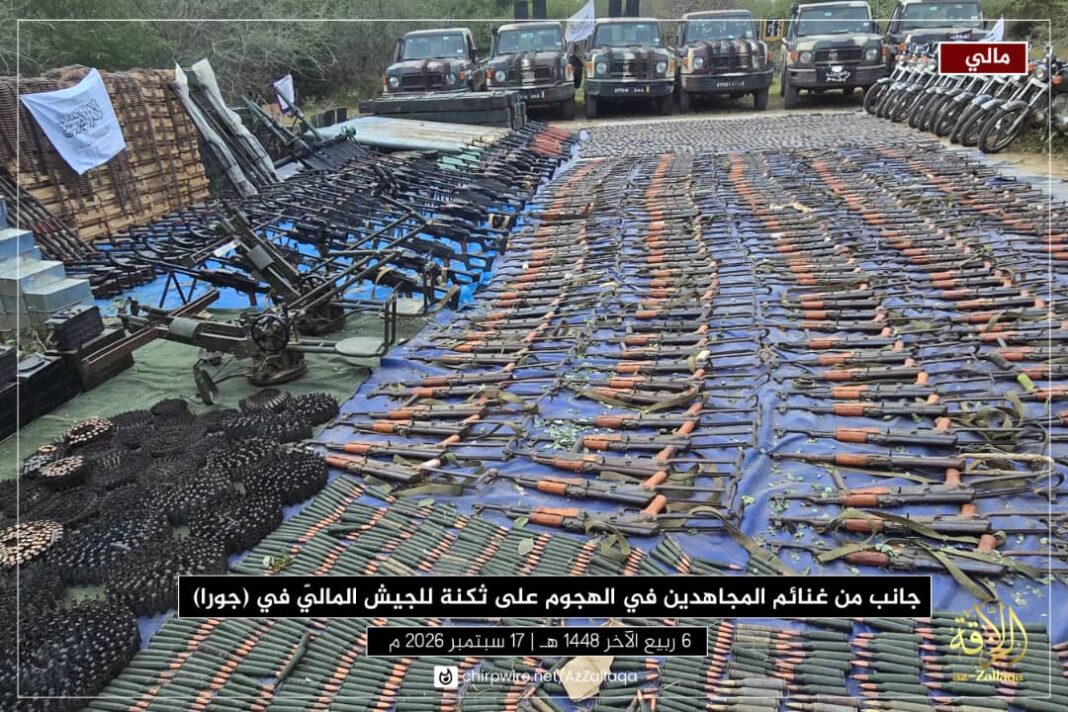
JNIM says it recovered six vehicles, ten motorcycles, six 14 mm-calibre weapons, 17 Douchkas, 32 PK machine guns, 233 Kalashnikovs, ten RPGs, three mortars and an SPG cannon, as well as a large quantity of ammunition.
Images released through the insurgents’ communication channels show part of what they present as equipment seized during the attack.
The Malian army has yet to disclose its own losses, while questions remain over the deployment of reinforcements at the time of the attack and the circumstances under which the camp fell into the hands of the insurgents.
For security specialists, the JNIM attack could mark an evolution in the group’s military strategy. Unlike some of its recent operations, the group is believed to have established a sustained siege around the town following its assault on the camp.
Survivors of the attack may reportedly have been able to contact their commanders and call for reinforcements.
For its part, the Malian army says that “the response is under way”.
Significant resources are reportedly being deployed to drive the insurgents out of Dioura. The military command has also announced that “air and ground operations have been launched against the attackers”, reporting the “neutralisation” of “several terrorist elements on motorcycles who were attempting to conceal themselves under vegetation cover”.
According to other sources on the ground, military convoys reportedly attempted to reach Dioura with reinforcements but failed to make it to the town.
Faced with this situation, the military command is believed to have decided to rely primarily on air strikes.
The General Staff of the Malian Armed Forces said several air strikes had targeted JNIM positions inside and around the town.
The insurgents swiftly rejected the military’s account. JNIM disputed statements made by the Malian army chief of staff, claiming in particular that “there is nothing in Dioura”.
However, several sources have reported that Malian military aircraft continue to carry out strikes in the area.
In addition to Malian soldiers, other sources have reported the presence of Russian soldiers at the camp at the time of the attack. According to these sources, “at least five Russian soldiers” were killed.
Dioura is an important strategic stronghold for the Malian army, allowing it to maintain control over a vast area stretching towards the Mauritanian border.
Sources close to the matter believe the insurgents are seeking to drive the army out of the area, establish a lasting presence and turn Dioura into a rear base for future operations.
The scenario is reminiscent of Boulkessi in 2025.
In that locality on the border with Burkina Faso, JNIM imposed a siege after destroying the military camp, eventually forcing the Malian military command to abandon the area completely.
Since late April 2026, the security situation in Mali has deteriorated further, with a series of coordinated attacks targeting army positions and transitional authorities, including in areas on the outskirts of Bamako.
The key question for the army now is whether the Dioura camp will suffer the same fate as Boulkessi, with the area ultimately being abandoned, or whether new troops will be deployed if control of the town is regained.
The Chief of the General Staff of the Armed Forces recently highlighted the importance of “manpower” within the army in confronting the insurgents.
The Dioura military camp has been repeatedly attacked by insurgent groups since 2019. However, this latest offensive appears to have been the deadliest, placing the Malian army before a major challenge: regaining control of Dioura and, above all, maintaining that control in the long term.
It should be noted the reported deaths of 150 Malian soldiers, the capture of 93 others, the alleged deaths of five Russian soldiers and the quantities of military equipment seized should remain clearly attributed to their respective sources and could not be independently verified.