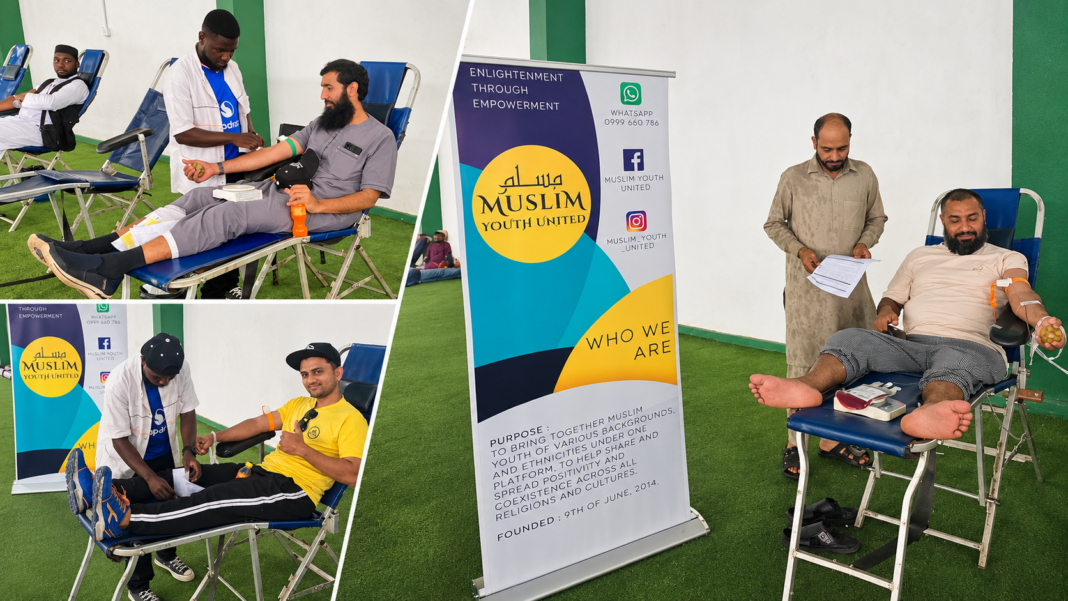

A youth-led blood donation drive in Malawi has broken the country’s record for the highest number of donors in a single day, with Muslim Youth United (MYU) mobilising young people and members of the wider community to donate blood and help save lives. They didn’t come for fame. They came to roll up their sleeves, and in doing so, they broke a national record.
It was not about numbers. It was about neighbours.
“The motivation behind the entire initiative was simply to serve the community and contribute towards saving lives. Nothing was done for personal benefit or recognition. It was an opportunity for us to fulfil our responsibility towards society and encourage people to participate in an act that can make a real difference in someone’s life,” Sufyaan Nathaniel, team manager at Muslim Youth United, told One Nation Media (ONM).
MYU holds an annual blood donation drive in Malawi, and this year was one to remember for the group.
“We managed to break Malawi’s record for the highest number of blood donors received in a single day,” Sufyaan said.
“Ultimately, the initiative was driven by a spirit of service, unity and giving back to the community. We hope it inspires more people to get involved in similar initiatives in the future,” he added.
Is blood donation allowed in Islam?
While blood donation is encouraged as an act of charity (sadaqah), questions may arise among Muslims about its permissibility in Islam.
Sheikh Laja Yasini, a director of the Independent Islamic Court (IIC), told ONM that blood donation is permissible and commendable, as long as it does not cause harm to the donor.
“From an Islamic perspective, blood donation is permissible and commendable, particularly when it serves a genuine medical need and helps preserve human life. One of the fundamental objectives of the Shariah is the preservation of life.
“Almighty Allah says: ‘Whoever saves a life, it is as though he has saved the lives of all mankind.’ (Quran 5:32).
“A Muslim may donate blood to Muslims and non-Muslims alike, provided the donation does not cause harm to the donor. The Prophet (peace be upon him) said: ‘There should be neither harming nor reciprocating harm.’ (Hadith 2340 reported by Ibn Majah),” Sheikh Yasini said.
He added that voluntary blood donation should be distinguished from selling blood, which is generally prohibited.
“There is a general prohibition regarding donating for the purposes of selling. Thus, selling blood should be distinguished from voluntary blood donation, which is permissible for the purpose of helping those in need,” Sheikh Yasini said.
In other words: give it freely, for Allah, for humanity, not for a price.
Humanity first
For one of the initiative’s sponsors, the drive was also an opportunity to demonstrate how Islamic values encourage service to humanity.
“Humanity is the first, and Islam is the deen, which gives everybody respect, love, and support,” Asif Gillani, managing director of Kips Restaurant and a sponsor of the event, said.
Gillani added: “This is the beauty of Islam, because we were brought up in such a beautiful upbringing which is given by the deen, which is given by, of course, the Holy Quran and Prophet Sallallahu Alaihi Wasallam. So, we understand that humanity comes first, before anything.”
He emphasised that what matters is helping and saving lives and that, in Islam, everyone is family in a community that looks out for one another.
The turnout reflected that spirit. It was not just one community. It was everyone.
“Generally, if you’re looking at the bigger picture, the people who were brought up in Africa are more cultural, humble, and respectful.
“And another thing, yes, the large number who came and donated are Muslim youth from the university, from different institutions where they are working; a large number of people who moved there for job purposes from different Asian communities, Indians, Pakistanis, and Bangladeshis and our Malawian fellow brothers, who were born and brought up here, with Asian background,” Gillani added.
More than a record
Zayda Kidy, a team representative at MYU, said the turnout was particularly encouraging.
“It was particularly inspiring to witness the incredible turnout and the willingness of so many people to come forward and donate blood for such an important cause. This was about much more than breaking a record; it was about saving lives, bringing communities together and making a meaningful difference,” Kidy said.
Sheikh Yasini also commended the initiative, saying it reflected the Islamic principles of compassion and service to humanity.
“The initiative by Muslim Youth United is therefore highly commendable. It reflects the beautiful teachings of Islam, which encourage compassion, generosity and service to humanity. It also demonstrates how Muslim organisations can make a meaningful contribution to the broader community,” he said.
“Together, we didn’t just donate blood, we gave hope, strengthened our community, and made a difference,” Gillani said.
Beyond the record, every donation represented an opportunity to give someone another chance at life, whether a mother in labour, a child with malaria or an accident victim on the way to hospital, showing that a simple act of generosity can make a lasting difference.