
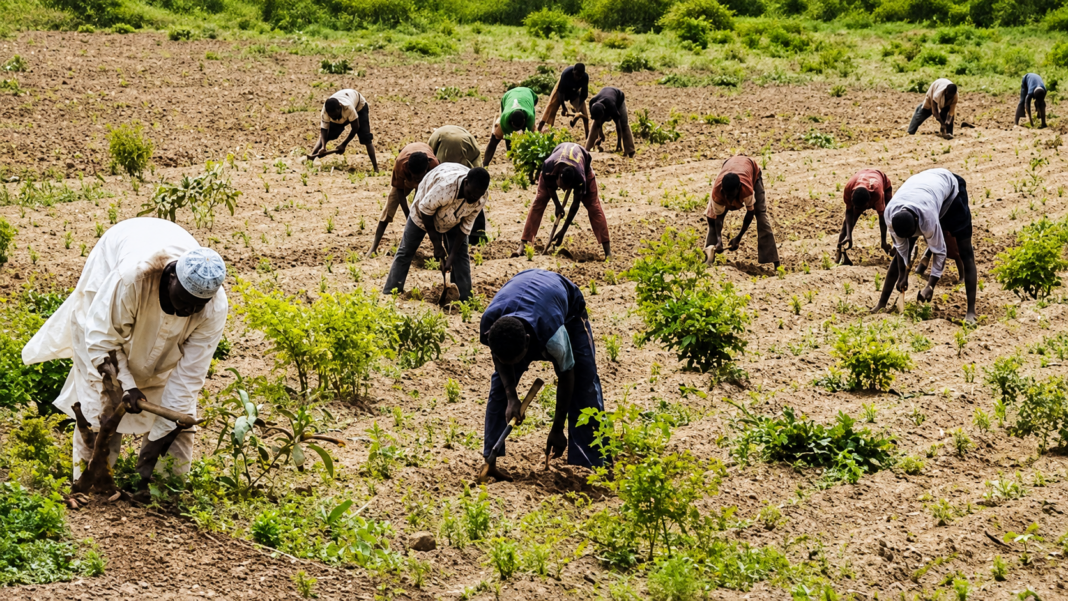

For Muslim farming families in parts of Sokoto State in north-west Nigeria, the agricultural season is no longer simply about rain, seeds and harvest. Increasingly, it is about whether they can afford to pay armed bandits for permission to cultivate land that has sustained their families for generations.
Across several rural communities, farmers are reportedly being forced to pay levies to armed groups before accessing their farms, with some facing further demands when their crops are ready for harvest. The payments, imposed outside any recognised government system, have effectively turned farmland into extortion zones controlled through fear and violence.
The latest reported demand in Kebbe Local Government Area has again highlighted the growing pressure facing predominantly Muslim rural communities across Sokoto.
₦40 million demand in Kebbe
Residents of Kebbe town were reportedly confronted on Tuesday, 1 September, with a ₦40 million demand from suspected bandits who threatened to attack the town and burn properties if the money was not raised.
According to local accounts, the demand was delivered through a resident who was given a mobile phone to take to the District Head of Kebbe, Mallam Lawal Labbo, enabling the armed group to communicate directly with community leaders.
Residents were initially given five days to raise the money, with the deadline later extended following appeals from the community. The phone was subsequently handed to the Divisional Police Officer in the area.
Sokoto State Police Command spokesperson DSP Ahmed Rufai confirmed that police were aware of the threat, saying the command’s Anti-Kidnapping Unit was acting on the information.
For Kebbe’s residents, the immediate concern is therefore not simply how to raise ₦40 million. It is whether they can continue living, farming and supporting their families without submitting to the demands of an armed group.
When farming becomes a negotiation with gunmen
For generations, farming has been central to the livelihoods of communities across Sokoto. Families depend on their land for food, income and the education and welfare of their children, while their produce supplies markets far beyond their villages.
But insecurity is increasingly disrupting that relationship between farmers and their land.
In some areas, farmers reportedly have to negotiate with bandits before entering their fields. Some are ordered to pay before cultivation, while others face fresh demands during the farming season or when crops are ready to be harvested.
The levies vary between communities. A farmer may be required to pay cash for permission to cultivate, surrender part of his harvest or contribute towards collective demands running into millions of naira.
The consequences of refusing can be severe. Farmers risk being prevented from reaching their fields, losing their crops, being kidnapped or facing violent attack.
Yet paying is hardly an easy option for poor farming households. Farmers already face the costs of seeds, fertiliser, pesticides, labour, fuel and irrigation. An additional levy imposed by armed men turns an already difficult livelihood into an increasingly precarious one.
Burden on farming families
These are not simply large commercial farms capable of absorbing additional operating costs. Many are small family farms on which entire households depend.
A farmer who pays a bandit levy may have to cut spending elsewhere, sell assets or borrow money to meet the demand. Others may decide that cultivating their land is no longer worth the danger.
For families dependent almost entirely on agriculture, abandoning their farms can mean losing their principal source of food and income.
The result is a vicious cycle: insecurity prevents farmers from working, reduced cultivation cuts household income and local food supplies, lower production places further pressure on food prices, and deepening poverty leaves already vulnerable communities exposed to further exploitation.
The scale of the problem became clearer in June 2026, when residents of at least 26 communities in Sabon Birni Local Government Area reported that armed groups had imposed fresh levies and barred them from accessing their farms ahead of the wet-season planting period.
Residents said they were given an ultimatum and warned not to enter their fields until the demanded payments had been made. Some communities have reportedly faced such demands repeatedly over several years, including before planting and again ahead of harvesting.
The pattern suggests that the threat is no longer limited to kidnapping for ransom or raids on rural communities. Armed groups are increasingly attempting to control economic activity in areas where state security remains weak.
From kidnapping to an underground tax system
Banditry in north-western Nigeria has long been associated with kidnapping, cattle rustling, village raids and killings. But the growing imposition of agricultural levies represents another form of control: repeatedly extracting money from communities simply for the right to work their own land.
Instead of obtaining money once through ransom, armed groups can demand payment before planting, return during cultivation and impose another levy when crops are ready for harvest.
In effect, an underground taxation system begins to emerge — one enforced not by law or public authority, but by guns.
Reports from Sokoto and neighbouring Zamfara in 2025 documented farmers being forced to make payments or surrender part of their crops before being allowed to harvest. In August 2025, communities across eastern Sokoto and parts of Zamfara were also reported to have paid millions of naira in so-called “peace levies” for access to farmland.
A farmer who has spent months cultivating a field is particularly vulnerable when harvest time arrives. Walking away at that stage could mean losing an entire season’s labour and investment.
Paying the armed group may therefore appear to be the only way to salvage something from the crop.
That desperation is precisely what makes the extortion system so damaging — and potentially sustainable for those imposing it.
Food security consequences
The consequences extend far beyond the communities directly affected.
Sokoto and other states across north-western Nigeria form part of an important agricultural region. When insecurity prevents farmers from cultivating or harvesting, the effects eventually move through markets and reach consumers.
Reuters reported in 2024 that armed gangs across northern Nigeria were demanding payments from communities before allowing farmers to work their land, while attacks and extortion had forced some farmers to abandon their fields altogether.
The security crisis comes on top of other pressures already facing farmers.
An Associated Press report from Sokoto in 2025 documented farmers struggling with drying rivers, increasingly expensive irrigation and declining yields, with some contemplating abandoning agriculture because they could no longer afford to keep their crops alive.
Bandit levies add another burden.
If a farmer must pay armed men before entering his field, the cost of producing food rises. If he abandons his farm because he cannot afford the levy or fears being attacked, production falls.
Either way, the impact eventually reaches ordinary households through reduced supply and pressure on food prices.
A challenge to state authority
The reported ₦40 million demand in Kebbe matters not only because of the size of the amount, but because of what it represents.
Every time an armed group can determine whether residents may safely enter their farms, the authority of the state is diminished. Every successful extortion demand also risks establishing a precedent for the next.
What begins as an emergency payment made to avert an attack can gradually become an entrenched system in which communities are effectively forced to purchase the right to live and work on their own land.
For Muslim farming families in the affected areas, the question is therefore no longer simply whether they can survive another agricultural season. It is whether they can retain control over the land and livelihoods on which their families depend.
The response cannot rest on communities negotiating one payment after another.
Security agencies need to provide sustained protection that allows farmers to reach their land safely, particularly during planting and harvesting seasons. Local authorities require effective mechanisms to receive and respond rapidly to threats, while those responsible for the extortion schemes and the networks supporting them must be confronted.
Most importantly, rural communities need to know that the authority to determine who farms, who harvests and what they must pay belongs to the lawful institutions of the state — not to armed groups.
The farmers of Kebbe and other affected communities are simply trying to cultivate their land, feed their families and contribute to Nigeria’s food supply.
Yet for an increasing number of farmers in Sokoto, that basic livelihood is being reduced to a dangerous question: can you afford to pay the men with guns before you are allowed to farm?


