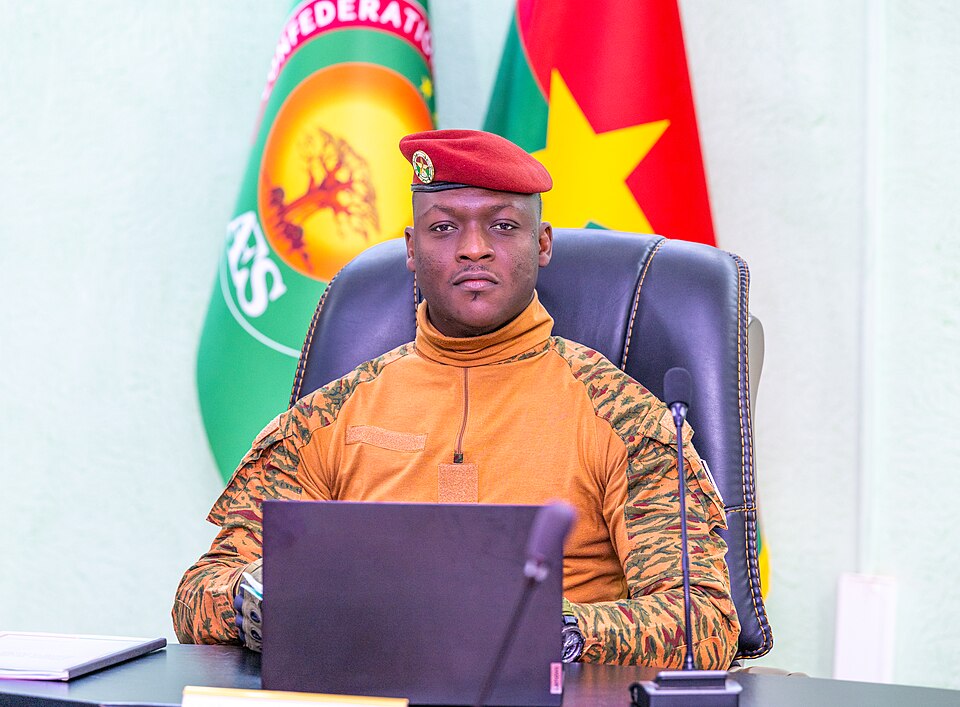

Maulana Usamah Dockrat argues that Ibrahim Traoré’s rejection of Sharīah governance, Islamic scholarship and a faith-based identity exposes a deeper contradiction at the heart of his anti-colonial politics.
Many Muslims were shocked by Ibrahim Traoré’s remarks about the spread of Islam across Africa, his criticism of students pursuing Islamic studies abroad, his rejection of Sharīʿah and the concept of an Islamic state, and his insistence that a person’s passport, rather than their religion, should define their identity.
Yet Traoré did not say anything especially unusual. He merely expressed, more openly than most, the demands of the modern nation-state.
Every nation-state requires national identity to take precedence over Islam. Religion may regulate prayer, marriage, burial and personal morality, but it must never challenge the authority of the state, the supremacy of its constitution or the sanctity of its borders. The Muslim is expected to think first and foremost as a citizen of the state.
Education in service of the state
Traoré’s criticism of students studying Islam abroad reveals another feature of this mentality: knowledge is valued primarily according to its usefulness to the state.
Students are encouraged to become engineers, technicians or administrators because these professions are considered productive, while the study of revelation, Islamic law and theology is treated as unnecessary or even dangerous.
Muslim societies certainly need doctors, scientists, engineers and skilled workers. However, they also require scholars capable of preserving their faith, law, moral vision and intellectual independence. A healthy civilisation needs both.
When education is viewed solely as a means of producing workers and administrators for national development, its value is no longer measured by whether it produces truthful, virtuous and God-conscious people, but by whether it strengthens the machinery of the state.
Traoré’s approach to Islam and Muslim scholarship echoes that of the European colonial administrations that preceded him. Colonial authorities regarded an independent Islam as a political threat and sought to domesticate it into a form that served the colonial state.
Religious institutions were regulated, while compliant scholars were elevated to legitimise an Islam that encouraged obedience to the existing order and abandoned any claim to shape public life.
Anti-colonial rhetoric, colonial categories
Traoré presents himself as an anti-colonial pan-Africanist. Yet by insisting that Burkinabè nationality defines the identity and political belonging of Burkina Faso’s people, he accepts the colonial nation-state as the natural framework through which Africans must understand themselves.
The irony runs far deeper than the relatively minor symbolism of wearing a beret or delivering his argument in French. The borders, nationality and political identity he places above religion are themselves products of the colonial order he claims to reject.
He seeks to decolonise African resources, military alliances and economic relations, but not the categories through which Africans understand religion, education, sovereignty and political belonging.
France may be expelled from the military base while the European conception of the secular nation-state remains firmly embedded in the African mind.
Traoré also reduces the spread and expansion of Islam across Africa to an Arab invasion, equating it with European colonialism and stripping African Muslims of their own rich history as part of the wider Ummah.
Islam did not demand that Africans become Arabs. It brought Arabs, Africans, Persians, Turks, Berbers and countless other peoples into a civilisation defined by faith rather than race.
African Muslims became scholars, rulers, jurists and builders of flourishing Islamic states and centres of learning. Mali, Songhay, Kanem-Bornu and the Sokoto Caliphate were not Arab colonies. Timbuktu became one of Africa’s greatest centres of scholarship.
These were African Muslim societies connected to a wider Ummah in which no Arab was superior to a non-Arab except through righteousness.
Islam was not Western colonialism
This was fundamentally different from Western colonialism.
European powers viewed Africans as inferior and conquered the continent to dominate its people, extract its wealth and reorganise its societies for their own benefit.
Islam, by contrast, incorporated Africans into a wider civilisation without requiring them to become Arabs or reducing them to subjects of an Arab nation.
Traoré rejects Western colonial rule while continuing to think through its most important political categories. He treats Islam, which Africans have professed, taught and preserved — and whose civilisation and scholarly traditions they helped shape — for more than a thousand years as a foreign intrusion.
At the same time, he presents the colonial successor-state, its borders and its passport as the authentic measure of African identity.
This is the deepest victory of colonialism: not when the coloniser continues to occupy the land, but when the supposedly liberated begin to see themselves, their history and their religion through the coloniser’s eyes.
Maulana Usamah Dockrat is an Islamic scholar who graduated from Jami’ah al-Ulum al-Islamiyyah in Johannesburg.