
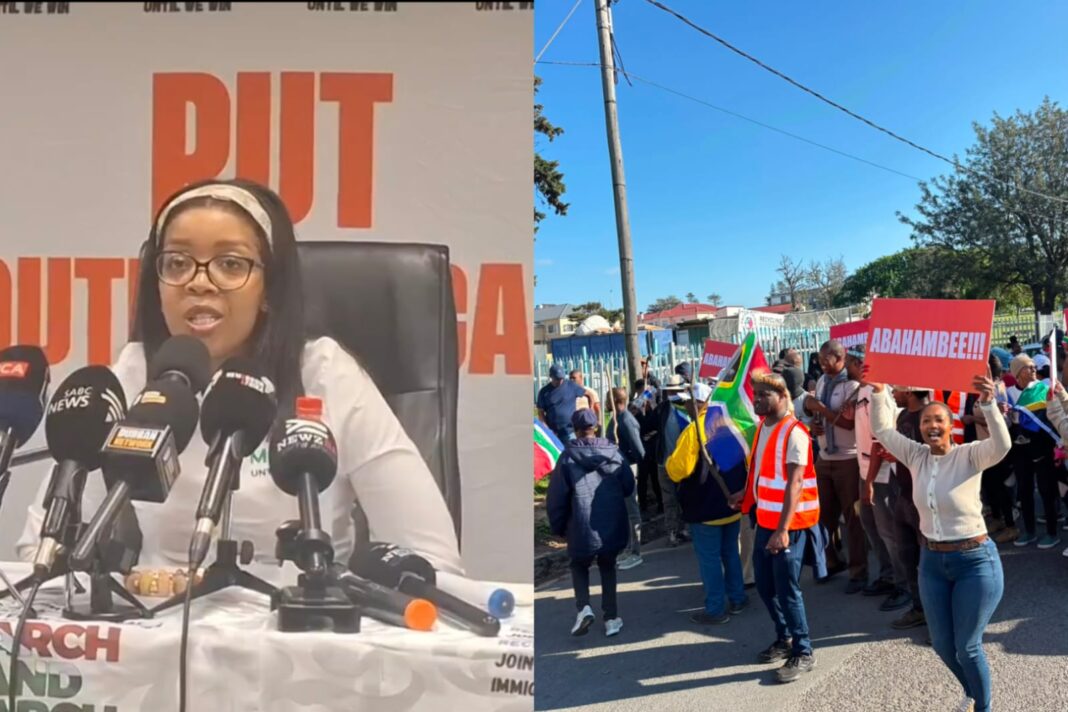

As South Africa approaches 30 June, a date promoted by the civic movement March and March as a deadline for undocumented migrants to leave the country voluntarily, the national debate over immigration has once again intensified.
At the centre of the renewed controversy is Jacinta Ngobese-Zuma, the movement’s founder and one of the country’s most prominent voices calling for stricter immigration enforcement.
To supporters, Ngobese-Zuma is articulating frustrations long ignored by the political establishment, particularly around unemployment, crime and pressure on public services. To critics, she has become the public face of a movement that risks deepening xenophobia and social division.
The growing attention on Ngobese-Zuma has also revived public interest in March and March and Operation Dudula. Although the two movements are frequently conflated, they are separate organisations with distinct origins, leadership structures and legal histories. Understanding these differences is essential to understanding one of South Africa’s most polarising national debates.
Who is Jacinta Ngobese-Zuma?
Ngobese-Zuma, a KwaZulu-Natal activist, entrepreneur and former radio presenter, has built her public profile around campaigning for tougher immigration controls and stricter enforcement of existing laws.
She argues that South Africa’s immigration system has been undermined by weak enforcement and corruption within the Department of Home Affairs, allowing undocumented migrants to remain in the country unlawfully. According to Ngobese-Zuma, her activism is directed at illegal immigration rather than foreign nationals as a group.
Supporters say she is giving voice to widespread frustrations among South Africans struggling with unemployment, poverty and overstretched public services. Critics, however, argue that some of her rhetoric risks fuelling xenophobia by presenting migrants as central contributors to the country’s socio-economic challenges.
The emergence of March and March
In 2025, Ngobese-Zuma launched March and March, a civic movement that describes itself as committed to lawful and peaceful activism aimed at strengthening border security and ensuring the enforcement of immigration legislation.
The organisation has organised demonstrations in several provinces and has called on undocumented migrants to leave South Africa voluntarily, while urging the government to restore what it describes as the rule of law.
The movement has recently intensified its campaign ahead of 30 June 2026, a date it has publicly promoted as a deadline for undocumented migrants to leave South Africa voluntarily. March and March has indicated that it plans further mobilisation and demonstrations if the government fails to act, a stance that has heightened public debate and attracted both support and criticism.
Ngobese-Zuma has repeatedly rejected accusations that the movement is xenophobic, maintaining that its focus is the enforcement of immigration laws rather than hostility towards foreign nationals.
How is it different from Operation Dudula?
March and March is frequently confused with Operation Dudula, but the two are distinct organisations.
Operation Dudula emerged in 2021 amid growing public anger over unemployment, crime and illegal immigration. The term dudula, derived from isiZulu, broadly means “push back” or “force out”.
The movement became known for community operations in which members visited businesses, informal settlements and public facilities, questioned people’s immigration status and called for the removal of undocumented migrants.
Although Operation Dudula maintained that it was targeting illegal immigration, its methods attracted widespread criticism from civil society organisations, legal experts and human rights groups, who accused the movement of vigilantism, intimidation and xenophobia.
Operation Dudula was founded by Zandile Dabula, who became one of its most prominent leaders. While Ngobese-Zuma was at times publicly associated with some of the movement’s campaigns, she later established March and March as an independent organisation with its own leadership and objectives.
Xenophobia has no place in Islam, watch Shaykh Laja Yasini explain.
A landmark court ruling
Operation Dudula’s activities eventually led to one of the most significant legal rulings on xenophobia in recent South African history.
In November 2025, the Gauteng Division of the High Court in Johannesburg ruled that several of the movement’s actions were unlawful and xenophobic in a case brought by Kopanang Africa Against Xenophobia (KAAX) and other civil society organisations.
The court prohibited Operation Dudula and its leadership from blocking access to hospitals, clinics, schools and trading areas; demanding passports or identity documents from members of the public; carrying out unlawful evictions; assaulting or intimidating people identified as foreign nationals; and publishing statements that promote hatred based on nationality, ethnicity or social origin.
The judgment reaffirmed that only authorised law enforcement and immigration officials have the legal authority to enforce South Africa’s immigration laws.
A debate far from settled
As South Africa continues to wrestle with border management, economic hardship and mounting public frustration, organisations such as March and March and Operation Dudula have become symbols of a deeply divided national conversation.
For some, these movements represent citizens demanding accountability and stronger enforcement of existing laws. For others, they serve as a warning of how social and economic frustrations can spill over into discrimination and exclusion.
Whatever one’s perspective, the debate has exposed difficult questions about immigration, governance, constitutional rights and social cohesion, questions South Africa can no longer afford to ignore.