
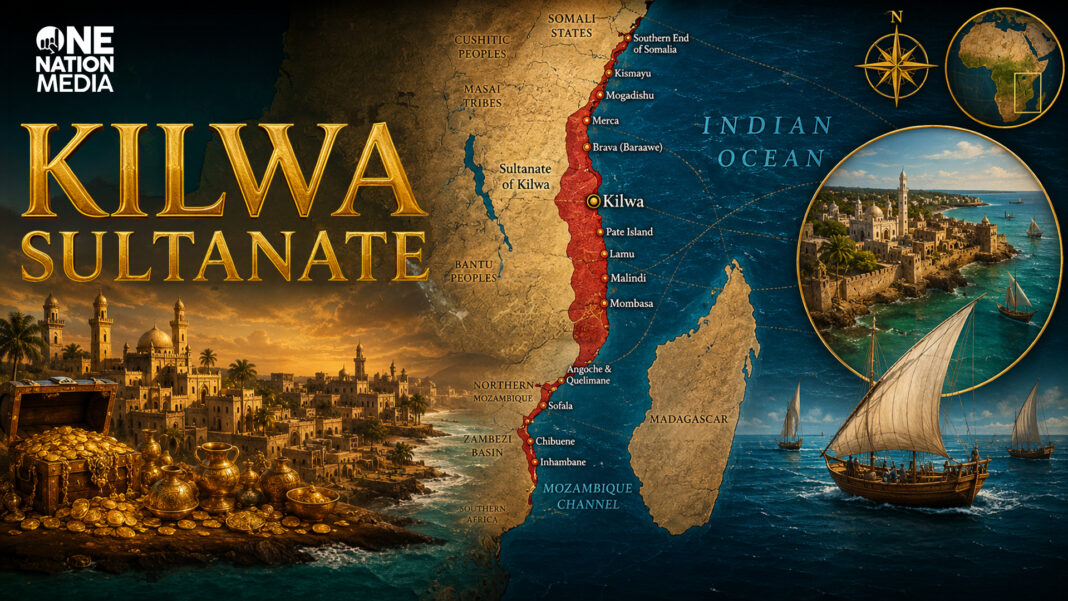

For centuries, the Indian Ocean was one of the world’s great highways of commerce, carrying merchants, scholars, sailors and travellers between Africa, the Middle East and Asia. Long before European colonial powers entered these waters, Muslim trading networks had already connected distant civilisations through the rhythm of the monsoon winds. Along Africa’s eastern coastline, a chain of Swahili Muslim cities emerged from this oceanic world, growing wealthy through trade and deeply shaped by Islam, writes Neelam Rahim.
Among the greatest of these coastal powers stood the Kilwa Sultanate, centred on the island city of Kilwa Kisiwani off the coast of present-day Tanzania. The sultanate rose from a modest settlement into one of medieval Africa’s most important trading centres. From its ports, African gold entered global markets, merchants arrived from Arabia, Persia and India, and Swahili culture flourished at the crossroads of continents. Kilwa was not simply a city enriched by trade, but a Muslim maritime kingdom that helped shape the political and economic life of the Indian Ocean world.
Kilwa’s rise formed part of the wider growth of Swahili civilisation along East Africa’s coastline. Over generations, African coastal communities traded with Muslim merchants arriving by sea, producing a distinct Swahili identity: African in roots, Islamic in faith and ocean-facing in outlook.
According to tradition, Kilwa was founded by Ali ibn al-Hassan Shirazi, who is believed to have arrived from Persia around the 10th century. While parts of this account remain debated by historians, Kilwa’s transformation into a major Muslim city-state is well established. What made Kilwa remarkable was not foreign influence alone, but the way African Muslim societies absorbed, adapted and built a thriving civilisation through trade, faith and political organisation.
The city built on gold
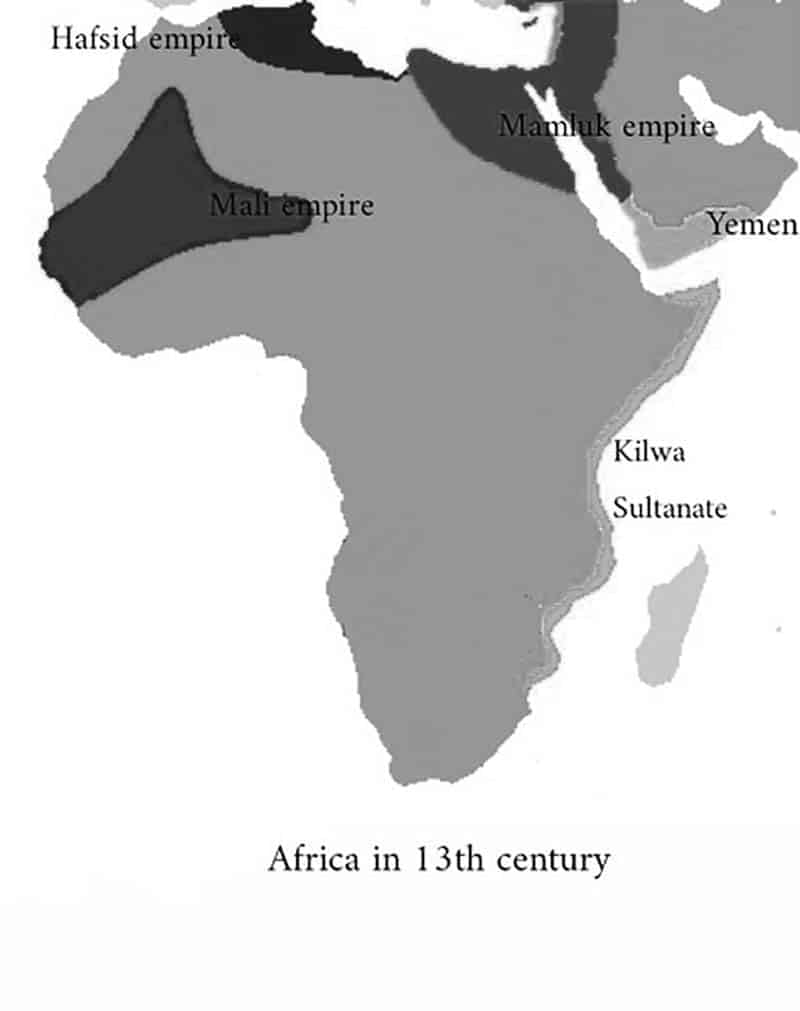
By the 13th century, Kilwa had become one of the wealthiest trading powers on the Swahili coast, with much of its prosperity coming from its role in the gold trade from southern Africa. Gold travelled through inland caravan routes before reaching Kilwa’s ports, where it was exported across the Indian Ocean to markets in Arabia, Persia and Asia. In return came silk, spices, porcelain, jewellery and fine textiles from distant lands, turning Kilwa into a gateway between Africa and the wider world.
The famous Moroccan traveller Ibn Battuta visited Kilwa in the 14th century and described it as a prosperous and beautiful Muslim city. He praised its ruler for generosity and noted the strong Islamic character of society. His account remains an important reminder that parts of Africa were already urban, connected and internationally engaged centuries before colonial rule.
A stone city of Islam
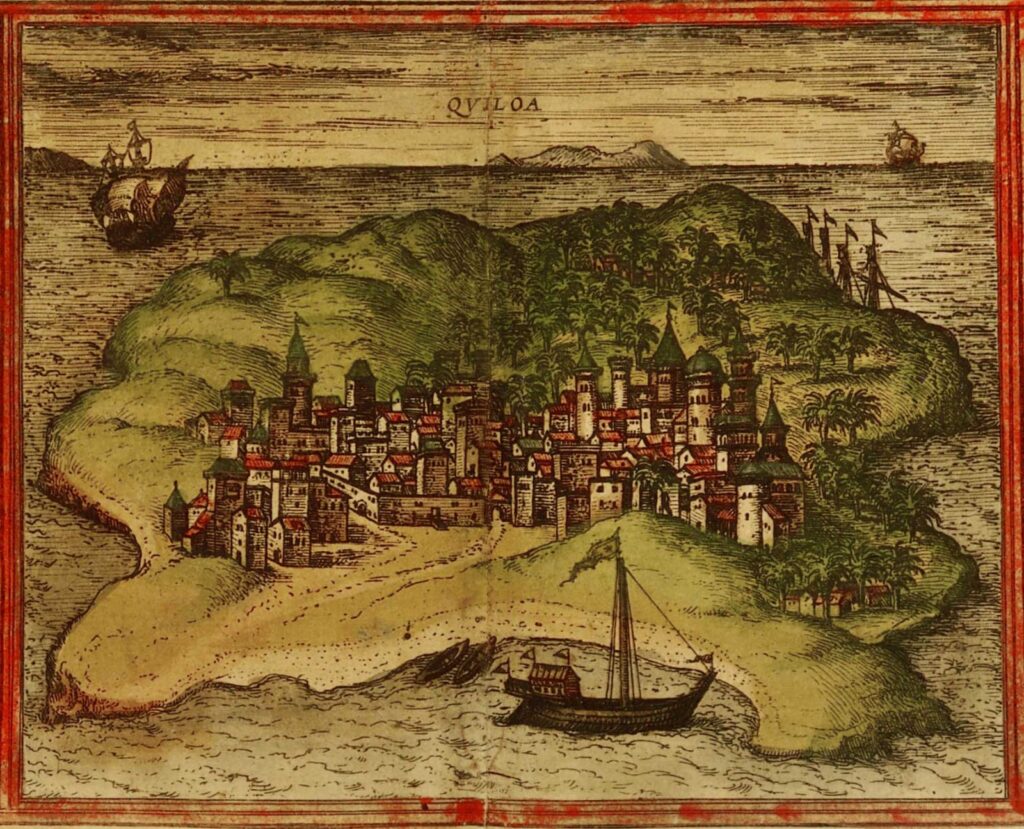
Kilwa’s wealth could be seen in its architecture. The Great Mosque of Kilwa became one of the most important mosques on the Swahili coast. Built from coral stone taken from the sea, it reflected the confidence of a growing Muslim society rooted in worship, learning and trade.
Nearby stood Husuni Kubwa, a vast palace complex overlooking the ocean. With its courtyards, halls and storage rooms, it symbolised the scale of Kilwa’s authority and commercial power. Across the island, stone houses, markets and mosques formed a thriving coastal city shaped by both commerce and faith.
Kilwa Kisiwani was not an isolated settlement on the edge of civilisation, but part of a wider network of Swahili Muslim cities that connected Africa to one of the busiest trading worlds of the medieval era.
Trust and Trade
In Kilwa, Islam shaped far more than religious life, it influenced trade, governance, diplomacy and social order. Muslim merchants carried not only goods across the ocean, but also ideas, language, scholarship and culture.
The Sultan ruled as both a political authority and protector of a maritime trading system that stretched across continents. This shared Islamic framework helped build trust between merchants from different regions, allowing trade to flourish across vast distances.
Kilwa’s success showed that Islam in Africa was not separate from commerce or civilisation-building, but stood at the centre of both.
The Portuguese disruption
Kilwa’s dominance eventually began to weaken towards the end of the 15th century, when Portuguese ships entered the Indian Ocean seeking control over the lucrative trade routes long dominated by Muslim merchants and coastal African states.
The arrival of Vasco da Gama marked the beginning of a new era of foreign intervention along the Swahili coast. Portuguese military expansion disrupted existing trade networks and weakened many of the Muslim coastal kingdoms that had flourished for centuries. Over time, Kilwa’s political and commercial influence declined, but its civilisational legacy endured.
Kilwa’s Civilisational Legacy
Today, the ruins of Kilwa Kisiwani and nearby Songo Mnara remain among the most important historical sites in Africa. Recognised by UNESCO as a World Heritage Site, they continue to testify to the sophistication of the Swahili Muslim world.
But Kilwa’s true legacy extends far beyond stone ruins. Its history lives on in the Swahili language, in East Africa’s coastal Muslim culture and in the memory of an African civilisation that stood confidently at the centre of global trade.
Kilwa reminds the modern world that Africa was never isolated from commerce, governance or civilisation. Along the shores of the Indian Ocean, Muslim societies built cities, controlled trade routes and connected continents centuries before European colonial powers arrived. It stands as proof that African Islamic civilisation was organised, wealthy, outward-looking and globally connected long before Europe attempted to write itself into the centre of Africa’s story.