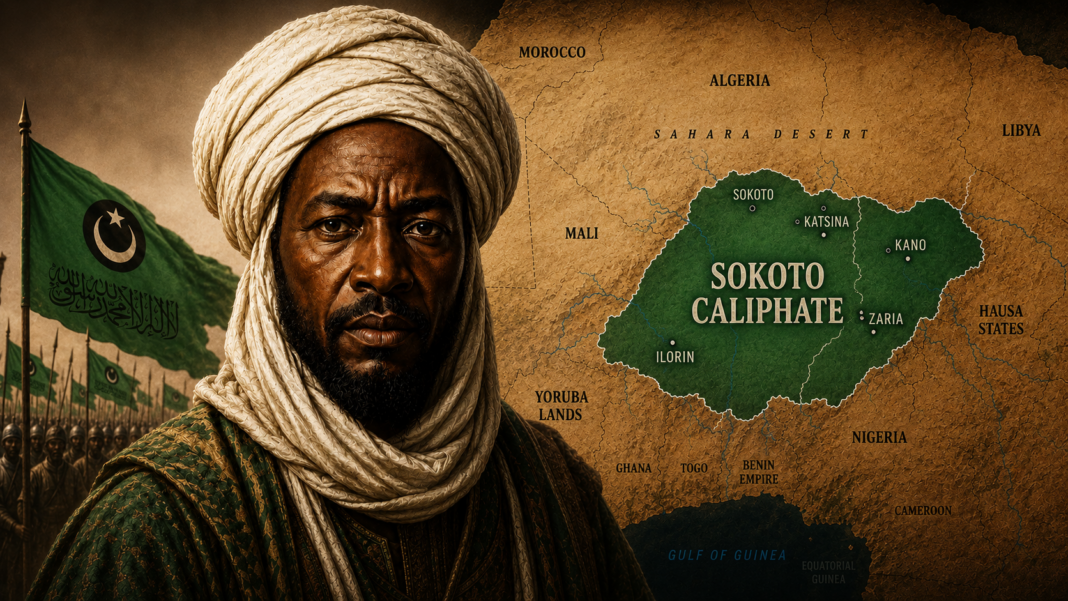

Across the vast plains of the Sahel, where caravans once carried gold, salt and manuscripts between West and North Africa, a powerful Islamic state emerged in the 19th century that would reshape the political and intellectual landscape of the continent, writes Neelam Rahim.
At the centre of that transformation stood Usman dan Fodio — a Fulani Muslim scholar, jurist, reformer and revolutionary leader whose movement gave birth to the Sokoto Caliphate, also known as the Sultanate of Sokoto, one of the largest and most influential Islamic states in African history.
Far more than a regional kingdom, the Sokoto Caliphate represented a sophisticated attempt to organise society around Islamic law, scholarship, justice and moral accountability at a time when much of Africa was facing political fragmentation and, later, European colonial expansion.
The scholar who challenged power
Born in 1754 in Gobir, in present-day northern Nigeria, dan Fodio came from the Fulani people, a widely dispersed Muslim community known across West Africa for pastoralism, trade and Islamic scholarship. He was educated in Qur’anic sciences, Arabic, theology and Maliki jurisprudence, developing within a sophisticated network of Islamic learning that connected Hausaland to major centres of scholarship such as Timbuktu and beyond.
Long before European colonialism arrived, West Africa already possessed deeply rooted Islamic intellectual traditions. Mosques, manuscript libraries, scholarly networks and Qur’anic schools formed part of a flourishing Muslim civilisation stretching across the Sahel.
The Sokoto Caliphate stood as further evidence that sophisticated systems of law, education, governance and administration existed in Africa long before European powers claimed to bring “civilisation” to the continent.
Dan Fodio emerged from this environment but became increasingly critical of the political order around him. He condemned rulers whom he viewed as corrupt, oppressive and disconnected from Islamic principles. Excessive taxation, abuses of power and the mixing of Islamic governance with un-Islamic customs became central themes in his preaching.
His message resonated widely among Fulani pastoralists, Hausa peasants, merchants, scholars and students. What began as a religious reform movement gradually evolved into a broader social and political awakening.
Islam as a system of governance
For dan Fodio, Islam was never confined to private spirituality or ritual worship. It was a complete framework for governance, law, economics, ethics and social order.
He wrote extensively on leadership, justice, education and the responsibilities of rulers, arguing that political authority had to remain accountable to divine law rather than personal ambition, tribal loyalty or dynastic power.
This reflected a long-standing Islamic political tradition in which governance was inseparable from moral responsibility. Judges, scholars and rulers were all bound by Sharia and accountable before God.
At a time when secular political systems increasingly divorce morality and revelation from governance, dan Fodio represented a fundamentally different model — one in which political legitimacy was tied to justice, moral conduct and submission to divine principles.
Revolution and the rise of the Sokoto Caliphate
By 1804, tensions between dan Fodio’s movement and the rulers of Gobir had escalated into open confrontation. Facing persecution, he declared a jihad, understood not simply as warfare, but as a comprehensive struggle to restore justice and Islamic rule.
What followed became one of the most transformative political revolutions in African history.
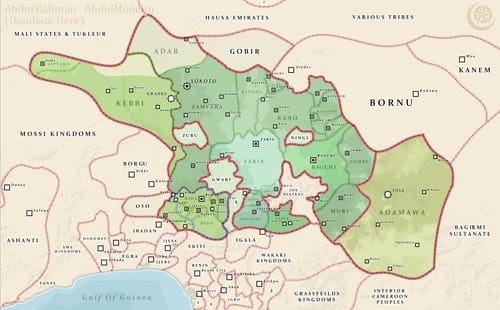
Dan Fodio’s movement rapidly expanded across Hausaland, overthrowing several Hausa kingdoms and replacing fragmented political structures with a unified Islamic political order. From this emerged the Sokoto Caliphate, which grew into one of the largest states in 19th-century Africa.
At its height, the caliphate stretched across much of present-day northern Nigeria and parts of Niger, Cameroon and Burkina Faso. Yet its strength did not rest solely on military expansion. Its durability came from institutions rooted in Islamic scholarship, administration and law.
Cities such as Sokoto, Kano, Katsina and Zaria became major centres of learning and governance. Islamic courts operated through qadis trained in jurisprudence, while scholars and teachers occupied central roles in public life. Arabic and Ajami literacy expanded widely, manuscript culture flourished and scholarly production increased across theology, law, governance and ethics.
The caliphate became one of the most intellectually active Islamic societies in sub-Saharan Africa.
British colonialism and the destruction of Islamic rule
Although often remembered through the lens of jihad, dan Fodio gradually withdrew from political leadership and dedicated his later years to teaching, writing and spiritual reflection until his death in 1817. Leadership consolidation and military administration were largely carried out by his brother Abdullahi dan Fodio and his son Muhammad Bello.
The Sokoto Caliphate continued for nearly a century after his death before confronting British colonial expansion in the early 20th century. In 1903, British forces defeated the caliphate following military campaigns across northern Nigeria. Sultan Muhammadu Attahiru I resisted colonial occupation but was eventually killed during retreat.
The colonial conquest did not simply remove a political authority. It dismantled an indigenous Islamic governance system that had rooted law, education and public administration within an Islamic framework.
European colonialism replaced indigenous Islamic political structures with foreign systems designed to subordinate Muslim societies economically, politically and intellectually under imperial rule.
Yet despite the collapse of its sovereignty, the intellectual and religious legacy of the Sokoto Caliphate endured. The Sultan of Sokoto remains an important symbolic Muslim authority in northern Nigeria today, while dan Fodio continues to be remembered as one of Africa’s most influential Islamic reformers.
More than two centuries later, the Sokoto Caliphate stands as a reminder that Africa’s Islamic history was never marginal or peripheral. It produced scholars, institutions and governing systems that sought to organise society around revelation, justice and moral accountability.
For many Muslims today, that legacy remains more than history. It remains evidence that Islamic civilisation in Africa once functioned not merely as belief or identity, but as governance, intellectual life and societal order.
You can read more of One Nation Media’s Islamic civilisation and African history features here.