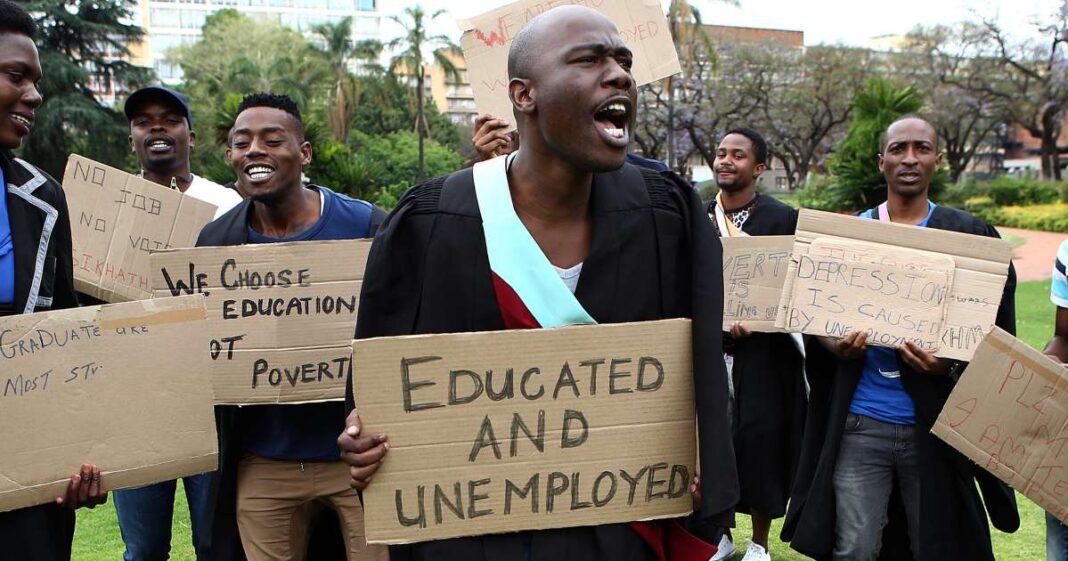

South Africa’s celebratory mood marking 32 years of democracy was quickly overshadowed by the announcement that the country’s unemployment rate had risen by 1.3 percentage points to 32.7% in the first quarter of 2026.
The increase translates into more than 300,000 South Africans losing their jobs in just three months. Official unemployment has now remained above 30% for more than five consecutive years, placing South Africa among the worst-performing labour markets in the world.
The crisis has deepened already extreme levels of inequality, prompting Nobel Prize-winning economist Joseph Stiglitz to describe South Africa’s condition as an “inequality emergency” during the G20 summit held in Johannesburg last year. The wealthiest 10% of South Africans control approximately 86% of the country’s wealth, while the bottom 90% share just 14%.
More than three decades after the end of Apartheid, those figures reinforce a growing belief that political freedom has not translated into meaningful economic transformation for the majority of the population.
Thirty-two years after South Africa’s first democratic elections brought formal Apartheid to an end, the country remains caught between the promise of political freedom and the unfinished struggle for economic justice.
What did ending Apartheid achieve?
The victory of 1994 delivered universal suffrage, constitutional democracy and the legal dismantling of white minority rule. It restored dignity to millions denied humanity under Apartheid and established one of the world’s most progressive constitutions.
Yet for many South Africans, democracy is no longer judged by constitutional ideals, but by whether it can provide work, security, food, functioning services and a meaningful future.
Marking Freedom Day this year, South African President Cyril Ramaphosa described the Constitution as the country’s “shield against injustice”, arguing that democracy had widened access to healthcare, education, housing, water and electricity.
Those gains are undeniable. Under Apartheid, Black South Africans were systematically excluded from quality education, healthcare, secure housing and basic infrastructure.
Since 1994, millions have gained access to formal housing, electricity, sanitation and social grants, while expanded tertiary funding has opened universities and colleges to students from poor and working-class families.
For many households, the abolition of Apartheid fundamentally changed the trajectory of an entire generation.
Muslims in the post-Apartheid era
Yet the deeper economic structure of Apartheid survived the political transition far more intact than many expected.
Youth unemployment remains catastrophic, trapping millions born after liberation in cycles of hopelessness and dependency. Poverty continues to define life across large parts of both rural South Africa and urban informal settlements, exposing how the racial and economic architecture built under colonialism and Apartheid was never fundamentally dismantled after 1994. Political liberation transferred voting power, but economic power largely remained concentrated in the hands of a small elite.
South African Muslims were themselves part of the broader anti-Apartheid struggle, with Islamic organisations, scholars and activists playing important roles in resistance movements, community mobilisation and welfare support during decades of racial rule.
In the post-1994 era, Muslim institutions have continued contributing significantly through schools, humanitarian organisations, clinics, feeding schemes, orphan support and charitable networks that often fill gaps left by failing state structures.
Islamic principles of justice also offer a broader framework through which many Muslims assess South Africa’s democratic journey.
In Islam, justice is not confined to elections or legal equality alone, but includes economic fairness, accountability in leadership, protection of human dignity and social responsibility towards the poor and vulnerable. Persistent poverty, corruption, inequality and unemployment are therefore not merely economic concerns, but moral and societal failures that undermine the very purpose of governance.
At the same time, post-Apartheid South Africa has provided Muslims with freedoms denied to many Muslim minorities elsewhere in the world. Muslims openly practise their faith, establish institutions, build mosques, operate independent media and participate fully in public life under constitutional protections for religious freedom. South Africa’s democratic framework has therefore created both opportunity and responsibility for Muslims: the opportunity to practise Islam freely, and the responsibility to contribute meaningfully towards justice and social reform within wider society.
Crime, corruption and collapsing service delivery have further deepened public frustration. Violent crime, organised criminal networks, failing municipalities and deteriorating infrastructure increasingly shape daily life, while trust in state institutions continues to erode. Many South Africans no longer believe political leaders, municipalities or law enforcement structures act in the public interest.
South Africa at 32 is therefore neither a failed state nor a completed success story. It is a nation suspended between extraordinary democratic achievement and profound unfinished business, a country where constitutional freedoms coexist alongside unemployment, hunger and economic exclusion.
The generation that voted in 1994 won political liberation. The generations after them are still waiting to see whether democracy can deliver economic liberation too.
That is the unresolved question of South Africa’s 32nd year: was democracy enough, or is its true test still to come? The jury, for now, is still out.