


Claims by US President Donald Trump that white South Africans are facing a “white genocide” have once again brought international attention to a narrative that has been widely debunked.
These assertions, echoed in some political and online circles, do not align with official crime data, court rulings, or findings from independent organisations.
Under the United Nations Genocide Convention, genocide refers to “the deliberate and systematic attempt to destroy a national, racial, ethnic, or religious group”. It requires proven intent to eliminate a population, not simply high levels of crime or social instability.
In South Africa, there is no evidence of such intent against white citizens. The country does, however, face a severe violent crime crisis that affects all communities. The majority of murder victims are black South Africans, reflecting broader issues of inequality, poverty, and systemic violence.
Farm attacks are often central to the “white genocide” narrative. While these incidents are deeply concerning and frequently violent, they represent a very small fraction of total murders, around 0.2%. In the first quarter of 2025, six people were killed in farm-related attacks: five were black and one was white. Investigations have consistently shown that these crimes are driven mainly by robbery and opportunistic violence rather than racial targeting.
South African courts have also weighed in on the issue. In February 2025, a court dismissed the idea of a “white genocide” as “clearly imagined” and “not real”, reinforcing what crime statistics already indicate.
Trump, Elon Musk, and South Africa
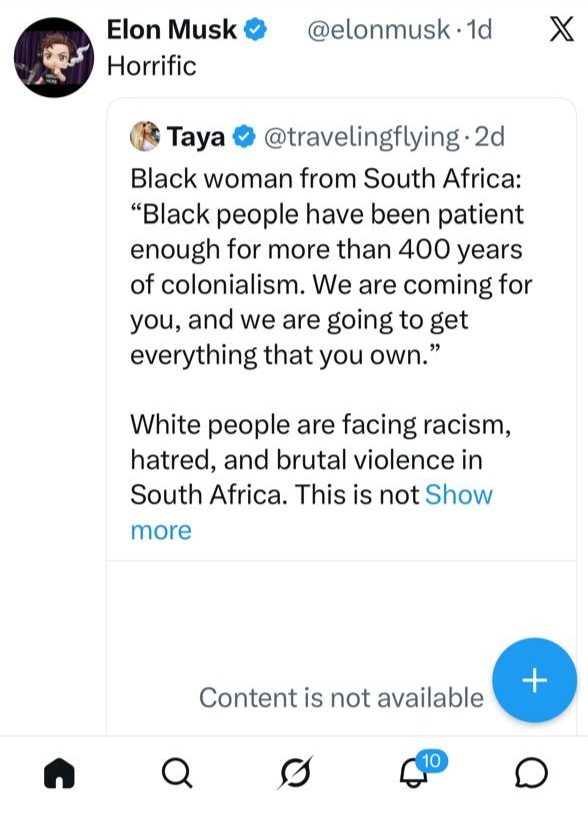
Despite this, the narrative continues to circulate globally. It has been amplified not only by Trump but also by his associate Elon Musk, both of whom have referenced the idea of targeted violence against white farmers. The claim has also surfaced in discussions around asylum applications in the US, where some individuals have cited alleged racial persecution. However, under international refugee law, such claims must be supported by evidence of targeted, systemic oppression, which has not been established in this case.
South Africa’s foreign policy decisions, including its case against Israel at the International Court of Justice (ICJ), have also intensified political scrutiny abroad, shaping how the country is portrayed in certain geopolitical narratives.
Ultimately, the evidence does not support the claim of genocide. What exists in South Africa is not a campaign of racial extermination, but a complex and unequal society struggling with violent crime. Conflating the two does not clarify reality; it distorts it, and in doing so weakens the meaning of genocide itself, which political allies of Israel have sought to diminish.