
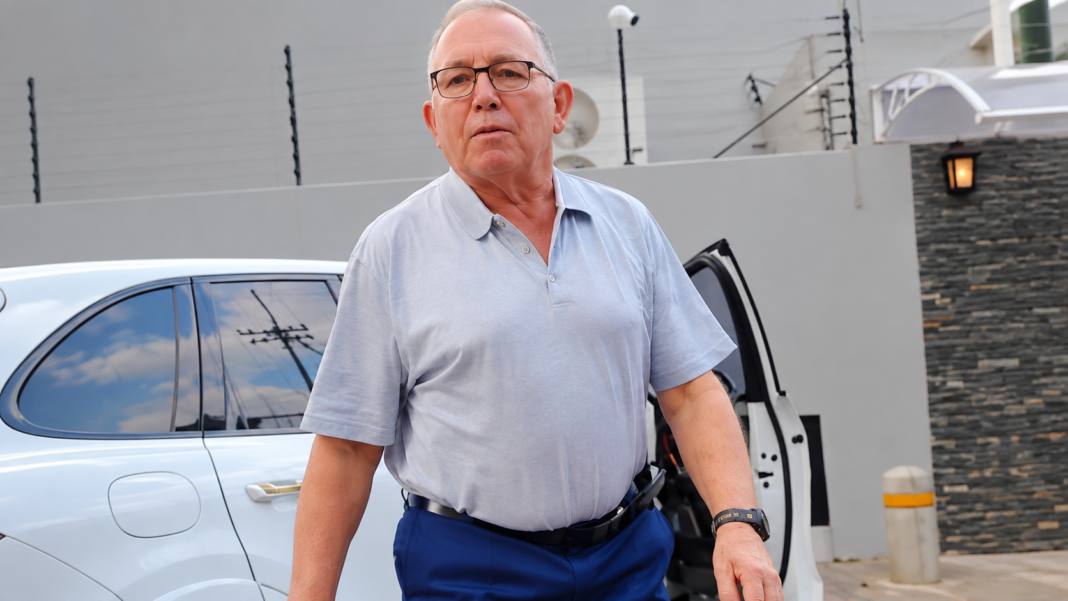

The racist and Islamophobic abuse in Norwood, Johannesburg has been condemned as an isolated incident. But when anti-Muslim hatred is accompanied by hostility towards Palestinians, condemning one individual’s behaviour is not enough. The wider political narratives that normalise dehumanisation must also face scrutiny, writes Moulana Uwais Dockrat.
A Muslim man, Abdur Rahmaan Aziz, was targeted by a Jewish businessman, Rodney Plett, in a tirade in which Muslims were collectively abused, racist slurs were used, and the war in Gaza entered the confrontation.
The incident started when Plett, driving a white Porsche Cayenne GTS, began aggressively tailing, hooting, and flashing his lights at Aziz’s car. Thinking the driver might just be a fan who recognised him, Aziz rolled down his window. Instead, he was hit with a wave of racist and furious abuse. Video recorded at the scene shows the driver, identified as Plett, launching into a disgusting attack, shouting horrible racist slurs including “Indian c***”.
The attack quickly turned into explicit Islamophobia and political bullying. In a moment that has sparked outrage across South Africa, Plett used the war in the Middle East to insult Aziz. He shouted that he now understood why Israelis are “killing you in Gaza”, using a global tragedy to humiliate a fellow citizen.
The South African Jewish Board of Deputies (SAJBD) condemned the conduct, while its Gauteng chairperson, Danny Mofsowitz, described it as an “isolated incident”.
The actions of one man do not represent an entire community. But the discussion cannot end there.
The real question is whether the ideas expressed in Norwood were themselves born in isolation.
A person can act individually without thinking independently.
That distinction matters.
The SAJBD itself acknowledged that events in the Middle East have created tensions between Jewish and Muslim communities. The same response that described the incident as isolated therefore recognised the wider political environment surrounding it.
This is precisely why Zionism cannot simply be removed from the discussion.
Zionism is a political ideology, distinct from Judaism as a religion and from Jewish identity. Its political expression in relation to Palestinians, particularly through the policies and rhetoric of the Israeli state, raises questions about how Palestinian suffering is justified, how resistance is portrayed and how entire communities can become associated with collective suspicion.
The SAJBD has publicly expressed its political position. Following 7 October 2023, it declared that the “South African Jewish community stands with Israel”.
When an incident involving anti-Muslim hostility includes references to Gaza, it is therefore legitimate to examine whether the wider political discourse surrounding Israel and Palestine has influenced attitudes closer to home.
That is not collective blame. It is an examination of ideology and its consequences.
The International Court of Justice’s January 2024 provisional measures order recorded statements by senior Israeli officials, including then-defence minister Yoav Gallant referring to those Israel was fighting as “human animals” and President Isaac Herzog declaring that responsibility extended to an “entire nation”.
This is why rhetoric matters.
When Palestinians are repeatedly discussed through the language of collective threat, suspicion and enemy identity, questions arise about whether those attitudes remain confined to Israel and Palestine.
Human beings do not leave their ideological frameworks behind when they board an aeroplane.
Ideas travel. Political narratives travel. So do the categories through which people learn to view others.
Simply saying that one individual was responsible does not answer the deeper question.
Of course, he remains individually accountable for his words and conduct. But individual responsibility does not establish ideological isolation.
Nor do positive relationships between Muslims and Jews mean that prejudice cannot be influenced by a wider political environment. Both realities can exist simultaneously.
And this brings us to the response from some Muslims.
There appears to be an eagerness to welcome such statements, commend them and celebrate them as though an extraordinary moral position has been taken.
For what?
For condemning racism? For declaring that threatening Muslims is unacceptable?
That is the minimum expected of any organisation committed to human dignity.
There is no reason to treat such a condemnation as the conclusion of a much wider conversation.
A statement rejecting blatant racism does not resolve the harder questions surrounding Zionism, political advocacy and the rhetoric used to justify Palestinian suffering.
Nor should expressions of communal harmony become a substitute for examining the political narratives that may contribute to hostility.
For Muslims, this is also a question of principle.
The Qur’an teaches that hostility towards a people must never become a justification for injustice (5:8). This principle demands consistency in how we recognise human dignity, whether the person facing discrimination is a Muslim in Johannesburg, a Jewish South African or a Palestinian in Gaza.
If dehumanising language is unacceptable in Johannesburg, it must remain unacceptable when directed at Palestinians thousands of kilometres away.
If Muslim South Africans are expected to recognise the humanity and individuality of their Jewish neighbours, Palestinians are entitled to that same recognition.
The dignity of one community cannot depend on the denial of another’s.
This is not an argument for holding Jewish South Africans collectively responsible for the conduct of one individual or the actions of the Israeli state. It is a political and moral argument about Zionism, the rhetoric surrounding Palestinian dehumanisation and whether such narratives can contribute to the hostility that organisations later condemn when it appears locally.
Calling Norwood an “isolated incident” does not, by itself, settle that question.
Condemning racism is necessary. But the discussion cannot stop at its most visible expression while leaving the political narratives that may contribute to it beyond scrutiny.
You cannot condemn the symptom while insisting that the disease is irrelevant to the discussion.