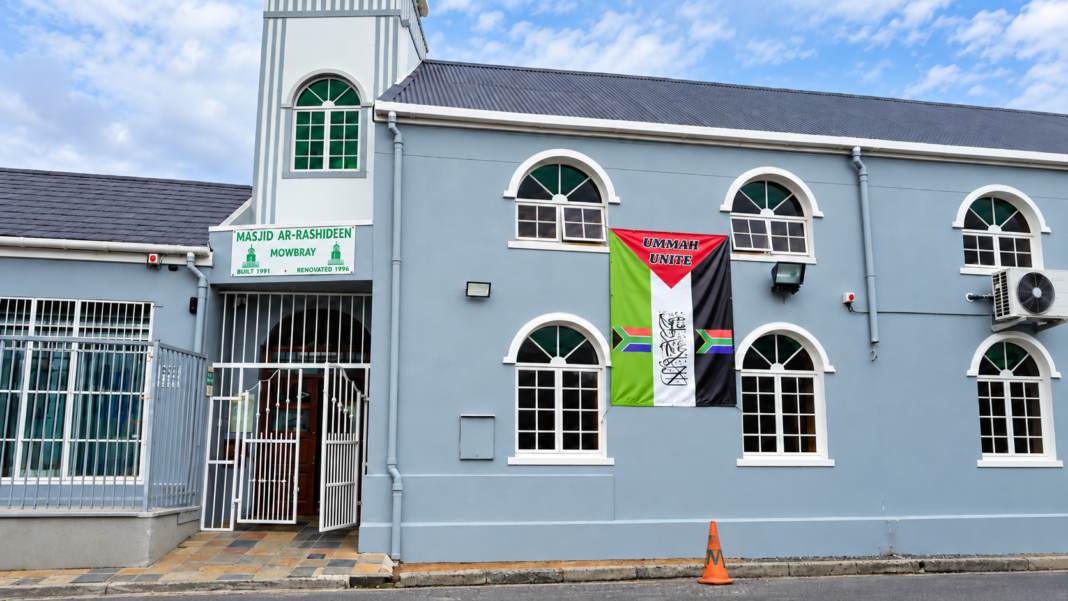

Sixty-five years after apartheid’s forced removals tore a community apart, a Cape Town family has found peace in knowing that the home they were forced to leave behind now belongs to their local mosque.
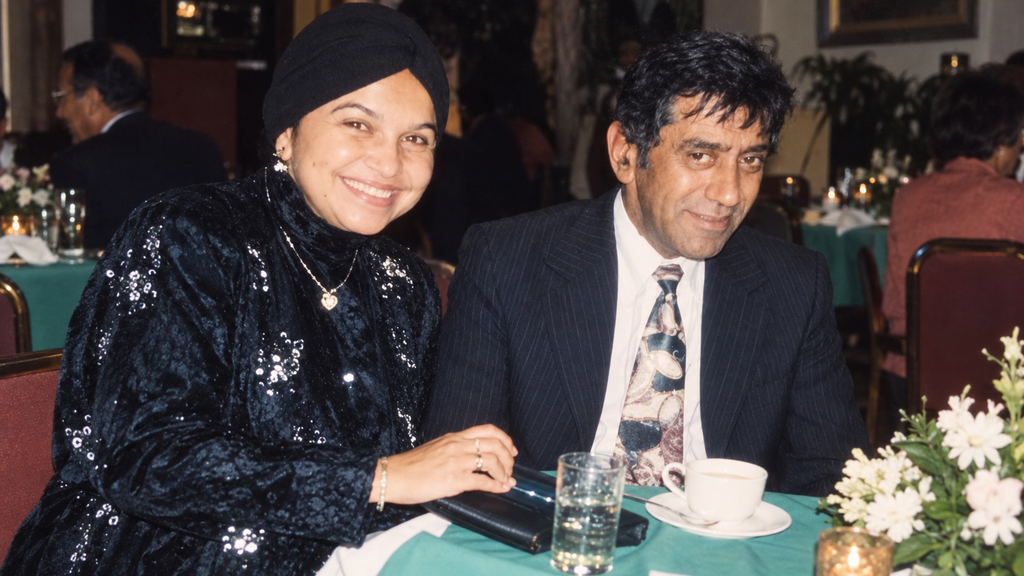
“Alhamdulillah, my heart is at ease because our family home is now the property of our Mowbray Masjid,” says Abdullah Samsoedien, 85, standing on the same street from which he was evicted as a young man.
His is not just a personal story. It is the story of Mowbray, a suburb in Cape Town’s southern suburbs where former residents, forcibly removed under the Group Areas Act, are gradually reconnecting with the homes and community they lost.
A R3,000 payout for a family home
Samsoedien’s family owned a three-bedroom house on the same road as Masjid Ar-Rashideen. His father died at 42, leaving his mother, a dressmaker, to raise four children alone.
Then came the eviction.
“In the 1960s they forced us out,” he says. “The house stood dormant for a couple of years and was then auctioned. My mother only received R3,000 for it.”
It was a meagre amount even then. The family was relocated to Athlone before eventually building a house in Crawford in 1976.
His wife, Shanaaz, 84, originally from Napier Street in the Bo-Kaap, suffered the same fate in her own community.
“Having to leave was the saddest thing,” she says. “Seeing this one leave today, and another family leaving tomorrow and another the day thereafter. The apartheid government never understood what they did to us.”
“It is something one cannot forget. There were so many tears. It made people sick and people died of heartache. They messed up our people when they scattered us.”
When one street was a family
What hurts most, Samsoedien says, is not simply the loss of the house, but the community and way of life that disappeared with it.
“We had a very, very close community. It was like family. Extremely good relationships and always there for one another. People would be in and out of one another’s homes, helping each other. Four houses would share one snoek for supper.”
It was a close-knit, religiously diverse community that apartheid’s forced removals would eventually dismantle.
“We lived with Muslims, Christians, Indians, whites and Portuguese people and we went to churches in the area for funerals and the Christians went to the mosque. We all respected one another’s religions and we loved one another.”
Years after the forced removal, Samsoedien took his children to see their old house. While standing outside, someone tapped him on the shoulder. It was a Christian childhood friend.
“He hugged me and cried, saying money can’t buy this or what we had.”
“It was hard for everyone that went through the evictions,” Samsoedien adds. “We could never get that life again anywhere else because we were all thrown into different areas where we had to start over.”
Samsoedien, who attended St Peter’s School and later became a stalwart of the Mowbray community, carries those memories with him as a musallee of the very mosque that now owns his former family home.
From family home to waqf
Mowbray Masjid purchased the Samsoedien family home about 15 years ago from an Irishman for R315,000.
The property had served as a bank before being converted into a shop and later a residence. It is now undergoing further renovations for residential use.
The purchase forms part of a deliberate strategy by the mosque to build a property portfolio that generates sustainable income.
“The Masjid thought it would be wise to expand its property portfolio to create rental income for the masjid, so we bought equity,” explains treasurer Igsaan Salie.
“These properties are rent-generational or have income capability to cover operational costs and expenses which includes utilities and salaries etc.”
“The operational cost is punitive and puts tremendous stress on community and management. The rent generated from the properties is waqf — money for Allah — and it takes the stress from the management and allows the Imam and others to focus on what the Masjid is for.”
Today, the mosque owns four properties in the area, all generating waqf income to support its operations.
“We acquired these properties over a period of time to create waqf income,” says Feroza Salie. “Our forefathers had a vision to expand the mosque and when property became available they purchased. My father was the chairperson of the mosque committee years ago and he always said that if the niyyah or intention was strong then it became possible and the money came.”
A 135-year-old mosque, kept alive
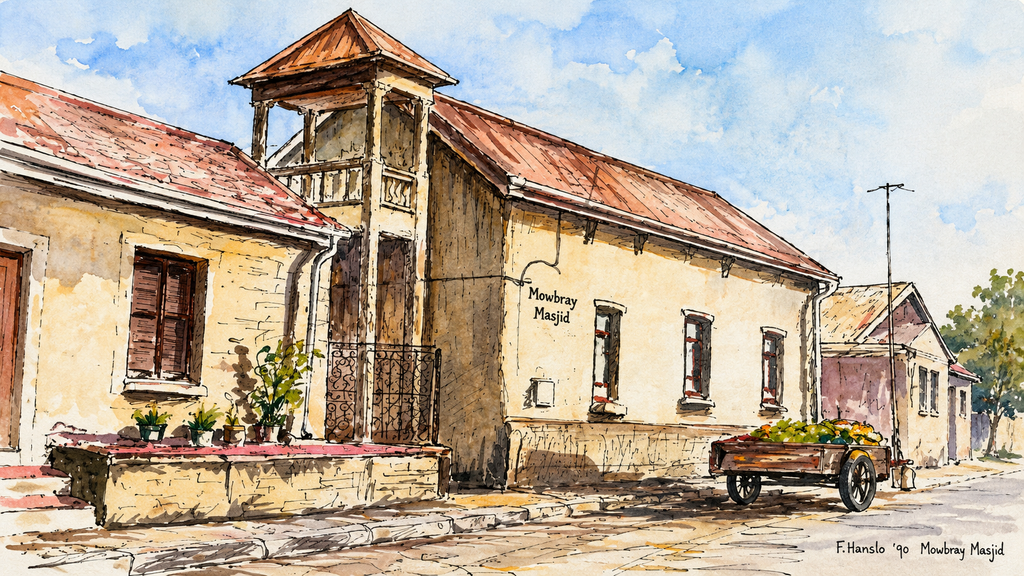
Masjid Ar-Rashideen on Queens Road is the 12th oldest mosque in South Africa.
Built in 1891 after the plot was purchased for 15 pounds sterling and three shillings, the agreement was signed on behalf of the then Mohammed Congregation of Mowbray by Jamie alias Jaman Jamans, Kalamdien Baserdien and Hadjie Jamalie Adams.
The mosque holds a significant place in Islamic education in South Africa as the first venue of learning for the renowned Jam Eyyatul Qurra Academy for Qur’an Memorisation, established in 1973 under Shaykh Yusuf Booley, Shaykh Abdurraghiem Sallie and Shaykh Moosa Goder.
Renovations in 1999 increased the mosque’s capacity tenfold. Its library houses a 193-year-old handwritten Arabic Qur’an discovered in the mosque itself.
The congregation is led by 86-year-old Imam Yusuf Pandy, who has served the community for 56 years.
“I was 15 years old when I taught here in this old mosque. It was a very tiny mosque at the time,” he recalls.
He is now assisted by Moulana Irshaad Sedick.
The mosque has recently undergone further renovations, including the addition of a multipurpose area and a modern, fully fitted kitchen. The new facilities also provide an overflow musallah and space for social activities.
“This is exactly what we wanted to create,” says Igsaan Salie. “We want activity, we want people to bless the masjid with their presence and spirituality. People feel they are part of the family here.”
Like many mosques in Cape Town, Masjid Ar-Rashideen has had to navigate tensions over the athan, or call to prayer, and parking.
To maintain good relations with its neighbours, the amplified athan is now only called for Jumuah, while the mosque has reached an agreement with a neighbour to pay for parking.
Today, its congregation reflects both the resilience of the original Mowbray Muslim community and the diversity of those who have since made the suburb their home.
Descendants of families forcibly removed under apartheid continue to return during Ramadan and on significant Islamic occasions, maintaining their connection to the mosque and the community their families helped establish.
They are joined by Muslims from across Africa and beyond, including Somalis, Zimbabweans, Malawians, Pakistanis, Yemenis and Congolese, as well as staff and students from the University of Cape Town and Groote Schuur Hospital.
In a suburb where apartheid once uprooted Muslim families and scattered their communities, the call to prayer continues to rise.
And for Abdullah Samsoedien, the family home his mother was forced to surrender for R3,000 has found its way back to the community that once surrounded it.
This time, it belongs to the mosque, where it will continue to serve the generations that follow.