
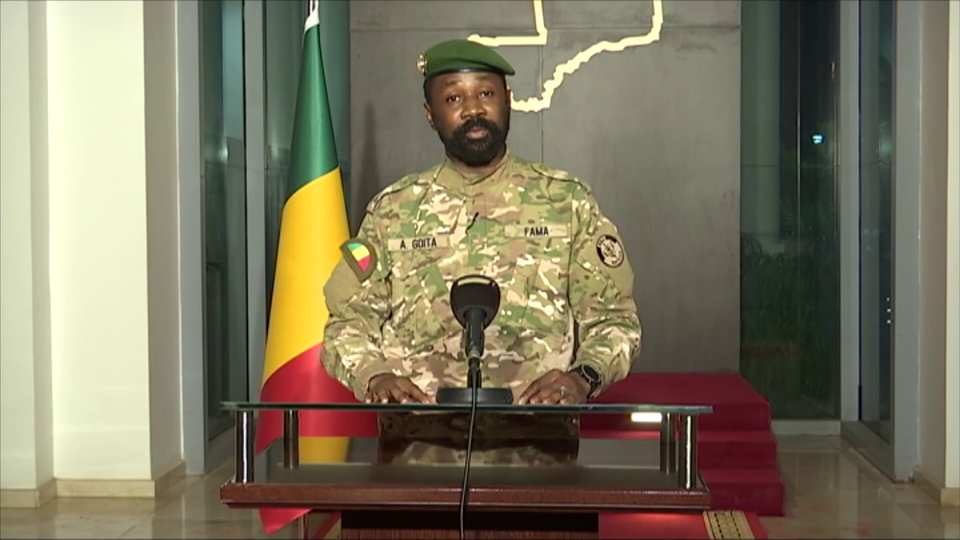

Mali’s local Al-Qaeda affiliate, Jama’at Nusrat al-Islam wal-Muslimin (JNIM), has offered millions of euros for information on the whereabouts of the country’s president and senior military officials.
In a statement shared by SITE Intelligence Group, which monitors “jihadist communications”, JNIM described the Malian government as illegitimate and offered €2 million for information leading to Assimi Goita, who has led the country since coups in 2020 and 2021.
The group also offered €1 million each for information on Colonel Lassina Diallo and General Malik Dicko.
JNIM said the rewards would be paid to anyone who provides information leading to their locations or takes action to “neutralise” them.
The announcement follows a similar offer by the Malian government for information leading to JNIM leader Iyad Ag Ghaly and other senior figures.
Mali has faced escalating violence in recent months, with Al-Qaeda-linked attacks and renewed fighting across the country’s desert north raising fears of further gains by armed groups.
Mali’s shifting alliances
Northern Mali has seen recurring rebellions since 1963, when Tuareg communities first rose up against the central government in Bamako. The Saharan and Sahelian regions inhabited largely by Tuareg and Arab communities have long accused the state of political neglect, marginalisation and heavy-handed rule.
Mali has faced a cyclical crisis since 1963, although the context has changed with each new phase of conflict.
The 2012 rebellion marked a major turning point when armed groups, including Ansar Dine, al-Qaeda in the Islamic Maghreb and Al-Mourabitoun, temporarily allied with the National Movement for the Liberation of Azawad to seize Mali’s northern regions of Gao, Timbuktu and Kidal.
France launched Operation Serval in January 2013, pushing armed groups out of major towns. The mission later evolved into Operation Barkhane, supported by the G5 Sahel Joint Force, the UN, the EU and the French-led Takuba Task Force.
That security architecture began to collapse after Mali’s military authorities, who seized power in the August 2020 coup, ended or restricted the mandates of foreign and multilateral forces operating in the country.
Regional diplomacy under strain
Moscow has issued repeated statements of support for Mali’s military government since the attacks, while Bamako continues to accuse France of backing armed groups, allegations Paris denies.
At the same time, Algeria’s traditional role as a mediator in northern Mali has largely deteriorated. Bamako has renounced the 2015 Algiers Peace and Reconciliation Accord, while relations worsened after Algerian air defences destroyed a Malian drone in an incident that triggered a diplomatic crisis between the two countries.
Both countries recalled their ambassadors, although Algerian President Abdelmadjid Tebboune has since proposed a new mediation initiative. Analysts remain sceptical that Bamako is currently willing to return to externally led mediation.