
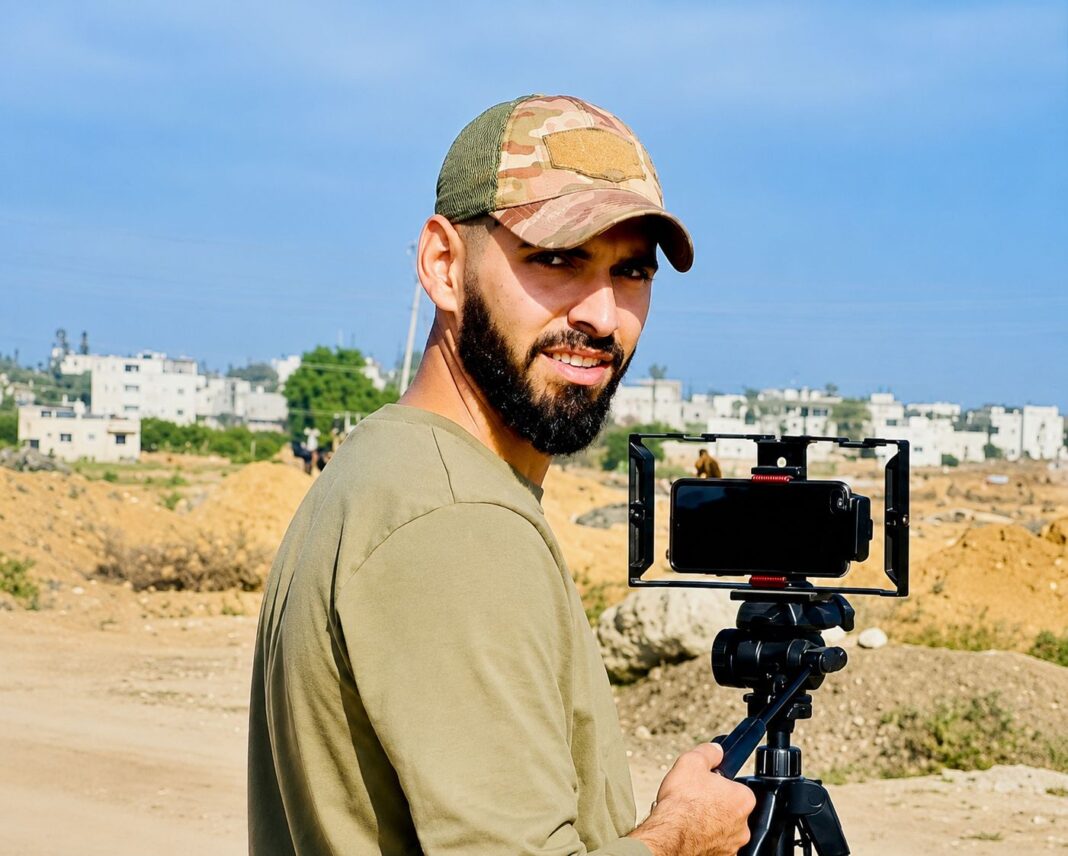

ONM journalist Nesma Darwish writes that behind every number added to the growing list of journalists killed by Israel in Gaza lies an entire life cut short.
On Monday, photojournalist Ahmed Washah became the 263rd journalist killed in Gaza since the start of Israel’s genocidal war on October 7, 2023.
An Israeli airstrike on Al-Bureij refugee camp in central Gaza transformed him from a witness documenting tragedy into one of its victims.
Ahmed was not merely another statistic. He now joins his brother, Muhammad Washah, an Al Jazeera Mubasher correspondent who was killed in Gaza two and a half months earlier. In a matter of seconds, the documented reality overtook the documentarians themselves.
Under these devastating circumstances, journalism in Gaza has evolved from a profession into a frontline defence of truth. Local journalists continue confronting the world with evidence of the immense human suffering and destruction unfolding on the ground.
Yet journalists themselves have increasingly found themselves at the centre of the conflict. Press markings, once regarded as legal protections under international law, have provided little protection amid the ongoing hostilities, according to media organisations and rights groups.
Amid the widespread destruction of infrastructure, journalists continue their work under near-total communications and internet blackouts, while also facing severe shortages of essential technical equipment. This technological siege, coupled with the continued ban on foreign media access to Gaza, has placed the burden of documentation almost entirely on local journalists.
They have become the international community’s primary source of information, carrying the immense responsibility of documenting events and conveying realities that might otherwise remain unseen.
The impact of the war has extended far beyond the field. Many journalists have lost family members, homes and colleagues, creating enormous psychological strain while they continue to work under constant threat.
Yet despite grief, displacement and fear, Gaza’s journalists have continued documenting events and telling the stories of their communities, demonstrating an extraordinary commitment to their mission.
Commenting on the situation, Dr Ismail Al-Thawabta, Director-General of the Government Media Office in Gaza, said the number of journalists killed since October 7, 2023, had reached 263.
He warned that the toll was likely to rise amid ongoing military operations and the absence of effective international accountability.
The deaths of Ahmed and Muhammad Washah, killed just months apart, stand as a stark example of the heavy price being paid by Gaza’s media workers. Nevertheless, the Government Media Office maintains that journalists in Gaza remain committed to their mission despite the extraordinary circumstances.
The images, videos and testimonies produced by Gaza’s journalists are creating an enduring archive of collective memory, one that resists erasure and preserves evidence for future generations.
Every image captured and every testimony recorded contributes to documenting a historic period marked by immense human suffering. These records may one day serve researchers, historians and human rights institutions seeking an authentic account of events despite attempts to silence witnesses and erase documentation.
What Gaza’s journalists carry today is more than a profession; it is a trust they refuse to abandon.
For many, this mission is rooted not only in professional responsibility, but also in faith: a belief in standing for truth, bearing witness and supporting the oppressed.
Despite displacement, the loss of colleagues and loved ones, and the constant risk of death, they continue to document reality and bring the voices of their people to the world.
As the list of fallen journalists continues to grow, their commitment to truth endures. Their work stands as a testament to the resilience of those who believe that facts must be recorded, stories must be told, and preserving the truth is both a professional duty and a moral responsibility.
In a place where many have sought to silence the narrative, Gaza’s journalists continue to carry the Trust of Truth, ensuring that the suffering, resilience and aspirations of their people are neither forgotten nor denied.