


BRICS may present itself as a challenge to Western hegemony, but Muslims should be cautious about mistaking multipolar power politics for civilisational liberation or economic salvation, writes Neelam Rahim.
BRICS is often presented across the Global South as the great emerging counterweight to Western dominance. For many in the Muslim-majority world, the bloc has come to symbolise the possibility of a new global economic order: one less dependent on Washington, less tied to the US dollar, and less dominated by Western political and financial institutions. But this expectation needs to be approached with realism, not romanticism, because BRICS may offer economic opportunity, diplomatic diversification and a useful challenge to Western hegemony, but it is not a liberation project, a moral alliance, or a saviour of the Muslim Ummah.
The expanded BRICS grouping, originally made up of Brazil, Russia, India, China and South Africa, now includes additional members such as Egypt, Ethiopia, Indonesia, Iran, Saudi Arabia and the UAE. Its language is powerful: multipolarity, development, reform of global governance, financial independence and a stronger voice for the Global South. But ambition is not the same as unity, and behind the diplomatic language lies a bloc defined more by negotiation than transformation.
A bloc of interests, not ideology
At its core, BRICS is not bound by shared values, religious identity or a unified political vision. It is a forum for coordination among emerging and non-Western powers seemingly dissatisfied with the current global order, particularly institutions long dominated by the US and its allies. That makes BRICS important, but it also limits what it can become.
China and India sit inside the same bloc despite being geopolitical rivals with unresolved border tensions and competing regional ambitions. Iran and the UAE are both members despite being positioned on opposite sides of several major Middle Eastern fault lines. Russia and China see BRICS partly through the lens of perceived confrontation with the West, while others view it more cautiously as a means of hedging, trade expansion and diplomatic leverage. These contradictions are not minor details, but structural realities that expose BRICS as a loose coalition of states that agree on some issues, disagree on many others, and prioritise sovereignty and national interest above any shared moral programme.
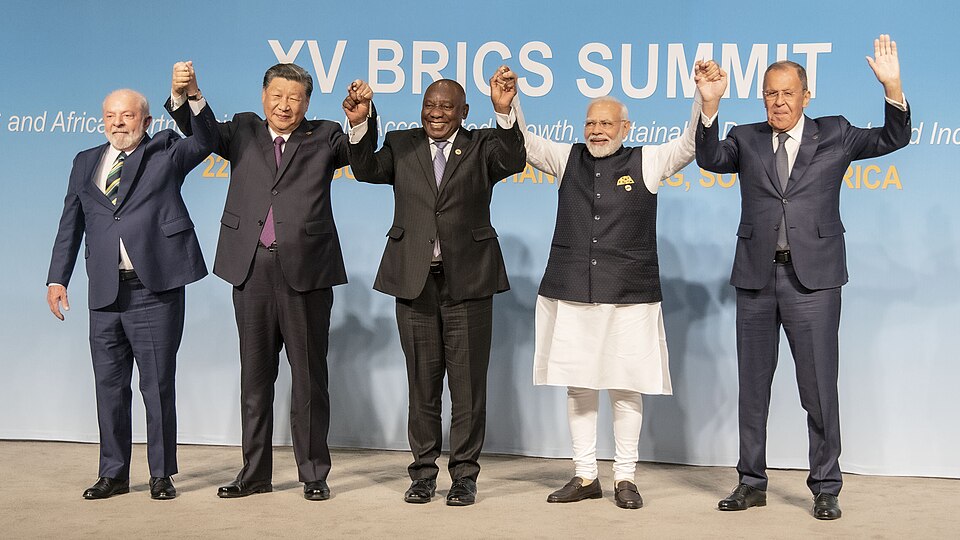
For the Muslim world, this distinction matters. The presence of Muslim-majority states inside BRICS has raised hopes that the bloc could become a geopolitical anchor for parts of the Ummah, with Egypt, Indonesia, Saudi Arabia, Iran and the UAE all bringing Muslim-majority populations, regional influence and strategic weight. On paper, this gives BRICS a significant “Muslim presence”, but mere representation is not the same as protection.
Some of the bloc’s most powerful states have serious blood on their hands over their treatment of Muslims. China has faced long-standing criticism from the UN, western governments and human rights groups over its treatment of Uyghur and other Turkic Muslim communities in East Turkestan (Xinjiang), including internment “re-education” camps, religious restrictions, forced assimilation and cultural suppression. Beijing rejects the allegations, but the issue remains one of the most serious human rights controversies in the Muslim world.
India, meanwhile, has faced sustained criticism from religious freedom monitors and advocacy groups over the normalisation of anti-Muslim hate, communal violence, citizenship policies, mosque and property demolitions, and the wider climate facing Muslims under Hindu nationalist politics. The concerns have become central to global debates about religious freedom in India under Narendra Modi and the BJP’s Hindutva regime. These realities should temper any simplistic idea that BRICS automatically represents Muslim interests, because a bloc cannot be romanticised as a saviour of the Ummah while some of its leading powers have policies that directly persecute Muslim.
De-dollarisation is real, but limited
One of the most attractive arguments around BRICS is de-dollarisation: reducing reliance on the US dollar, expanding trade in local currencies, building alternative payment systems, and weakening Washington’s ability to dominate global finance through sanctions, reserves and settlement infrastructure.
This ambition is not imaginary. BRICS countries have openly discussed local currency settlement, alternative financial mechanisms and reform of the international monetary system.

The dollar’s share of global reserves has also declined over the long term, reflecting a gradual diversification of central bank holdings. But the scale of change is often exaggerated, because the US dollar remains the dominant global reserve currency and the central currency of international trade, commodities, debt markets and cross-border finance.
The Chinese yuan has grown in importance but remains far behind the dollar in global payments. Even many countries that want more financial autonomy still rely heavily on dollar-based systems because of liquidity, trust, market depth and existing infrastructure. So BRICS is not dismantling the dollar order; it is trying to create more room within and around it.
For Muslim-majority countries, reducing overdependence on Western financial systems may be strategically useful, but de-dollarisation alone does not produce justice, sovereignty or Islamic political renewal. A country can trade in local currencies and still be authoritarian, exploitative, secular, nationalist or complicit in oppression. Economic diversification is therefore not the same as liberation.
The danger of political romanticism
The Muslim world has suffered deeply under Western imperialism, military intervention, sanctions, occupation, debt dependency and political manipulation. It is therefore understandable that many Muslims look towards alternative power centres with hope. But replacing Western dominance with non-Western power politics does not automatically produce justice.
China, Russia, India, Brazil, South Africa, Iran, Egypt, Saudi Arabia, the UAE, Indonesia and Ethiopia are not one civilisational project. They do not share one worldview, one moral compass or even the same strategic priorities. Some may challenge Western power on certain fronts while reproducing injustice on others. Some may support Palestine rhetorically while maintaining relationships that prevent meaningful action. Some may speak of sovereignty while suppressing dissent at home. Some may criticise Western hypocrisy while pursuing their own regional ambitions. This is the reality of nation state politics, and it means BRICS reflects a changing world, but not necessarily a more principled one.
Engagement without illusion
None of this means Muslim-majority states should ignore BRICS. Engagement may bring real benefits: trade diversification, infrastructure financing, diplomatic leverage, alternative development partnerships, and reduced dependence on Western-controlled institutions. For countries trapped in unequal relationships with Washington, London, Paris or the IMF-led financial order, BRICS may offer useful space to manoeuvre.
But engagement must be strategic, not emotional. Muslim states should deal with BRICS as they would any other power arrangement: with caution, clarity and self-interest rooted in the welfare of the Ummah. They should extract benefit where possible, build economic resilience, diversify partnerships, and avoid becoming dependent on any single bloc.
The mistake would be to confuse access with protection, multipolarity with autonomy, or anti-Western positioning with Islamic revivalist alignment. Ultimately, BRICS is not the answer to global imbalance, but part of its reconfiguration. Power is shifting, but it is not necessarily becoming more moral. Western dominance is being challenged, but not always by forces committed to justice. A multipolar world may weaken US hegemonic control, but it may also produce new forms of rivalry, exploitation and authoritarianism.
For the Muslim Ummah, the lesson is clear: BRICS may be useful, important and capable of creating room for manoeuvre in a world long dominated by Western capitalist power, but it is not salvation, Islamic solidarity or a liberation movement. It is a bargaining table between states. Until Muslim-majority countries rebuild their own political confidence, economic strength, intellectual independence and civilisational direction, expectations of BRICS as a political, economic or moral saviour will continue to outpace reality.


Mashallah , briliant and necessary