
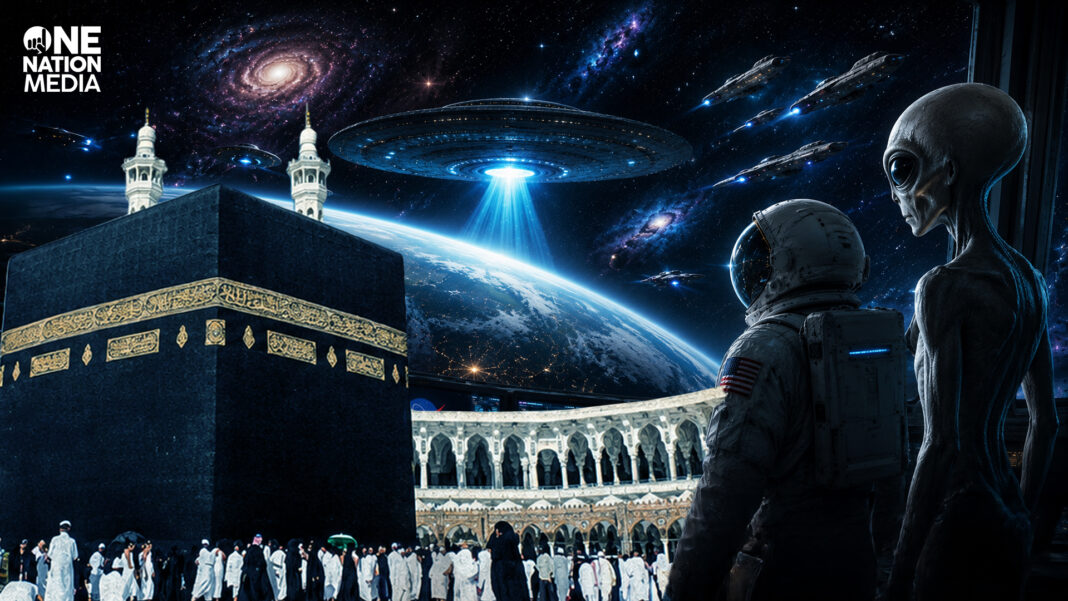

The Pentagon’s latest UAP disclosures are not merely a curiosity about unidentified objects in the sky. They raise deeper questions about faith, human identity, surveillance and the technocratic attempt to redefine creation itself, writes Najm Al-Din.
Recently, the Pentagon began a rolling release of declassified files on Unidentified Anomalous Phenomena (UAP), commonly known as UFOs.
Following the 2022 congressional hearings and growing public pressure, the Trump administration framed the disclosure as part of a wider transparency pledge involving the FBI, NASA and the Department of Defense.
The initial files include military reports, visual media and historical documents featuring astronaut accounts of flashing lights, videos of high-speed spherical objects and FBI records referring to ellipsoid metallic aircraft.
While critics dismiss the material as a distraction from mounting crises facing the Trump administration, there is another dimension to these revelations that warrants urgent attention from faith-based communities and civil rights groups.
Spiritual crisis
US officials are reportedly briefing Christian leaders to prepare congregations for the ontological shock of impending UAP and non-human intelligence (NHI) disclosure, as the recent file releases fuel fears that such evidence could challenge the biblical creation narrative.
Traditional faiths are often premised on the belief that human beings occupy a unique and elevated place within God’s creation. Official evidence of advanced non-human beings or civilisations could therefore destabilise anthropocentric worldviews, reducing humanity to a lesser position within a wider cosmic hierarchy and potentially eroding trust in religious institutions.
Christian theologians are already grappling with how doctrines of redemption and salvation would apply to such entities. The claim that UAP may have seeded human origins could also trigger serious theological confusion, empowering secular critics to challenge religious doctrines of creation, salvation and human uniqueness.
Transhumanism
Traditional faith communities must also recognise that factions within the global technocracy may view NHI as a model for a transhumanist future. Transhumanism is the belief that technological innovation can overcome human biological limitations.
Those associated with this worldview include figures within the US tech elite and military-industrial complex, including Elon Musk and Peter Thiel, who have promoted visions of merging human life with technology. Synthetic biologists such as George Church have also suggested that UAP may represent self-replicating probes or AI-driven machines.

UAP narratives that emphasise technologically superior and wise entities reinforce transhumanist aspirations of biodigital convergence, the permanent integration of technology with biology, which some present as the next stage of human evolution. Transhumanists are therefore likely to interpret these files as evidence of beings that used technology to surpass biological limits, offering a blueprint for redefining humanity in the machine age.
By decoupling intelligence and consciousness from the human mind, transhumanists are normalising NHI and placing consciousness on a spectrum, preparing humanity to accept autonomous AI as a form of equal or superior intelligence. This supposed progression toward a post-biological state challenges traditional concepts of God and creation by redefining humanity’s cosmic place and presenting the integration of biology with technology as a path to secular salvation.
By promising to conquer disease, upload consciousness to digital networks and radically extend lifespans, all without divine grace, humanity is being nudged toward looking to technology for ultimate existential meaning. It is therefore likely that prominent transhumanists will eventually embrace the UAP phenomenon as an example of how transcendence can be achieved through biodigital convergence and technological advancement rather than spiritual redemption.
Surveillance and militarisation
The release of these files has also reignited discussions about how such disclosures may serve as mechanisms for systemic control. Historical precedents show that civil liberties require vigilant protection during national traumas, as crises are often used to expand state authority, compromise foundational rights in the name of national security and increase public oversight and control.
After 9/11, the Patriot Act granted the FBI immense investigatory powers and expanded executive authority. This set a global precedent, leading many nations to rewrite privacy and anti-terror laws using broad and vague language. Nearly 25 years later, human rights groups still warn that this legacy fuels draconian digital surveillance and suppresses free expression.
Similarly, the COVID-19 pandemic led much of the world to sacrifice personal freedoms in the name of public safety. Under the guise of pandemic preparedness, governments and tech giants deployed location tracking, facial recognition systems and data-harvesting infrastructure that helped normalise mass surveillance.
Continued UAP releases may therefore be exploited to push for greater state securitisation, using existential threats to justify intrusive emergency powers. In particular, classifying UAP as foreign adversary weapons risks significant mission creep. By treating them primarily as military targets rather than scientific anomalies, the state legitimises the expansion of space defence and surveillance, potentially accelerating a permanent interagency security infrastructure that could pave the way for centralised global governance.
Given these spiritual and civil liberty threats, why must Muslims treat this issue with urgency?
Islam and UAP
As the UAP phenomenon gains mainstream military and academic credibility, Muslim scholars must anchor explanations of these events within the Islamic worldview, especially in a digital age where young Muslims frequently encounter UAP disclosures on social media.
So is there an Islamic framework for understanding this phenomenon? A common theory advanced by Muslim academics at the Sapience Institute links UAP to jinn.
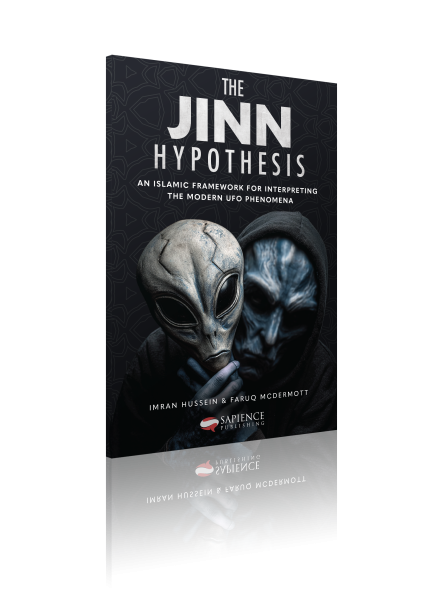
In Islamic theology, jinn are sentient supernatural beings created from smokeless fire. They possess free will, intellect and moral agency, making them accountable on the Day of Judgment. Although they exist in a parallel dimension and generally belong to the unseen realm, known as ghayb, theological exceptions and modern research reveal striking overlaps between jinn and UAP, including aerial flight, shapeshifting and instantaneous travel.
For instance, computer scientist Jacques Vallée’s interdimensional hypothesis suggests UFOs may be intelligent beings from parallel dimensions rather than extraterrestrials. This mirrors the Islamic view of jinn as inhabiting a parallel space-time continuum alongside our universe.
Manifestation and disappearance
A striking parallel between modern UFO encounters and Islamic jinn traditions is their shared ability to materialise and disappear.
While military pilots report anomalous craft vanishing from radar and defying known physics, Islamic tradition similarly describes jinn as beings capable of instantly manifesting and disappearing from human perception.
Maneuverability
The UAP narrative and Islamic theology also converge on movement that appears to defy conventional physical laws.
Islamic texts highlight the extraordinary speed of jinn, including their ability to travel in the blink of an eye. In Surah Al-Naml, a powerful jinn offers to bring the throne of the Queen of Sheba to Prophet Sulaiman (AS) before he can even rise from his place.
This extraordinary mobility mirrors military accounts of UAP instantly accelerating to extreme speeds without creating sonic booms.
Shapeshifting
Modern UFO accounts and Islamic theology both describe elusive non-human entities operating at the edge of human perception.
Eyewitnesses have reported UAP changing form mid-air, morphing from solid craft into mist or glowing discs. This mirrors Islamic scholarship, which notes that jinn can alter their form and deceive human senses.
Furthermore, UFO researcher Jacques Vallée documented encounters with humanoid or seemingly ordinary human entities, echoing hadith literature stating that jinn can assume human form.
Consequently, there is a clear overlap between modern UAP accounts and Islamic tradition regarding fluid morphology and anthropomorphic deception.
The sea
Another compelling overlap is the connection to the ocean. Islamic tradition describes certain jinn as ghawwas, meaning “deep-sea divers”, or entities residing in the sea. This aligns closely with modern observations of underwater UAP activity and the “cryptoterrestrial hypothesis”.
While psychological factors and mental health conditions may explain some encounters, the Qur’anic title Rabbul Alamin, Lord of the Worlds, suggests that divine creation extends across a vast and populated reality. This perspective can also accommodate extraterrestrial phenomena without undermining Islamic belief.
Ultimately, modern UAP research documenting shapeshifting, extreme speeds and subjective paranormal experiences aligns with traditional Islamic scholarship on the form and capabilities of jinn.
Conclusion
As we enter the era of AI and transhumanism, it is my contention that the convergence of Pentagon UAP declassifications and Steven Spielberg’s upcoming blockbuster Disclosure Day functions as predictive programming, psychologically acclimatising the public to world-altering realities with the aim of disrupting religious systems.
Spielberg’s comments on the theological dislocation caused by such disclosure do not exist in a vacuum. Rather, they form part of a wider conditioning process preparing society for a secular techno-cultural revolution, as influential interest groups frame UAP entities as cosmic creators of human evolution and consciousness.
Ultimately, UAP disclosures should not unsettle Muslims. Viewing them through the traditional jinn hypothesis equips believers to navigate this era without spiritual disorientation. However, Muslim scholars must actively oppose ideological movements that weaponise the UAP narrative to promote trends that undermine traditional concepts of God and creation by framing humanity as a mere stepping stone toward technological singularity.
As we enter the Fourth Industrial Revolution, which is likely to usher in a social contract rooted in AI and transhumanism, the UAP files may catalyse an ideological transition away from traditional monotheism toward an encompassing paradigm of cosmic consciousness.
Muslims must expose this movement’s hubris and dehumanising nature. It represents ultimate human arrogance by attempting to bypass divine decree and hand creative power to a soulless technocracy. It convinces humanity to look to technology, rather than God, for salvation.
Against the backdrop of these technocratic designs, Muslims must remind humanity that true transcendence and purpose are found exclusively through submission to the Creator, preserving the sacred boundaries of our humanity and grounding our worldview in the light of Islamic revelation.
You can download Sapience Institute’s new book The Jinn Hypothesis here.