


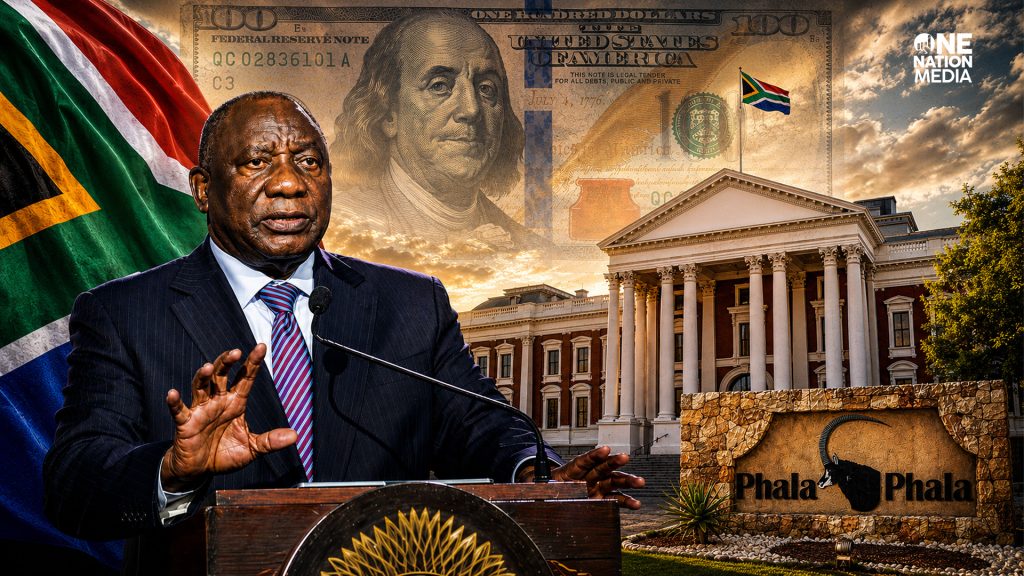
The Phala Phala scandal, often referred to as “Farmgate”, is one of the most significant political controversies to confront President Cyril Ramaphosa during his presidency.
At the centre of the case is the theft of a large amount of foreign currency from Ramaphosa’s private Phala Phala game farm in Limpopo, and allegations that state resources were subsequently used to conceal the incident rather than investigate it through normal legal channels.
The incident dates back to 9 February 2020, when burglars broke into the wildlife-breeding farm and stole a large sum of US dollars allegedly concealed inside furniture.
The amount stolen remains disputed. Former State Security Agency director-general Arthur Fraser, who laid a criminal complaint against Ramaphosa in 2022, alleged that approximately US$4 million was taken. Ramaphosa has consistently maintained that the amount involved was US$580,000.
According to the President, the money came from a legitimate cash sale of buffaloes to Sudanese businessman Hazim Mustafa. Ramaphosa has denied any wrongdoing and maintains that the funds were lawfully obtained.
Why did the scandal become so controversial?
The controversy centres less on the burglary itself than on what allegedly happened afterwards.
Instead of immediately reporting the theft through the normal South African Police Service (SAPS) channels, Ramaphosa informed the head of the Presidential Protection Unit, Major-General Wally Rhoode, who subsequently oversaw an unofficial investigation.
It has been alleged that suspects were pursued into neighbouring Namibia, informally apprehended and questioned, and offered money to remain silent about the theft. These claims fuelled accusations that state resources had been used to protect the President’s private interests rather than uphold the law.
The matter remained out of the public eye until June 2022, when Fraser accused Ramaphosa of money laundering, corruption, kidnapping and failing to declare the foreign currency to the relevant authorities.
His complaint transformed what had been a private burglary into a major political and constitutional controversy.
What have official investigations found?
Several state institutions have investigated different aspects of the matter, reaching different conclusions.
The South African Reserve Bank concluded in 2023 that it could not find that Ramaphosa had contravened exchange-control regulations. It determined that the buffalo transaction had not been legally completed because certain contractual conditions remained outstanding. As a result, the farming entity involved had no legal entitlement to the foreign currency when it was stolen.
The Public Protector also cleared Ramaphosa of violating the Executive Ethics Code. Opposition parties criticised the findings, arguing that the investigation had failed to address several central concerns adequately.
The Independent Police Investigative Directorate, however, found that Rhoode and other members of the Presidential Protection Unit had acted beyond their lawful authority by conducting an unofficial investigation without registering a formal criminal case.
IPID found that Rhoode had failed to report the theft through the prescribed chain of command and that members of the unit had pursued investigative activities outside their lawful mandate.
How did the matter become a constitutional battle?
The scandal eventually developed into a broader dispute over presidential accountability and Parliament’s constitutional oversight responsibilities.
In late 2022, an independent panel established under Section 89 of the Constitution concluded that there was prima facie evidence suggesting Ramaphosa may have committed serious misconduct or violated his constitutional obligations.
Despite the panel’s findings, the African National Congress used its parliamentary majority to vote against establishing a full impeachment inquiry.
Opposition parties, including the Economic Freedom Fighters and the African Transformation Movement, subsequently challenged Parliament’s decision in court.
On 8 May 2026, the Constitutional Court ruled that the National Assembly had acted unlawfully when it rejected the panel’s report and blocked the impeachment process in 2022.
The judgment revived the process and required Parliament to reconsider the allegations through a multiparty impeachment committee.
Where does the case stand now?
On 24 July 2026, the Western Cape High Court granted Ramaphosa an urgent interim interdict temporarily halting formal proceedings by Parliament’s Section 89 impeachment committee while his separate judicial review remains pending.
Judge André Le Grange ruled that the impeachment process should be paused while the court considers Ramaphosa’s challenge to the legality of the original independent panel’s report.
The judicial review is expected to be heard in September 2026.
Presidential spokesperson Vincent Magwenya said Ramaphosa respected the court’s decision and maintained that the original panel had relied on flawed legal principles and exceeded its mandate.
Opposition parties, including the MK Party and the ATM, criticised the ruling, arguing that it further delayed constitutional accountability.
Although the committee cannot proceed with formal hearings for now, it may continue undertaking preparatory and administrative work while the legal challenge is determined.
Why does the Phala Phala scandal matter?
The Phala Phala controversy has become about far more than the theft of foreign currency from a private game farm.
It raises broader questions about presidential accountability, the possible use of state resources for private matters, Parliament’s responsibility to hold the Head of State accountable and the independence of South Africa’s oversight institutions.
While some investigations have cleared Ramaphosa on specific ethical, legal and regulatory questions, others have raised serious concerns about the conduct of members of his security detail and Parliament’s handling of its constitutional responsibilities.
With major court proceedings still pending and the Section 89 process temporarily suspended, the Phala Phala scandal remains unresolved.
The outcome of Ramaphosa’s judicial review and any subsequent parliamentary proceedings is likely to shape not only his political future, but also the interpretation of presidential accountability under South Africa’s Constitution for years to come.