


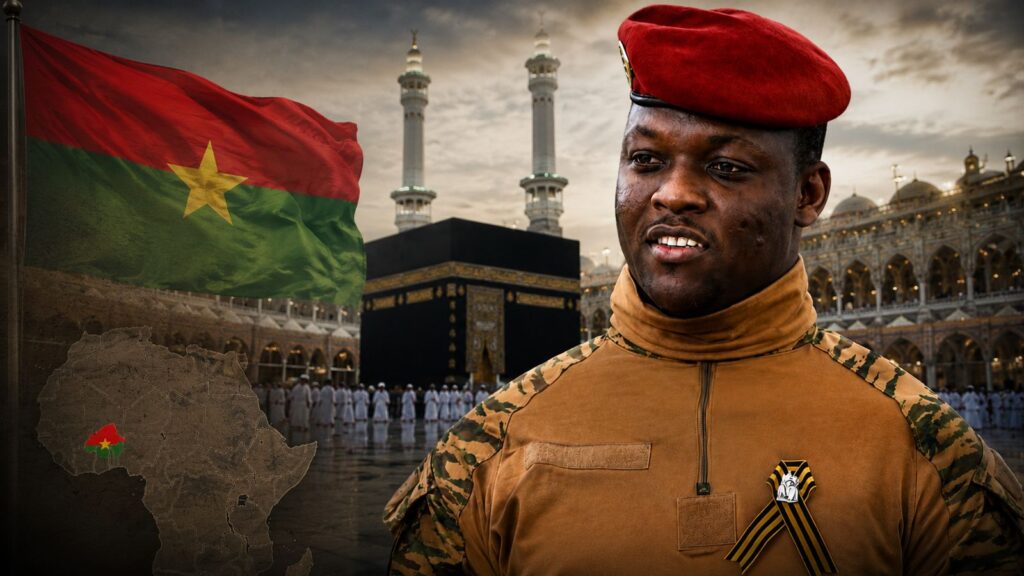
Burkina Faso’s President Ibrahim Traoré has rejected calls for the introduction of Sharia law, insisting that religion cannot supersede national sovereignty and announcing plans to recall hundreds of Burkinabè citizens studying Islamic jurisprudence abroad.
Traoré made the remarks during a meeting with imams in Ouagadougou, where he addressed religious leaders on Islam, national unity, education and security as Burkina Faso continues to battle an armed insurgency.
Questioning the government’s longstanding practice of supporting religious studies overseas, Traoré said authorities had reviewed a list of Burkinabè citizens studying in several Arab countries.
“We are currently taking stock of the situation in some Arab countries where people are learning something. The latest statistics I saw showed that it was 800 and something. I looked at the document. Nobody seems to know about their departure. Nobody knows what they’re doing. The embassies that are there are not aware of them.”
He said his concern was not only the number of students abroad, but also the subjects they were studying.
“And do you know what they learn? Sharia, Islamic laws and Islamic jurisprudence. None of those 800-odd people on the list shown to me last time are learning a single trade. Nobody! Is it to come and apply Sharia law where? Here?”
Traoré stressed that Burkina Faso would not permit the implementation of Sharia law, arguing that the country needed graduates equipped with practical skills to contribute to national development.
“You see why it’s good to control what goes out? That’s why I say the important phase is ahead of us. These people, I’m going to bring them back. Anyone who does not return is no longer Burkinabè.”
Addressing the assembled imams, Traoré urged them to take greater responsibility for providing Islamic education within Burkina Faso rather than relying on institutions abroad.
“But we need to change. If you yourselves — the imams here — cannot educate our youth in Islam, you must let it go.”
The president also revealed that some individuals had urged him to declare Burkina Faso an Islamic state, claiming that doing so would bring peace and end terrorism.
“Many people came to see us… wished for Burkina Faso to be an Islamic state. Terrorism would end for sure, we would have peace. But we’d be a rear base, a cancer in the middle of West Africa to destabilise others.”
Rejecting the proposal, Traoré said: “I don’t operate like that. I cannot be manipulated like that.”
He further criticised those who, in his view, elevate their religious identity above their national identity.
“At the time, I saw people making posts, saying… religion above the country, you know. You leave the country, you go where you think they will welcome you because you’re a Muslim. But what is this stupidity? Everywhere you go in this world, first they ask for your passport and nationality. That’s what allows you to enter somewhere. If anyone thinks religion alone will get them somewhere, they should just leave. Not here.”
Traoré also referred to Africa’s historical experience of slavery under Arab rule, arguing that this chapter of history is often overlooked.
“They’ve been trying to exterminate us for a long time. Are you even aware of it? First, the Arab-Muslim conquest. That’s over a thousand years of slavery in Africa. That’s a part of history they try to erase. And many people don’t know, they are ignorant of it. That we endured over 1,000 years of slavery under Arabs, and the last slave market to close was in Medina in 1962.”
The remarks form part of a broader shift in the Burkinabè government’s approach towards sections of the country’s Muslim religious leadership.
In recent months, Traoré has called for tighter oversight of religious education, criticised sermons he considers extremist and insisted that all religious activity must operate within the framework of the state.
Burkina Faso remains at the centre of the Sahel’s security crisis, where armed groups linked to al-Qaeda and the so-called Islamic State continue to carry out attacks despite sustained military operations.
The military-led government has consistently framed its campaign as one focused on restoring national sovereignty, strengthening state authority and resisting both armed groups and foreign influence.