


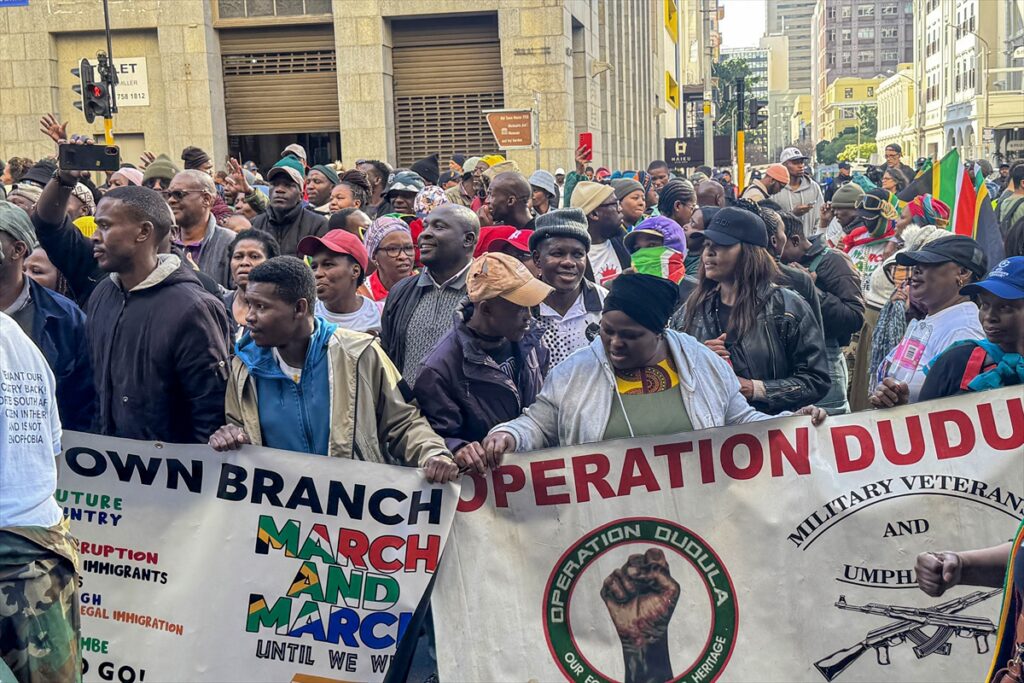
South Africa’s anti-migrant unrest is no longer only about borders, jobs or undocumented migration. It is increasingly becoming a test of whether the country can address legitimate public concerns without allowing them to descend into xenophobia, Islamophobia and violence against those seen as outsiders.
As anti-migrant marches and threats against foreign-owned businesses spread, Justice Minister Mmamoloko Kubayi and former president Thabo Mbeki have both suggested that the mobilisation may be more organised than it appears.
Kubayi warned that South Africa’s decision to take Israel before the International Court of Justice has placed the country at the centre of a wider geopolitical contest.
“Our presence and our taking Israel to the ICJ — if anyone underestimates that, that person is naive,” she said.
Her remarks followed reports that foreign entities may be seeking to exploit instability in South Africa. While Kubayi did not directly accuse Israel of orchestrating the marches and protests, her comments have fuelled debate over whether the country’s internal tensions are being manipulated to weaken it politically.
Mbeki was more direct in his assessment of the anti-migrant mobilisation.
“There’s money behind it. There’s purpose behind it. It’s organised. It’s not spontaneous. It doesn’t come from the masses of the people,” he said.
He also rejected the idea that anti-migrant violence is simply an expression of ordinary South Africans turning against African migrants. Reflecting on the 2008 attacks, Mbeki said: “That thing was not xenophobia from the ordinary people of Alexandra saying we hate these Africans. It didn’t come from that.”
According to Mbeki, the violence was politically driven and intended to pressure Zimbabwean migrants living in South Africa to return home ahead of Zimbabwe’s 2008 elections.
Whether similar forces are operating today remains unclear. What is evident, however, is the impact of the current climate. Foreign nationals have reported threats, intimidation and growing fear, while some have closed their businesses, left their homes or sought assistance from embassies and community organisations.
Religious dimension
For visibly Muslim migrants, particularly those from Somalia, Bangladesh, Pakistan, Ethiopia and elsewhere, anti-migrant sentiment can quickly evolve into Islamophobia. A hijab, kufi, niqab, beard or Muslim-owned business can make someone a target in an environment where visible markers of identity are wrongly associated with foreignness.
This is especially dangerous because it blurs the distinction between lawful immigration enforcement and religious or ethnic prejudice. South Africa has every right to strengthen border management, address undocumented migration and dismantle criminal networks. But those legitimate objectives must never become a licence to target people because of their nationality, appearance or faith.
Kubayi has emphasised that the government has a constitutional duty to protect everyone’s rights.
“The state today is not going out to threaten its own citizens, but we have an obligation as government to ensure that there is law and order. We have an obligation as government to ensure that no one’s rights are infringed,” she said.
She added: “Today, however, is about keeping South Africans safe.”
That commitment to safety must extend to everyone, including migrants, refugees, asylum seekers and Muslims who increasingly fear being singled out in their workplaces, neighbourhoods and places of business.
The question, then, is not only whether a third force is fuelling South Africa’s unrest. It is also who benefits when struggling communities are encouraged to see migrants as the cause of unemployment, crime and failing public services.
The answers may lie not only on the streets, but also within the political, criminal and disinformation networks that stand to gain from deepening social division.