


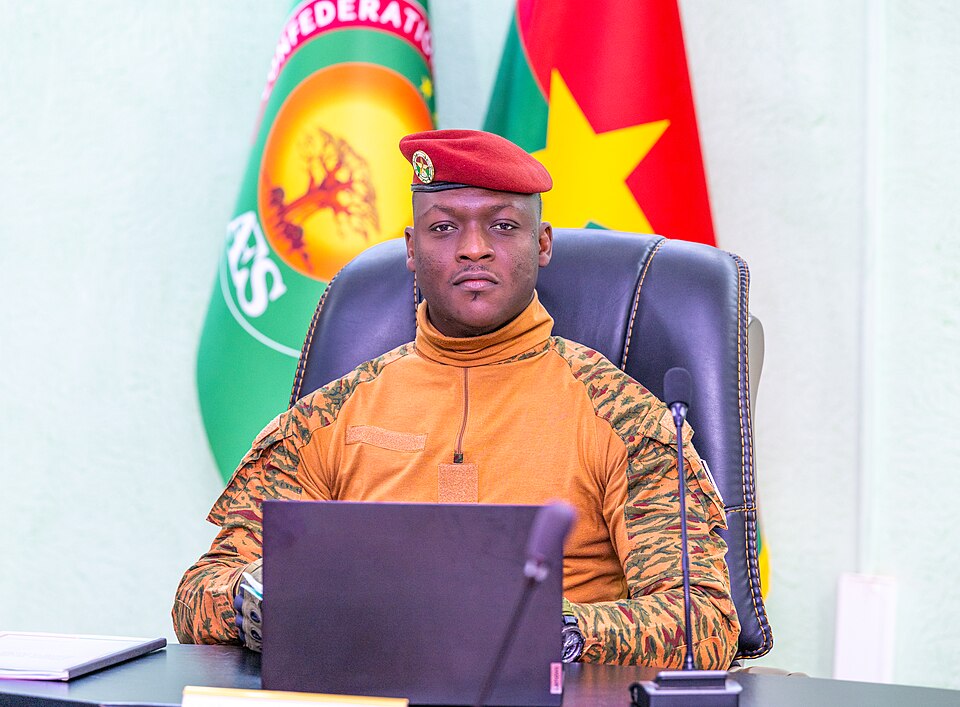
Burkina Faso’s interim president, Ibrahim Traoré, is increasingly being celebrated across Africa as a symbol of resistance to foreign influence and a champion of African sovereignty. Yet the recent arrest of a prominent Islamic scholar has renewed concerns that the country’s popular military leader may also be displaying troubling authoritarian tendencies.
The latest controversy centres on Imam Mohammad Ishaq Kindo, President of the Sunni Ulema of Burkina Faso and one of the country’s most influential religious figures. More than three weeks ago, security forces reportedly arrested him at his residence in the capital, Ouagadougou. Witnesses said the operation involved police officers and hooded military personnel, who took the imam to an undisclosed location.
His detention has raised alarm among religious leaders, civil society groups and supporters, who argue that criticism of government policy is increasingly being met with repression.
Traoré came to power in September 2022 after leading a military coup that removed Lieutenant-Colonel Paul-Henri Sandaogo Damiba, who had himself seized power earlier that year by overthrowing President Roch Marc Christian Kaboré. At 37, Traoré became the world’s youngest head of state and quickly gained popularity among many Africans for his anti-imperialist rhetoric, economic reforms and efforts to reduce foreign influence in the Sahel.
Under his leadership, Burkina Faso joined Mali and Niger in withdrawing from the Economic Community of West African States (ECOWAS) and forming the Alliance of Sahel States, a regional bloc aimed at strengthening cooperation between the military-led governments of the region.
Despite initially promising a return to civilian rule, recent political developments suggest that military governance could continue for several more years, potentially keeping Traoré in power until at least 2029.
The arrest of Imam Kindo followed a sermon in which he criticised proposed legislation regulating the practice of religion within public institutions. The bill, approved by the Council of Ministers on 19 March, seeks to regulate the exercise of religious freedoms and restrict certain religious activities in public spaces, including government offices, hospitals and military barracks.
The proposal has generated significant debate across Burkina Faso, particularly among members of the Sunni Muslim community. Imam Kindo emerged as one of the most outspoken critics of the legislation, arguing that some of its provisions could undermine religious freedoms.
His arrest on the eve of Eid al-Adha, known locally as Tabaski, triggered demonstrations by hundreds of worshippers in Ouagadougou. Security forces reportedly used tear gas and conducted crowd-dispersal operations as tensions escalated in parts of the capital.
In response, the Federation of Islamic Associations of Burkina Faso (FAIB) urged worshippers to remain calm, avoid confrontation and refrain from spreading unverified information. The organisation also said it had engaged government authorities in an effort to obtain clarity over the imam’s situation.
The uncertainty surrounding Imam Kindo’s detention was compounded by rumours circulating on social media that he had died in custody. Judicial authorities later denied the claims.
Authorities subsequently ordered the temporary closure of the main Sunni mosque in Ouagadougou’s ZACA district, citing concerns over public order.
Beyond the fate of a single religious leader, the controversy has reignited wider debate about the direction of governance in Burkina Faso. Supporters of the proposed legislation argue that the state has a responsibility to regulate public institutions and maintain social cohesion. Critics, however, warn that restrictions on religious expression and the detention of dissenting voices risk undermining fundamental freedoms.
For many observers, the arrest of Imam Kindo has become a test of Traoré’s commitment to the principles he says are guiding Burkina Faso’s renewal. While the military leader continues to enjoy considerable popularity both at home and abroad, questions are growing over whether the country’s political transformation will strengthen public participation or consolidate power in the hands of a military elite.
As Burkina Faso navigates the complex challenges of insecurity, governance and national unity, the handling of dissenting voices, particularly respected religious leaders, may prove a defining measure of the country’s future direction.